
The True Economics of Desoldering Copper Plumbing
Removing soldered copper pipe is a task that bridges basic plumbing and advanced DIY soldering. Whether you are replacing a failed gate valve, upgrading to a ball valve, or rerouting a supply line, the decision to tackle the desoldering process yourself or hire a licensed plumber hinges on a strict cost-benefit analysis. While melting apart a copper joint seems straightforward, the financial implications of tooling, material waste, and potential property damage require careful calculation.
In this comprehensive cost analysis, we break down the exact expenses associated with removing soldered copper pipe in 2026, comparing the DIY approach against professional plumbing rates, while examining the hidden costs of metallurgical failures.
The Metallurgy and Mechanics of Desoldering
To accurately estimate costs, you must first understand the physical process. Soldered joints rely on capillary action to draw molten alloy into the microscopic gap between the pipe and the fitting. To reverse this, the joint must be heated uniformly to the melting point of the specific solder alloy used.
Modern plumbing codes mandate lead-free solder. According to the EPA's Reduction of Lead in Drinking Water Act, plumbing solders must contain no more than 0.2% lead. Most modern residential copper systems use a 95% Tin / 5% Antimony alloy, which has a melting point of approximately 452°F (233°C). If you are working on a pre-1986 home, you may encounter legacy 50/50 tin-lead solder, which melts at a lower 361°F (183°C) but requires strict safety protocols to avoid toxic fume inhalation.
DIY Cost Breakdown: Tools, Consumables, and Time
Executing a clean desoldering job requires more than a basic hardware store torch. The initial capital expenditure for a DIYer is the most significant hurdle.
Essential Desoldering Tooling
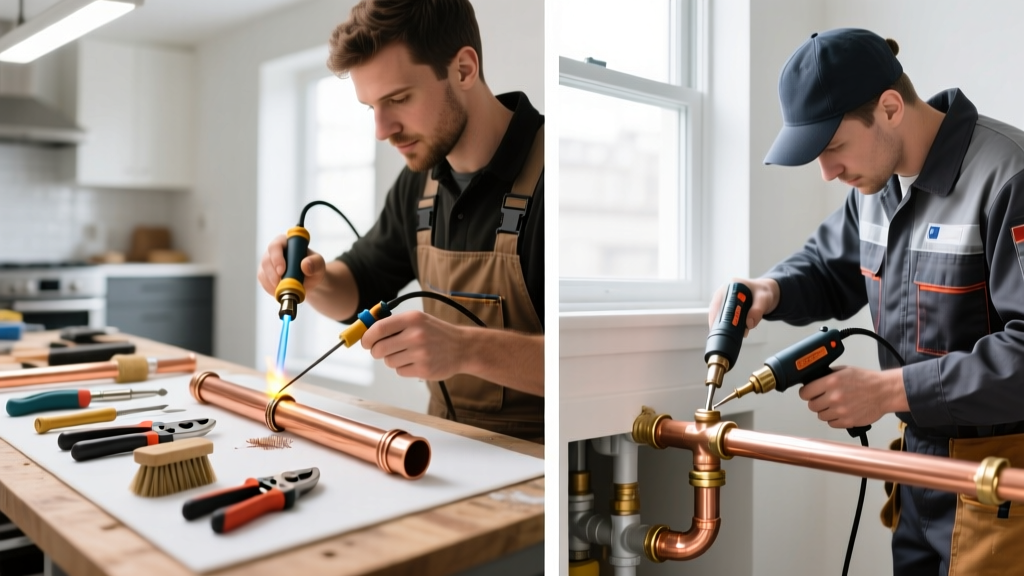
- High-Intensity Torch: A standard propane torch struggles to overcome the heat-sink effect of water-filled or thick-walled copper. The Bernzomatic TS8000 ($55 - $65) paired with MAP-Pro gas is the DIY standard for rapid, localized heating.
- Fuel Cylinder: MAP-Pro gas (e.g., Bernzomatic 14.1 oz cylinder) burns at roughly 3,730°F in air, costing about $12 per cylinder.
- Heat Protection: Oatey heat shield cloth or Abesco firestop paste ($15 - $22) is non-negotiable when working near drywall or wood framing.
- Mechanical Grip: Channel-lock pliers or a specialized internal pipe wrench ($25) are required to twist the fitting while the solder is in a liquid state.
- Surface Preparation: Emery cloth and wire brushes ($9) to clean oxidized copper post-removal.
Total DIY Upfront Tool Cost: $116 - $133
The Hidden Cost of Time and Mistakes
The most expensive component of DIY desoldering is the learning curve. If water remains in the line, it acts as a massive heat sink. You will burn through fuel and scorch the surrounding area before the solder ever reaches 452°F. Furthermore, overheating the copper oxidizes the interior surface, turning it black and preventing new solder from wicking during reconnection. This failure mode forces the DIYer to cut out the ruined section and start over, wasting $15 to $30 in new copper fittings and push-to-connect adapters.
Professional Plumber Costs: What to Expect
Hiring a professional shifts the burden of risk and tooling to the contractor. According to the U.S. Bureau of Labor Statistics, the median compensation for plumbers reflects the high overhead of their trade, including insurance, specialized equipment, and licensing.
Hourly Rates vs. Flat Fees
In 2026, the national average for a licensed plumber ranges from $125 to $250 per hour, depending on the metropolitan area. However, most plumbing companies operate on a minimum service call fee or 'trip charge,' typically ranging from $150 to $250 just to arrive at your home.
For a standard valve replacement involving desoldering one joint and sweating a new one, expect the total invoice to land between $350 and $550. This includes the trip charge, one hour of labor, and a minor markup on the replacement brass valve.
When to Hire a Pro (Risk Assessment)
Expert Insight: If the soldered joint is located inside a finished wall cavity, within 12 inches of structural framing, or directly above an electrical panel, the DIY risk multiplier is too high. A single spark from a torch igniting wall insulation can result in thousands of dollars in fire restoration costs, instantly negating any DIY savings.
Cost Comparison Matrix: DIY vs. Professional Removal
The following matrix compares the estimated financial outlay for two common scenarios involving the removal of soldered copper pipe.
| Scenario | DIY Cost (Excluding Time) | Professional Plumber Cost | Risk Factor |
|---|---|---|---|
| Single Valve Replacement (Exposed Pipe) | $125 (Tools + Valve) | $350 - $450 | Low |
| Rerouting 10-Foot Section (Behind Drywall) | $210 (Tools + Copper + Drywall Patch) | $850 - $1,400 | High (Fire/Water) |
| Desoldering Pre-1986 Lead Solder | $140 (Tools + PPE Respirator) | $400 - $600 | Medium (Toxicity) |
Step-by-Step Desoldering: Maximizing DIY ROI
To ensure your DIY investment pays off, follow this precise metallurgical procedure recommended by the Copper Development Association (CDA) for joint reversal:
- Drain and Dry: Shut off the main water supply and open the lowest faucet in the house. Use a shop-vac or compressed air to blow out residual water from the specific line. Even a few drops of water will vaporize, creating steam pressure that blows molten solder out of the joint.
- Shield the Area: Wrap fiberglass heat-shield cloth around any adjacent joists or drywall.
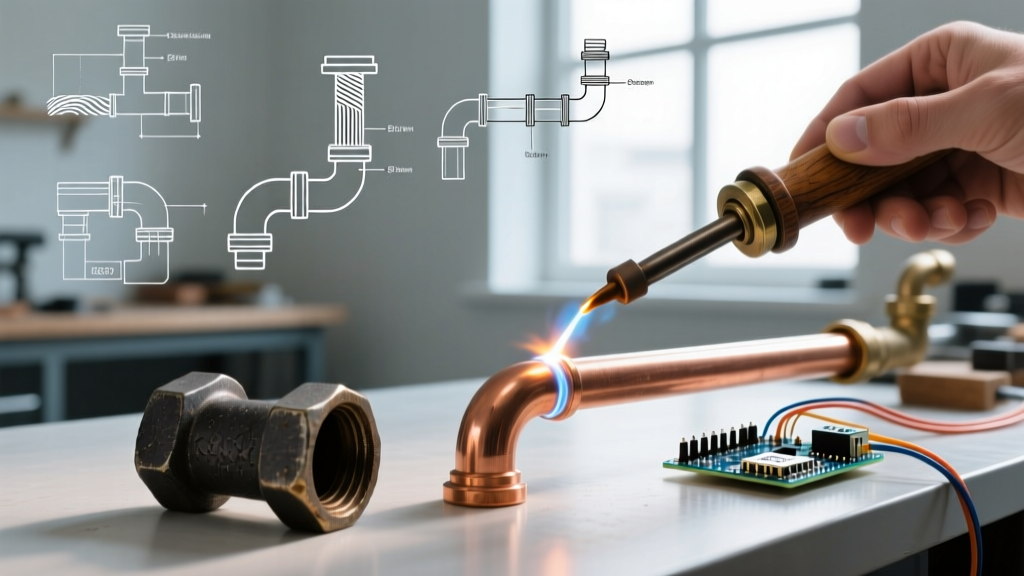
- Apply Uniform Heat: Ignite your MAP-Pro torch. Keep the flame moving in a circular pattern around the base of the fitting, not directly on the solder ring. Heating the bulk of the brass fitting ensures the heat transfers inward to the solder layer.
- The Twist Test: After 15-20 seconds, grip the fitting with channel-lock pliers and apply gentle rotational force. When the solder reaches its liquidus state, the fitting will twist freely. Do not yank or pull, as this can tear the softened copper pipe.
- Quench and Clean: Wipe the excess molten solder from the pipe end with a damp cotton rag (wear heavy leather gloves). This immediate quenching stops the oxidation process, leaving bright copper that is ready for re-soldering with minimal emery cloth preparation.
Alternative Methods and Their Financial Impact
If the cost of desoldering tools or the risk of torch work is too high, alternative connection methods offer a different financial profile.
SharkBite Push-to-Connect Fittings
Instead of desoldering the entire fitting, many DIYers cut the pipe just below the solder joint and use a SharkBite push-to-connect coupling ($10 - $15 per fitting). This eliminates the need for a torch entirely. While the per-fitting cost is 300% higher than a traditional copper sweat coupling ($2), the elimination of tooling costs and fire risk makes it highly economical for one-off repairs.
ProPress Technology
Professional plumbers increasingly avoid desoldering and re-soldering altogether, opting instead for ProPress copper fittings. These fittings use an O-ring and are crimped with a specialized battery-powered jaw tool. However, a professional-grade RIDGID RP-342 ProPress tool costs upwards of $2,500. This is a capital expenditure that only makes financial sense for high-volume contractors, completely pricing it out of the DIY market.
Expert Verdict: Maximizing Your ROI
The cost analysis of removing soldered copper pipe heavily favors the DIY approach for exposed, easily accessible plumbing lines. If you already own a high-intensity torch and understand the thermal dynamics of capillary action, your out-of-pocket cost for a valve swap is under $30 in materials, saving you upwards of $400 in professional labor.
However, if the joint is concealed, involves legacy lead solder, or requires extensive drywall demolition, the financial safety net of a licensed plumber's insurance policy justifies the $500+ service call. Evaluate your workspace, respect the metallurgy of the copper alloy, and choose the path that protects both your wallet and your property.