
The Hidden Dangers of Pot Soldering in DIY Electronics
Pot soldering, often referred to as dip soldering, is a highly efficient method for tinning heavy-gauge stranded wires (such as 10 AWG to 2/0 AWG battery cables) or batch-processing through-hole DIP components. By submerging prepared copper into a crucible of molten alloy, you achieve a uniform, professional-grade solder coat in seconds. However, managing a 2 kg crucible of molten metal at temperatures exceeding 400°C introduces severe thermal, chemical, and explosive hazards that standard soldering iron tutorials rarely cover.
Whether you are building high-current EV battery packs or restoring vintage audio amplifiers, treating a solder pot with the same casual respect as a 60W pencil iron is a recipe for catastrophic injury. This guide details the uncompromising safety best practices, metallurgical realities, and workspace engineering required for safe pot soldering in 2026.
The Physics of Solder Pot Hazards: The Moisture Explosion
The single most dangerous hazard in pot soldering is not the heat itself, but the introduction of moisture. When water is exposed to temperatures above its boiling point, it flashes into steam. In a confined or semi-confined space—like the microscopic gaps between strands of copper wire inside a solder pot—this phase change results in a volumetric expansion of approximately 1,700 times in milliseconds.
Critical Safety Rule: Never dip a wire, component, or tool into a solder pot unless it is bone dry. A single drop of condensation or residual cleaning solvent trapped inside stranded wire will cause a violent molten solder geyser, ejecting 400°C metal directly at your face and hands.
Preventing Moisture-Induced Eruptions
- Pre-Baking: If wires or components have been stored in high-humidity environments, bake them at 80°C for 30 minutes before tinning.
- Solvent Evaporation: If you use isopropyl alcohol (IPA) to clean flux residue prior to re-dipping, allow a minimum of 5 minutes for complete evaporation, or use a low-heat heat gun to force-dry the strands.
- Flux Volatiles: Liquid fluxes contain carriers (like water or alcohols). Always apply flux and let it become "tacky" before dipping. Dipping wet flux causes violent spattering.
Equipment Selection: Crucible Metallurgy and Failure Modes
Not all solder pots are built equally, and using the wrong pot for your chosen alloy can lead to catastrophic crucible failure. The transition from leaded (Sn63Pb37) to lead-free (SAC305) solder has fundamentally changed solder pot engineering.
The Lead-Free Crucible Dissolution Problem
Lead-free alloys, particularly those with high tin content like SAC305 (96.5% Sn, 3.0% Ag, 0.5% Cu), are highly aggressive to iron and steel. If you use a cheap, generic cast-iron solder pot (often priced between $40 and $60) with lead-free solder, the molten tin will actively leach the iron from the crucible walls. This creates a brittle iron-tin intermetallic layer. Over a few months of use at 400°C, the crucible wall will thin and eventually crack, dumping kilograms of molten lead-free solder onto your workbench and electrical wiring.
| Alloy Type | Melt Point | Target Pot Temp | Required Crucible Material | Recommended Equipment Example |
|---|---|---|---|---|
| Sn63Pb37 (Leaded) | 183°C | 330°C - 350°C | Cast Iron / Mild Steel | Generic 500W Cast Iron Pot (~$50) |
| SAC305 (Lead-Free) | 217°C | 380°C - 420°C | Ceramic / Titanium / Specialized Coating | Hakko FX-470-51 Ceramic (~$170) |
| Sn96.5/Sn99 (Pure/Silver) | 221°C - 232°C | 400°C+ | Ceramic / Titanium | Metcal STP-CH50 System (~$450+) |
For DIYers working with lead-free alloys, investing in a ceramic-heater pot like the Hakko FX-470-51 is not just a performance upgrade; it is a critical safety requirement to prevent crucible dissolution and subsequent molten metal leaks.
Mandatory PPE and Workspace Engineering
Solder pots generate massive thermal plumes and concentrated chemical fumes. Standard safety glasses and open windows are insufficient for protecting your respiratory system and corneas.
Respiratory Protection and Fume Extraction
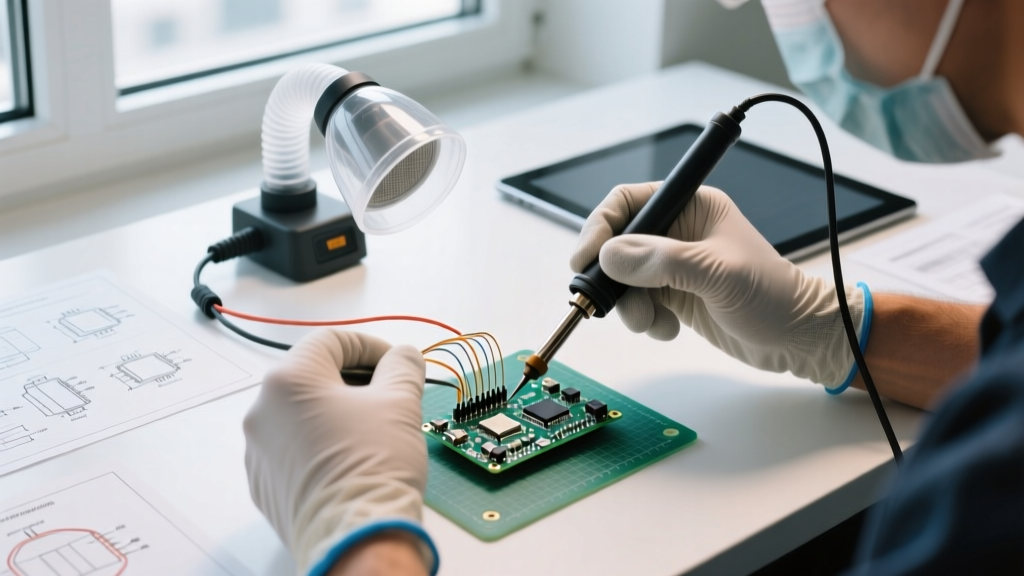
Rosin-based (colophony) flux fumes are a known respiratory sensitizer. Prolonged exposure can induce occupational asthma, a condition that is often irreversible. According to the UK Health and Safety Executive (HSE) guidance on soldering fume, local exhaust ventilation (LEV) is mandatory to capture fumes at the source before they reach the operator's breathing zone.
- Entry-Level Extraction: The Hakko FA-400 (~$75) uses a fan and activated carbon filter. It is better than nothing but requires frequent filter changes and does not capture sub-micron particulates.
- Professional Extraction: For heavy pot soldering, a HEPA + Gas filtration unit like the BOFA Print Pro 3 (~$1,200) or a properly ducted external blower system is required. Position the extraction nozzle exactly 2 to 3 inches from the solder surface to capture the thermal updraft effectively.
Thermal and Ocular PPE
Molten solder splatter can easily bypass standard ANSI Z87.1 safety glasses, pooling in the gap between the lens and your cheek. Required Gear:
- Full Face Shield: A polycarbonate face shield worn over safety glasses provides complete facial coverage against upward splatter.
- Nomex or Kevlar Sleeves: Cotton can catch fire; synthetics like polyester will melt into your skin. Wear flame-resistant Nomex sleeves or heavy leather welding cuffs to protect your forearms from radiant heat and accidental contact with the pot's exterior (which often exceeds 150°C).
- Lead Handling Protocols: If using Sn63Pb37, follow OSHA's Lead Standards rigorously. Wash hands with cold water and specialized lead-removal soap (like D-Lead) before eating or touching your face. Never use hot water, which opens skin pores and increases lead absorption.
Step-by-Step Safe Tinning Procedure
Execute the following sequence to minimize thermal shock, flux explosions, and dross generation.
Step 1: Pre-Heat and Flux Away from the Pot
Never hold a wire directly over the open crucible while applying liquid flux. Drips will fall into the melt, causing immediate spattering. Apply your no-clean or water-soluble flux at a designated prep station at least 12 inches away from the pot.
Step 2: The 45-Degree Entry Angle
Do not plunge the wire straight down (90 degrees). Hold the wire at a 45-degree angle and slowly introduce the tip into the solder. This allows the flux volatiles to boil off gradually as the wire heats up, rather than trapping expanding gases under the surface tension of the molten metal.
Step 3: Dwell Time and Withdrawal
For heavy gauge wire (e.g., 8 AWG), a dwell time of 2 to 4 seconds is usually sufficient. Withdraw the wire slowly and smoothly. Jerking the wire out creates a "solder tail" or icicle, which can snap off and cause secondary burns, while also leaving an uneven coat.
Dross Management: Economics and Safety
Dross is the oxidized, crusty layer that forms on the surface of the molten solder. It acts as a natural insulating blanket that actually reduces further oxidation and retains heat.
The Amateur Mistake: Skimming dross every 10 minutes. By constantly exposing fresh, liquid solder to atmospheric oxygen, you accelerate oxidation, wasting expensive alloy (SAC305 costs upwards of $40 per pound).
The Professional Approach: Only skim dross when it physically interferes with the dipping process. When you do skim, use a specialized slotted skimmer and press the collected dross firmly against the inner wall of the crucible. This squeezes the trapped liquid solder back into the pot, leaving only the dry, oxidized powder in the skimmer. For high-volume users, applying a specialized dross-reduction powder (which chemically separates the tin oxide from the pure tin) can recover up to 70% of otherwise wasted metal.
Final Thoughts on Solder Pot Maintenance
Always power down and unplug the solder pot when leaving the bench, even for a 10-minute break. Molten solder retains enough thermal mass to cause third-degree burns hours after the heating element is turned off. Store your skimmers, tweezers, and wire prep tools on a dedicated, heat-resistant silicone mat—never directly on your workbench. By respecting the metallurgy, managing moisture, and engineering your fume extraction, pot soldering becomes a remarkably safe and indispensable technique for heavy-duty electronics fabrication.