
Decoding the IPC Soldering Standard Ecosystem
In the high-stakes world of electronics manufacturing and advanced repair, IPC soldering is not merely a buzzword; it is the global benchmark for reliability. Governed primarily by the IPC-J-STD-001 (Requirements for Soldered Electrical and Electronic Assemblies) and IPC-A-610 (Acceptability of Electronic Assemblies) standards, IPC compliance dictates everything from wetting angles to the microscopic thickness of intermetallic compounds (IMC). As of 2026, with the rapid expansion of high-density EV battery management systems (BMS), aerospace drone avionics, and medical wearables, IPC compliance has transitioned from a corporate luxury to a strict liability requirement.
For small repair shops, independent contractors, and advanced DIYers looking to pivot into high-reliability sectors, understanding the financial barrier to entry is critical. This cost analysis breaks down the exact capital expenditure (CapEx), operational expenditure (OpEx), and return on investment (ROI) required to achieve and maintain IPC-compliant soldering operations.
Certification Costs: CIS vs. CIT in 2026
The foundation of IPC soldering compliance is human certification. The IPC offers tiered training programs, and the costs vary significantly based on your operational goals. According to the IPC Certification Programs, training must be conducted by an Authorized Training Center (ATC).
| Certification Tier | Target Audience | Duration | Estimated 2026 Cost (USD) | Renewal Cycle |
|---|---|---|---|---|
| CIS (Certified IPC Specialist) | Technicians, Assemblers, Repair Techs | 4-5 Days | $1,800 - $2,400 | Every 2 Years |
| CIT (Certified IPC Trainer) | Shop Managers, QA Leads, Instructors | 5-7 Days | $3,500 - $4,800 | Every 2 Years |
| CSE (Certified Standards Expert) | Process Engineers, Compliance Officers | 3 Days | $2,200 - $2,900 | Every 2 Years |
Note: Costs typically include the mandatory IPC handbook, study materials, and the practical soldering exam. Travel and lodging for ATC attendance are additional.
CapEx Breakdown: Building an IPC-Compliant Workstation
A common misconception is that IPC certification alone guarantees compliance. In reality, IPC-J-STD-001 strictly mandates equipment capabilities, particularly regarding thermal recovery, tip temperature validation, and electrostatic discharge (ESD) safety. You cannot pass an IPC audit using a $40 hobbyist iron because it lacks NIST-traceable calibration and the thermal mass to handle heavy ground-plane heat sinking without dropping below the solder's liquidus temperature.
1. Thermal Profiling & Soldering Stations
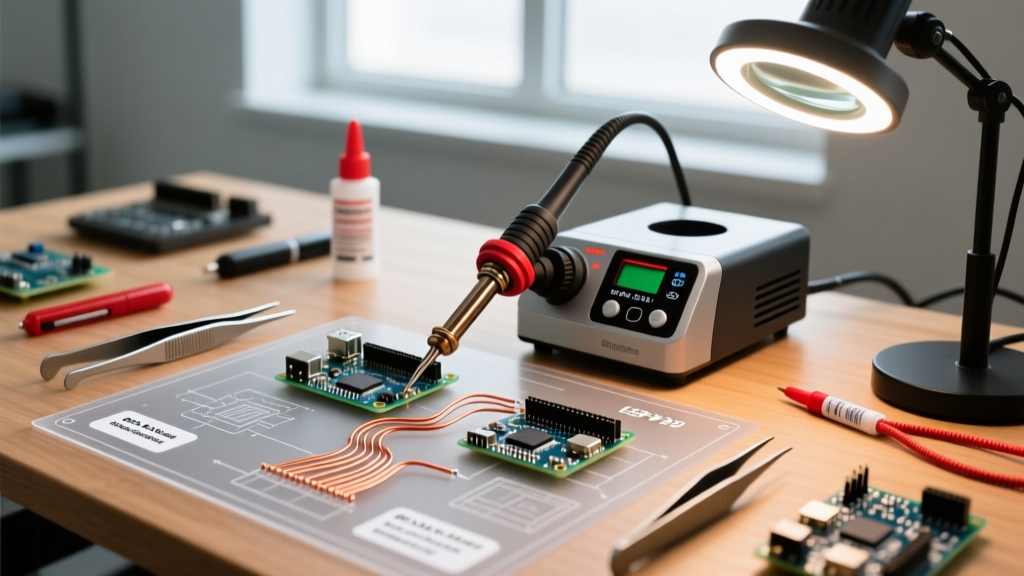
To meet IPC Class 2 and Class 3 requirements, your equipment must maintain tip temperature within ±5°C of the set point under load. In 2026, the industry standards for IPC-compliant benches include:
- Metcal CV-5200 SmartHeat Station (~$650): Uses inductive heating to adjust power output based on the thermal load of the joint, eliminating the need for manual temperature calibration.
- Weller WX2021 Dual Channel (~$1,100): Features rapid thermal recovery and proprietary tip telemetry, essential for logging temperature data during aerospace rework.
- JBC CD-2BQF (~$850): Offers exclusive cartridge technology where the heating element is integrated into the tip, providing near-instantaneous heat transfer for heavy multilayer PCBs.
2. ESD and Environmental Compliance
IPC standards operate in tandem with ESD Association standards (specifically ANSI/ESD S20.20). A compliant bench requires:
- ESD-Safe Matting & Grounding: 3M Stat-Mat or similar dissipative surfaces ($150 - $250), paired with continuous wrist strap monitors ($120).
- Fume Extraction: IPC and OSHA guidelines mandate source-capture fume extraction to prevent flux residue contamination on adjacent high-impedance circuits. The BOFA Print PRO 3 ($1,500) or Weller Zero Smog Guard ($800) are baseline requirements for professional labs.
- Preheaters: For BGA rework or thick copper planes, a Weller WHP3000 preheater ($900) prevents thermal shock and ensures uniform flux activation.
The Hidden Economics of Intermetallic Compounds (IMC)
To truly understand the ROI of IPC soldering, one must look at the metallurgy. When molten solder (like SAC305 lead-free alloy) contacts a copper pad, it forms an Intermetallic Compound (IMC) layer, typically Cu6Sn5.
Expert Insight: "IPC-A-610 dictates that a reliable joint requires a continuous, uniform IMC layer. If your iron lacks thermal recovery and the temperature drops during the wetting phase, the IMC layer forms unevenly or remains too thin, resulting in a 'cold joint' that will fail under thermal cycling. Conversely, excessive dwell time creates a thick, brittle Cu3Sn layer that fractures under mechanical vibration. Precision equipment isn't just about melting solder; it's about controlling metallurgical phase changes."
The cost of a single field failure in an automotive or medical device due to a brittle IMC layer can easily exceed $50,000 in recall and liability costs. This metallurgical reality is what financially justifies the $3,000+ CapEx of an IPC-compliant bench.
ROI Matrix: When is IPC Soldering Financially Viable?
Is the investment worth it for your specific operation? Use this matrix to determine your financial trajectory.
| Business Model | Primary Market | IPC Necessity | Estimated ROI Timeline |
|---|---|---|---|
| Consumer Electronics Repair | Smartphones, Laptops, Consoles | Low (Adopt practices, skip cert) | N/A (Cert is overkill) |
| Industrial Automation Repair | PLCs, Motor Drives, CNCs | Medium (Class 2 preferred) | 12 - 18 Months |
| Aerospace & Medical Rework | Avionics, Pacemakers, BMS | Critical (Class 3 Mandatory) | 3 - 6 Months (via contract acquisition) |
| Prototype Assembly House | Startups, R&D Labs | High (Client requirement) | 6 - 9 Months |
The "Shadow IPC" Strategy for Advanced DIYers
For advanced hobbyists, makers, and independent repair technicians who cannot justify the $2,400 CIS certification fee, the most cost-effective approach is the Shadow IPC Strategy. This involves adopting the rigorous practices of IPC-J-STD-001 without paying for the paperwork.
- Purchase the Standard: Buy a legitimate digital copy of the IPC-A-610 visual acceptability guide. Use it as your visual benchmark for every joint.
- Invest in Optics, Not Just Heat: IPC inspection requires 10x to 30x magnification. Allocate $400 for an AmScope trinocular stereo microscope. Visual verification of wetting angles and fillet contours is 50% of the IPC standard.
- Standardize Your Flux Chemistry: Stop using cheap, no-clean flux pens that leave corrosive residues. Switch to IPC-approved ROL0 (Rosin, Low Activity) or ORL0 (Organic, Low Activity) fluxes from brands like Kester or Indium, and implement a strict ultrasonic or aqueous cleaning protocol post-soldering.
- Document Your Profiles: Even without a CIT certification, create standard operating procedures (SOPs) for your bench. Document the exact tip geometry, temperature setting, and dwell time for specific component packages (e.g., 0402 vs. QFN-48).
Frequently Asked Questions
Does IPC soldering certification expire?
Yes. Both CIS and CIT certifications are valid for exactly 24 months from the date of passing the exam. Recertification requires a shorter refresher course and a new practical exam, typically costing between $800 and $1,200.
Can I use leaded solder (Sn63/Pb37) and still be IPC compliant?
Yes, but only under specific exemptions. IPC-J-STD-001 supports both lead-free (e.g., SAC305) and tin-lead processes. However, in 2026, RoHS (Restriction of Hazardous Substances) compliance is legally mandated for almost all commercial electronics in the EU and California. Leaded IPC soldering is generally restricted to military, aerospace, and specific life-saving medical devices where long-term tin-whisker mitigation is prioritized over environmental regulations.
What is the most common reason technicians fail the IPC practical exam?
The most frequent failure point is improper wire termination and turret soldering. Technicians often fail to wrap the wire the required 180 to 270 degrees around the terminal before soldering, or they leave exposed, uninsulated wire segments that violate the strict spacing requirements outlined in IPC-A-610 Class 3.