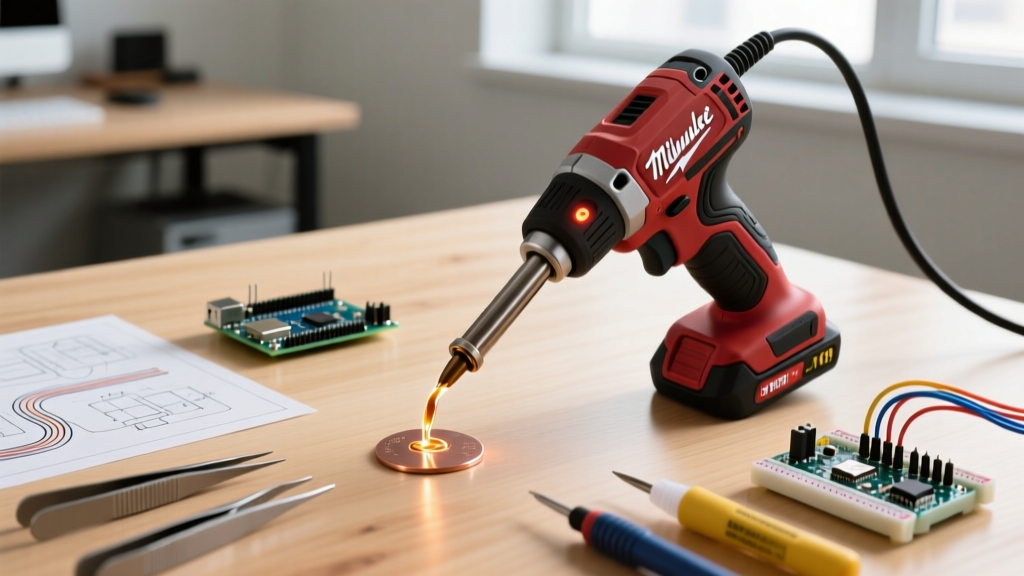

The transition from benchtop AC stations to cordless power tools has fundamentally changed field electronics repair, HVAC servicing, and automotive wiring. At the forefront of this shift is the Milwaukee M18 Soldering Iron (Model 48-68-0001). While it offers unparalleled portability and rapid heat-up times, executing Milwaukee soldering procedures introduces a unique matrix of safety hazards that traditional soldering stations simply do not possess.
As of 2026, the widespread adoption of high-discharge lithium-ion batteries paired with 400°C ceramic heating elements demands a rigorous, updated approach to job site safety. This guide dives deep into the specific failure modes, thermal risks, and ESD (Electrostatic Discharge) challenges associated with cordless Milwaukee soldering equipment, providing actionable protocols for professional technicians.
The Paradigm Shift: AC Stations vs. Cordless DC Soldering
To understand the safety profile of the Milwaukee M18, we must first contrast it with traditional grounded AC stations like the Weller WE1010 or Hakko FX-888D. Cordless irons operate on a floating DC circuit, completely isolated from earth ground. This isolation provides distinct advantages for preventing ground loops in sensitive automotive ECUs, but it severely complicates static dissipation and thermal management.
| Safety Metric | Traditional AC Station (e.g., Hakko FX-888D) | Milwaukee M18 Cordless Iron (48-68-0001) |
|---|---|---|
| Power Source | 120V/240V AC Mains | 18V DC REDLITHIUM Battery |
| Grounding | Hardwired Earth Ground via 3-prong plug | Floating DC (Isolated from Earth) |
| Thermal Runaway Risk | Negligible (Transformer/Heatsink limited) | Moderate (Li-ion cell venting if casing melts) |
| Arc Flash Hazard | Low (AC zero-crossing limits arc sustainment) | High (DC current sustains arcs if shorted to chassis) |
| Auto-Sleep Function | Gravity/Motion switch in holster | Manual trigger/button timeout dependent |
Lithium-Ion Thermal Runaway & Battery Protection
The most critical differentiator in Milwaukee soldering safety is the proximity of high-density energy storage to extreme heat. The M18 Soldering Iron reaches 700°F to 850°F (370°C - 450°C) in under 60 seconds. The polycarbonate and ABS plastic housing of an M18 REDLITHIUM battery pack begins to soften and deform at approximately 140°C (284°F).
The 'Drop and Melt' Failure Mode
If a technician drops the active soldering iron onto the battery pack or a nearby M18 tool, the 400°C tip will instantly melt through the battery casing. Puncturing or severely heating a lithium-ion cell can trigger thermal runaway, resulting in the violent venting of toxic, highly flammable electrolyte gases (such as hydrogen fluoride) and potential cell ignition.
2026 Field Protocol: Never leave the M18 iron resting on its side on a workbench. Always use the integrated high-temperature silicone holster. If the battery pack casing shows any scorch marks or deformation from a stray iron tip, immediately quarantine the battery in a fireproof Li-ion bag and contact Milwaukee Tool for warranty evaluation. Do not attempt to charge a heat-damaged pack.
ESD (Electrostatic Discharge) in Floating DC Systems
According to the IPC J-STD-001 standards for soldered electrical assemblies, proper grounding is essential when working on static-sensitive components like MOSFETs, microcontrollers, and modern automotive CAN-bus modules. Because the Milwaukee M18 iron is powered by an isolated DC battery, the tip is not inherently tied to earth ground.
Mitigating the Floating Ground Hazard
When performing Milwaukee soldering tasks on sensitive PCBs, technicians cannot rely on the tool itself to bleed off static charges. You must implement a secondary grounding strategy:
- Wear an ESD Wrist Strap: Connect a 1-megohm current-limiting wrist strap to a verified earth ground point.
- Use an ESD Mat: Place the workpiece on a grounded conductive mat.
- Pre-Touch Ground: Before bringing the hot iron tip to a sensitive IC pin, touch the iron's metal shaft (avoiding the tip) to the chassis ground of the device being repaired to equalize potentials.
Flux Fume Mitigation in Mobile Environments
Soldering with rosin-core wire generates colophony fumes, a known respiratory sensitizer that can lead to occupational asthma. While benchtop setups utilize localized HEPA/carbon fume extractors, field techs using the Milwaukee M18 often bypass extraction due to the lack of AC power for portable vacuums.
The OSHA ventilation standards dictate that airborne contaminants must be controlled at the source. Inhaling flux fumes in confined spaces—such as inside an electrical panel, an HVAC air handler, or a vehicle dashboard—is a severe long-term health risk.
Field-Ready Fume Extraction Solutions
- Battery-Powered Extractors: Invest in cordless, rechargeable benchtop fume extractors (e.g., Hakko FA-400 or equivalent brushless DC fan units) that can sit adjacent to your Milwaukee tool bag.
- Cross-Ventilation Tactics: When working inside enclosures, use a high-CFM cordless blower (like the Milwaukee M18 Compact Blower) positioned to create negative pressure, pulling fumes away from the breathing zone. Warning: Ensure the blower does not cool the soldering tip so rapidly that it causes cold-solder joints.
- Respiratory PPE: In unventilated confined spaces, an N95 mask is insufficient for chemical vapors. Use a half-face respirator equipped with P100 particulate filters and organic vapor (OV) cartridges.
The Pre-Ignition Safety Checklist
Before depressing the power trigger on your Milwaukee 48-68-0001, run through this 5-point safety audit to prevent DC arcing and thermal accidents.
- Inspect the Ceramic Heater: Ensure the tip is fully seated. A loose tip creates high electrical resistance, leading to localized overheating of the internal ceramic heating element and potential melting of the iron's aluminum collar.
- Check Battery Contacts: Look for metallic debris, copper snips, or stray solder splatters in the M18 battery receptacle. DC short circuits at the battery terminal can cause instant arcing and terminal welding.
- Verify Holster Placement: Ensure the silicone holster is deployed and secured to your belt or a stable magnetic surface, away from flammable solvents like isopropyl alcohol or contact cleaners.
- Assess the Workpiece Ground: Confirm you are not soldering on a live circuit. While the M18 iron is isolated, soldering on energized 120V/240V AC lines poses a lethal shock risk if flux bridges the gap to the iron's internal circuitry.
- Set the Correct Temperature: Use the digital dial to select the minimum viable temperature. For standard 63/37 Sn/Pb eutectic solder, 600°F (315°C) is sufficient. Pushing the iron to 850°F (450°C) unnecessarily degrades the tip's iron plating and increases the severity of potential burn injuries.
Frequently Asked Questions (FAQ)
Can the Milwaukee M18 Soldering Iron shock me if I touch the tip?
No. The output from the M18 REDLITHIUM battery is 18V DC, which is well below the human perception threshold for electrical shock. Furthermore, the heating circuit is isolated. However, you will suffer a severe thermal burn instantly, as the tip operates at over 370°C.
Is it safe to use the Milwaukee soldering iron in explosive atmospheres?
Absolutely not. The M18 Soldering Iron is not intrinsically safe (ATEX/IECEx certified). The internal relays and battery contacts can produce micro-sparks during power-on, which can ignite flammable gases, refrigerant leaks, or grain dust. For explosive environments, you must use specialized pneumatic or intrinsically safe battery-powered tools.
How do I safely dispose of a damaged M18 battery used with the iron?
If a battery has been dropped, melted by the iron tip, or swollen, do not throw it in standard waste. Tape the terminals with Kapton or electrical tape, place it in a fireproof Li-ion bag, and take it to a designated hazardous waste facility or an authorized Milwaukee Tool service center for recycling.
Conclusion
The Milwaukee M18 Soldering Iron is a triumph of cordless engineering, freeing technicians from the constraints of AC power cords. However, this freedom requires a heightened state of situational awareness. By respecting the thermal limits of lithium-ion chemistry, implementing rigorous ESD controls, and managing flux exposure in the field, professionals can leverage the full power of Milwaukee soldering tools without compromising their safety or the integrity of their work.