
The Metallurgical Reality of the Modern Soldering Technician
In 2026, the role of a professional soldering technician extends far beyond simply melting wire onto a pad. With the industry's aggressive shift toward miniaturized components, high-reliability automotive electronics, and mixed-alloy assemblies, a technician must act as an applied metallurgist. The core challenge is wettability—the ability of a molten filler metal to spread and adhere to a base metal. This is dictated by surface oxides, thermal mass, and flux chemistry.
Whether you are terminating aerospace wiring or reworking a high-density server motherboard, understanding material compatibility is the dividing line between a reliable intermetallic compound (IMC) and a catastrophic field failure. This guide breaks down the exact base metals, surface finishes, and flux chemistries every soldering technician must master to ensure structural and electrical integrity.
Base Metal Compatibility Matrix
Not all metals accept solder equally. Copper is the gold standard for wettability, but technicians frequently encounter brass, nickel, stainless steel, and occasionally aluminum. Using the wrong alloy or flux on these metals results in non-wetting, dewetting, or catastrophic corrosion. Below is the definitive compatibility matrix for structural and electronic soldering.
| Base Metal | Wettability | Required Flux Type | Recommended Alloy | Common Failure Mode |
|---|---|---|---|---|
| Copper (Cu) | Excellent | ROL0 / ROL1 (Rosin) | SAC305 / Sn63/Pb37 | Over-oxidation from excessive dwell time |
| Brass (Cu/Zn) | Good | Mild Acid / Activated Rosin | Sn60/Pb40 / Sn96.5 | Zinc leaching causing brittle joints |
| Nickel (Ni) | Fair | High-Activity Rosin (REL1) | SAC305 / Sn96.5/Ag3 | Dewetting due to passive oxide layer |
| Stainless Steel | Poor | Specialized Acid / Halide | Sn96.5/Ag3/Cu0.5 | Non-wetting; severe post-solder corrosion |
| Aluminum (Al) | Very Poor | Fluoride-based (Non-electronic) | Zinc-Tin / Indium-based | Instantaneous oxide reforming |
Expert Insight: When a soldering technician must join stainless steel to copper in a mixed-material RF shield, never use standard electronics rosin flux. You must use a specialized halide-activated liquid flux, solder the joint, and immediately neutralize and clean the assembly with an isopropyl alcohol and deionized water solution to prevent galvanic corrosion. For aerospace and high-reliability applications, always defer to the NASA Workmanship Standards for specific wire termination and structural soldering protocols.
PCB Surface Finish Compatibility
A soldering technician working on printed circuit boards must adapt their thermal profile and flux selection to the specific surface finish applied by the board house. Each finish reacts differently to the heat of a soldering iron and the chemical attack of flux.
1. ENIG (Electroless Nickel Immersion Gold)
ENIG provides a flat, highly solderable surface, but the gold layer is incredibly thin (typically 2-4 microinches). The soldering technician must use a moderate temperature profile (320°C to 350°C at the tip) and a highly active no-clean or water-soluble flux to dissolve the gold into the tin matrix rapidly. Warning: Excessive rework cycles on ENIG can lead to 'gold embrittlement' or damage to the underlying nickel phosphorus layer, resulting in pad lift.
2. HASL (Hot Air Solder Leveling)
HASL is essentially pre-tinned copper. It offers excellent wettability and a long shelf life. The primary challenge for the technician is the uneven surface topology, which can make seating fine-pitch components (like 0.4mm BGA or 0201 passives) difficult before reflow. Use a standard ROL0 rosin flux and standard SAC305 or Sn63 wire.
3. OSP (Organic Solderability Preservative)
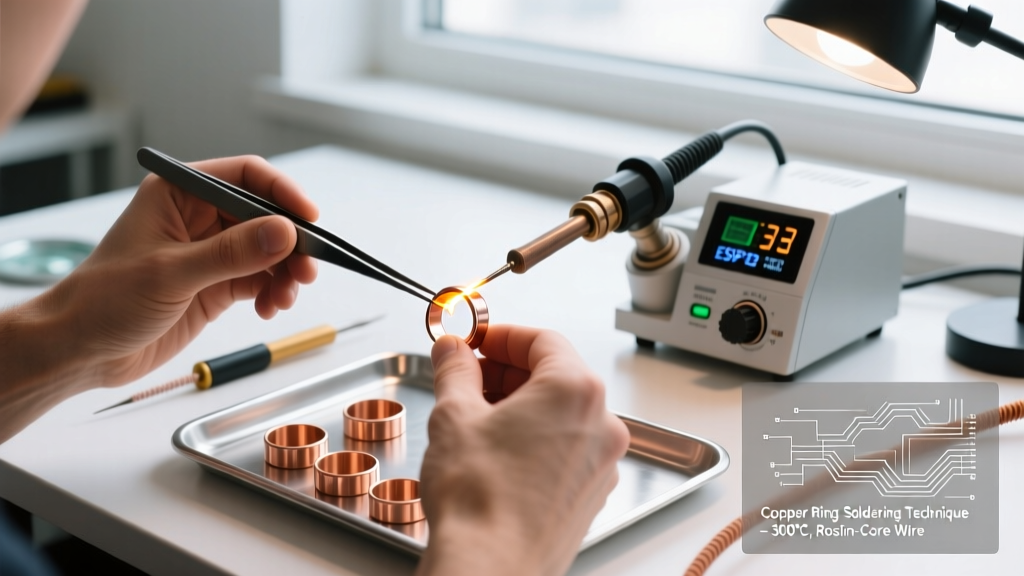
OSP is a thin organic coating that protects raw copper. It degrades rapidly under heat and has a short shelf life. When hand-soldering OSP boards, the soldering technician must use a flux with higher activator content (like a REL1 classification) to burn through the organic layer and expose the raw copper. Dwell times must be kept under 3 seconds per pad to prevent the OSP from charring and creating a non-wetting carbon barrier.
4. Immersion Silver (ImAg)
Immersion silver offers great high-frequency performance and flatness but is highly susceptible to tarnishing (creep corrosion) if exposed to sulfur in the environment. Technicians should handle ImAg boards strictly with nitrile gloves and use mildly activated rosin fluxes. Avoid aggressive water-soluble fluxes, as the silver layer can be slightly porous, allowing flux residues to penetrate and cause long-term electromigration.
Flux Chemistry: Decoding IPC J-STD-004B
A master soldering technician does not just grab a random spool of flux-core wire. They select the flux based on the IPC J-STD-004B classification system, which categorizes flux by material composition, activity level, and halide content.
- RO (Rosin): Derived from pine trees. Excellent for general electronics. Leaves a hard, non-conductive residue that is often left on the board (No-Clean).
- RE (Resin): Synthetic rosin. Offers better thermal stability and is less prone to charring under high-heat lead-free profiles.
- OR (Organic): Water-soluble acids. Highly active, necessary for heavily oxidized boards or nickel/stainless steel, but must be cleaned with DI water post-soldering to prevent dendritic growth.
- IN (Inorganic): Strong acids (hydrochloric/zinc chloride). Used strictly for plumbing, HVAC, and heavy structural metals. Never use on PCBs.
The numerical and alphabetical suffixes (e.g., ROL0, REL1) denote activity and halide presence. 'L' means Low activity, 'M' is Medium, 'H' is High. '0' means less than 0.5% halides, '1' means more than 0.5%. For Class 3 high-reliability medical or aerospace electronics, a soldering technician will typically default to ROL0 or ROL1 to balance wettability with long-term ionic cleanliness.
Thermal Management and Tool Selection
Material compatibility is useless if the thermal delivery system fails. In 2026, lead-free alloys like SAC305 (melting point 217°C) and SAC405 require higher tip temperatures and superior thermal recovery compared to legacy tin-lead.
When soldering a heavy 14-layer PCB with a massive copper ground plane to a delicate 0603 capacitor, the soldering technician faces a thermal mass mismatch. If you use a standard chisel tip, the iron will stall, leading to cold joints or pad delamination from prolonged dwell times.
The Preheater Advantage
Professional labs now mandate the use of bottom-side preheaters (such as the Hakko FR-830 or similar IR/convection plates) to bring the entire PCB ambient temperature up to 100°C - 120°C. This reduces the delta-T (temperature difference) the soldering iron must overcome. By preheating, the technician can lower their iron tip temperature from 380°C down to 320°C, vastly extending tip life (such as Weller RT4 or Hakko T18 series tips, which cost roughly $10-$15 each and degrade rapidly above 350°C) and preventing thermal shock to ceramic components.
Sourcing and Alloy Economics
Understanding the cost and availability of materials is part of the technician's operational knowledge. According to market data tracked by major suppliers like Indium Corporation, the price of specialized alloys fluctuates based on raw metal commodities. As of early 2026, standard Sn63/Pb37 wire remains highly cost-effective (approx. $25-$35 per pound), while high-reliability SAC305 wire hovers around $50-$70 per pound. For ultra-low-temperature applications (like soldering to heat-sensitive glass or flexible circuits), Indium-based alloys (e.g., Indium/Tin eutectic melting at 118°C) are utilized, though they carry a premium price tag exceeding $300 per pound and possess very low mechanical shear strength.
Frequently Asked Questions (FAQ)
Can a soldering technician use plumbing acid flux on a PCB in an emergency?
Absolutely not. Plumbing fluxes (typically zinc chloride or ammonium chloride bases) are highly corrosive and inorganic. Even if cleaned, the ionic residues will seep into the vias and under BGA packages, causing rapid dendritic shorting and catastrophic board failure within weeks. Always use IPC-compliant rosin or synthetic resin fluxes for electronics.
Why does my solder ball up and refuse to stick to a brass connector?
Brass contains zinc. When heated, zinc migrates to the surface and forms a stubborn zinc oxide layer that standard rosin flux cannot break down. A soldering technician must use a mildly activated (ROL1) or organic acid flux specifically formulated for brass, and mechanically abrade the surface with a fiberglass scratch pen immediately before applying flux and heat.
How do I prevent 'tombstoning' when hand-soldering 0402 components?
Tombstoning is caused by uneven wetting forces pulling the component upright. To prevent this, the soldering technician must pre-tin only one pad, place the component with precision tweezers, and reflow that single joint. Allow the joint to cool and solidify completely before soldering the second pad. Ensure your iron tip is perfectly symmetrical and clean.
What is the maximum dwell time for a single through-hole joint?
According to IPC-A-610 and general industry best practices, the maximum dwell time for a single hand-soldered joint should not exceed 3 to 5 seconds. If the joint does not flow within this window, the technician must remove the heat, allow the board to cool, reassess the thermal mass, apply fresh flux, and try again with a larger tip geometry or a preheater.