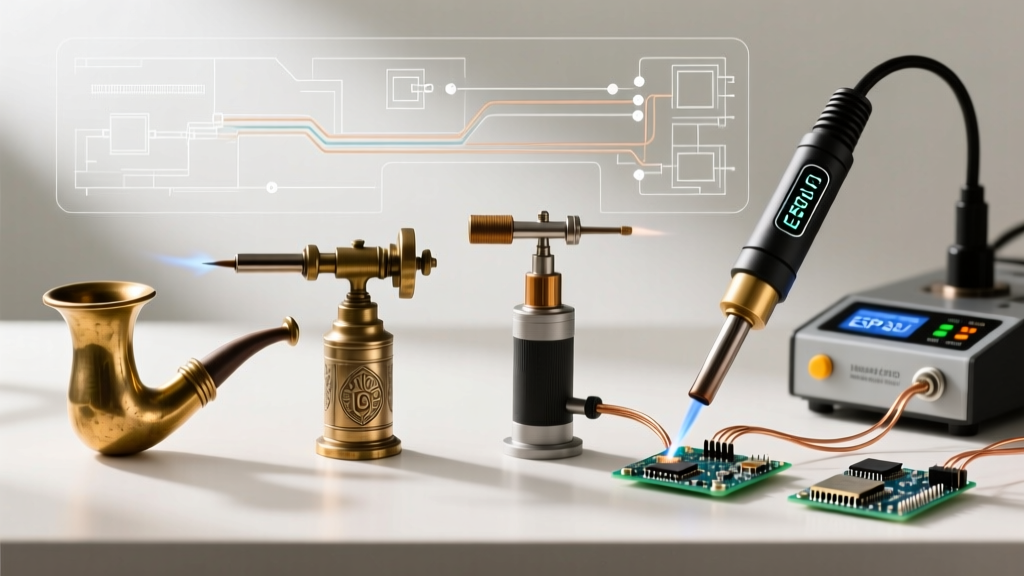

The transition from the 18th-century mouth blowpipe to the modern oxy-hydrogen micro-torch represents a profound shift in metallurgical arts. What began as a test of human lung capacity and cheek muscle endurance has evolved into an exercise in molecular-level flame chemistry and ergonomic precision. For contemporary jewelers, understanding the history of the jewellers soldering torch is not merely an academic exercise; it provides critical context for selecting the right thermal tool for specific alloys, karats, and intricate micro-pave settings in 2026.
The Mouth Blowpipe Era: Human Breath and Charcoal
For centuries, the primary tool for precious metal soldering was the mouth blowpipe. Typically a 12- to 18-inch tapered tube made of brass, reed, or bone, the blowpipe was used to direct a continuous stream of air through the flame of an oil lamp or candle onto a piece of metal resting on a charcoal block.
The charcoal block served a dual purpose: it acted as a heat-resistant soldering surface and, crucially, it released carbon monoxide when heated, creating a localized reducing atmosphere that prevented oxidation on the precious metal. However, the physical toll on the jeweler was immense. Maintaining a steady, continuous airflow required inflating the cheeks and using them as a secondary set of lungs, breathing in through the nose while continuously blowing out through the mouth. This led to widespread fatigue, inconsistent flame temperatures (rarely exceeding 800°C), and the infamous "blowpipe cheek" muscle hypertrophy.
Bellows, Town Gas, and the First Mechanization
The mid-19th century introduced two massive technological leaps: the foot bellows and the commercialization of town gas (coal gas). The foot bellows liberated the jeweler's respiratory system, allowing for continuous, rhythmic airflow driven by the calf and thigh muscles. Simultaneously, the replacement of flickering oil lamps with piped town gas provided a cleaner, hotter, and more consistent fuel source.
By the late 1800s, the "gas-air" torch became the standard bench fixture. These early torches utilized a mixing chamber where ambient air was drawn in by the Venturi effect as gas flowed through the nozzle. While a vast improvement over the mouth blowpipe, these early gas-air torches still lacked the pinpoint precision required for the increasingly intricate filigree and micro-setting work that defined the Art Deco era.
The Oxy-Fuel Revolution and the Little Torch
The true paradigm shift in the jewellers soldering torch occurred with the miniaturization of oxy-fuel welding technology. While heavy oxy-acetylene rigs were used for industrial welding, the jewelry trade required a micro-scale equivalent. This need was answered by the invention of the miniature oxy-fuel torch, most notably the iconic Smith Little Torch.
Introduced in the mid-20th century and still manufactured today by Smith Equipment, the Little Torch revolutionized the trade. By utilizing pure oxygen mixed with propane or acetylene, the torch could reach temperatures up to 2,800°F (1,537°C) at the tip of a flame no larger than a sewing needle. The system relies on interchangeable tips, typically numbered from #00 to #5:
- Tip #00 & #0: Used for micro-soldering, jump rings, and delicate chain repairs.
- Tip #1 & #2: The workhorses for ring sizing, prong retipping, and general soldering.
- Tip #3 to #5: Reserved for heating large masses of metal, casting flask sprues, or melting small ingots.
The Modern Era: Butane Micro-Torches and Water Torches
As we navigate the 2026 market, the evolution has bifurcated into two distinct high-tech paths: advanced butane micro-torches and oxy-hydrogen water torches.
Piezo-Ignited Butane Micro-Torches
For bench jewelers requiring portability and quick setup, high-end butane torches like the Blazer Big Shot GT-8000 have become ubiquitous. Utilizing piezoelectric ignition and anti-flare technology, these torches burn at approximately 2,500°F (1,371°C). They are entirely self-contained, eliminating the need for heavy oxygen tanks and regulators, making them ideal for quick sizing jobs, bezel setting, and enamel work.
Oxy-Hydrogen Water Torches
At the absolute pinnacle of modern torch technology is the water torch (often referred to by brand names like Achatek or HHO generators). These devices use electrolysis to split distilled water into pure hydrogen and oxygen gas, which is then mixed and ignited at the handpiece. The resulting flame burns at roughly 2,800°C but is incredibly pinpoint and, most importantly, produces only water vapor as a byproduct. This guarantees a perfectly clean, non-carburizing flame, which is absolutely critical when soldering platinum or working with high-karat gold where carbon inclusions can cause catastrophic porosity.
Evolutionary Comparison Matrix
The following table illustrates the technological progression of the jewellers soldering torch across key metrics:
| Era / Technology | Primary Fuel Source | Max Temp (Approx) | Precision Level | Primary Drawback |
|---|---|---|---|---|
| Mouth Blowpipe (Antiquity-1800s) | Human Breath + Oil Lamp | 800°C (1,472°F) | Low (Broad flame) | Extreme physical fatigue; inconsistent heat |
| Gas-Air Bench Torch (Late 1800s) | Town Gas + Ambient Air | 1,200°C (2,192°F) | Medium | Lacked pinpoint focus; soot-heavy flame |
| Oxy-Fuel Micro-Torch (1950s-Present) | Oxygen + Propane/Acetylene | 1,537°C (2,800°F) | High (Interchangeable tips) | Requires heavy, pressurized gas cylinders |
| Butane Micro-Torch (1990s-Present) | Refined n-Butane | 1,371°C (2,500°F) | Medium-High | Temperature drops as fuel depletes; struggles with platinum |
| Oxy-Hydrogen Water Torch (2000s-Present) | Electrolyzed H2O | 2,800°C (5,072°F) | Extreme (Micro-point) | High initial capital cost ($1,500+) |
2026 Buyer's Framework: Choosing Your Torch
When sourcing equipment from major industry suppliers like Rio Grande or specialized educational forums like Ganoksin, the decision matrix should be driven by your primary metal alloys and production volume.
Tier 1: The Hobbyist and Repair Bench ($60 - $150)
If your daily work consists of silver sizing, jump ring soldering, and basic gold repairs, a premium butane torch is sufficient. The Blazer Big Shot ($70-$90) or the SE MT3001 Deluxe ($40-$50) offer excellent thermal mass. Expert Tip: Always use highly refined 5x or 11x butane; cheap hardware-store butane contains impurities that will clog the micro-jets and cause flaring.
Tier 2: The Professional Production Bench ($350 - $600)
For full-time jewelers working with 14k/18k gold and platinum, the Smith Little Torch outfit remains the undisputed industry standard. Expect to spend roughly $350 for the torch and hoses, plus an additional $200-$250 for the oxygen and propane regulators and tanks. The ability to instantly swap from a #1 tip for a prong repair to a #4 tip for melting a 10-pennyweight gold casting button makes this the most versatile system on the market.
Tier 3: The Master Platinum and Micro-Pave Specialist ($1,500 - $3,000+)
Platinum soldering requires localized, extreme heat without carbon contamination. An Oxy-Hydrogen Water Torch (such as those from Achatek or equivalent HHO generators) is mandatory for high-end micro-pave and platinum fabrication. The flame is so concentrated that you can solder a 0.8mm platinum prong directly adjacent to a heat-sensitive gemstone like an emerald or tanzanite without causing thermal shock, provided a heat-shield paste is used.
Expert Insights: Flame Chemistry and Solder Flow
Regardless of the era or the torch technology, the fundamental physics of solder flow remain unchanged. A common failure mode among novice jewelers is misunderstanding the reducing versus oxidizing zones of the flame.
The Golden Rule of Flame Chemistry: The hottest part of an oxy-fuel flame is just beyond the tip of the inner blue cone. However, this zone is highly oxidizing. To achieve a clean solder joint on precious metals, the metal must be heated using the outer, feathery envelope of the flame—the reducing zone—which actively strips oxygen away from the metal surface, allowing the silver or gold solder to flow via capillary action without balling up or pitting.
Furthermore, modern cadmium-free solders (which have become the global standard due to toxicity regulations) require slightly different heat management than legacy cadmium-bearing solders. Cadmium-free hard silver solder typically flows around 740°C (1,364°F), but it has a narrower plastic range. This means the jeweler must bring the entire assembly to temperature evenly before applying the flame directly to the solder chip, a technique that is vastly easier to execute with the pinpoint control of a modern #2 micro-torch tip than with the broad, sweeping heat of a 19th-century gas-air burner.
Conclusion
The evolution of the jewellers soldering torch is a testament to the trade's relentless pursuit of precision. From the exhausting rhythms of the mouth blowpipe to the silent, water-splitting efficiency of the modern HHO generator, the tools have changed, but the objective remains identical: to manipulate precious metals with absolute thermal control. By understanding this history and the specific mechanical advantages of modern systems, today's jewelers can select the exact thermal instrument required to execute their craft flawlessly.