
The Core Metallurgical Difference: Fusion vs. Capillary Wetting
When beginners ask, "Is soldering like welding?", the short answer is a definitive no. While both are thermal joining processes used in fabrication and electronics, their underlying metallurgical mechanisms are fundamentally opposed. Understanding this distinction is the foundation of any material compatibility guide.
Welding is a fusion process. It involves heating the base metals to their melting points (often exceeding 1,500°C / 2,732°F for steel) so they coalesce into a single, continuous mass, often with the addition of a filler metal. The resulting joint is essentially a new alloy forged in the heat-affected zone (HAZ).
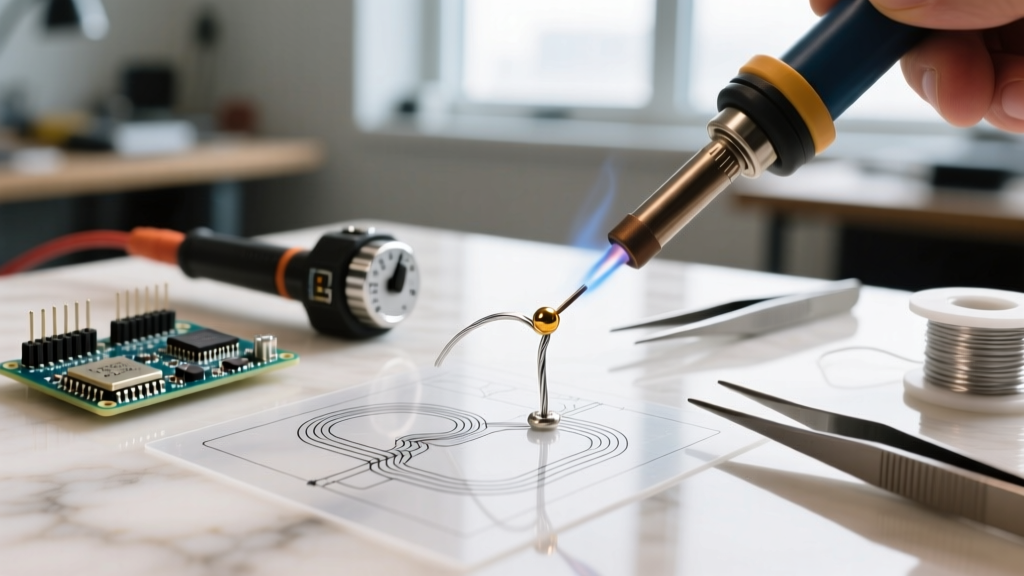
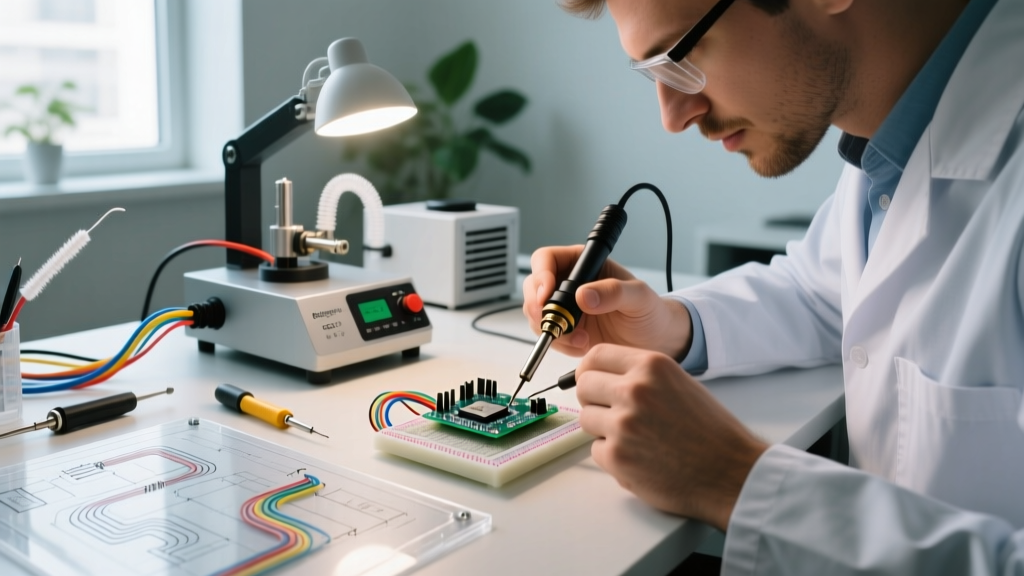
Soldering, conversely, is a solid-liquid diffusion process. The base metal never melts. Instead, a lower-melting-point filler alloy (the solder) is liquefied and drawn into the joint via capillary action. The bond is created through metallurgical wetting, where the liquid solder dissolves a microscopic layer of the base metal and forms an Intermetallic Compound (IMC) layer at the boundary. According to The Welding Institute (TWI), this IMC layer is what provides the mechanical and electrical connection, and it occurs at temperatures strictly below 450°C (842°F).
Expert Insight: A common failure mode in electronics manufacturing is an overly thick IMC layer. If a soldering iron dwell time exceeds 3 to 5 seconds on a standard PCB pad, the IMC layer (typically Cu6Sn5) grows beyond the ideal 1–3 microns, becoming brittle and prone to thermal shock fracturing.
Material Compatibility Matrix: What Works Where?
Because welding alters the base metal's crystalline structure and soldering relies on surface wetting, their material compatibilities differ wildly. Below is a compatibility matrix for common fabrication and electronics metals.
| Base Metal (Alloy) | Weldability | Solderability | Recommended Joining Process & Filler | Material Edge Cases & Failures |
|---|---|---|---|---|
| Copper (C11000) | Fair to Good | Excellent | Solder: SAC305 or Sn60Pb40 with RMA flux. Weld: GTAW (TIG) with Cu-ETP filler. |
Welding causes massive grain growth and loss of temper. Soldering is preferred for electrical joints. |
| Aluminum (6061) | Excellent | Poor | Weld: MIG/TIG with 4043 or 5356 wire. Solder: Zinc-based alloys + ultrasonic agitation. |
Aluminum oxide (Al2O3) melts at 2,072°C, blocking standard solder wetting. Welding is almost always required. |
| Stainless Steel (304) | Excellent | Poor to Fair | Weld: TIG with 308L filler. Solder: Sn62Pb36Ag2 with Zinc Chloride (acid) flux. |
Chromium oxide layer prevents standard rosin flux wetting. Acid flux residue causes rapid galvanic corrosion if not neutralized. |
| Brass (C26000) | Poor | Very Good | Solder: Sn60Pb40 with mild organic acid flux. Weld: Oxy-acetylene (high zinc fuming risk). |
Welding vaporizes zinc, creating toxic fumes and porous, brittle welds. Soldering or brazing is mandatory. |
| FR-4 / PCBs | Impossible | Excellent | Solder: Sn96.5Ag3.0Cu0.5 (SAC305) with No-Clean flux. | Base material is a woven glass-epoxy composite. Heat >280°C for >10 seconds causes delamination and pad lift. |
Deep Dive: Soldering vs. Welding Specific Alloys
Copper and Brass: The Electronics Standard
Copper is the undisputed king of electrical conductivity, but its high thermal conductivity (approx. 401 W/m·K) makes it notoriously difficult to weld. When you apply a TIG torch to C11000 copper, the heat dissipates so rapidly that you often fail to achieve a fusion puddle without preheating the entire workpiece to 400°C. Furthermore, the Copper Development Association (CDA) notes that the intense heat of welding destroys the cold-worked temper of the copper, leaving the joint mechanically soft and prone to fatigue.
The Soldering Advantage: Soldering copper wire (e.g., 14 AWG to 24 AWG) using a 60/40 Tin-Lead alloy (melting point 183°C–190°C) or a lead-free SAC305 alloy (melting point 217°C–220°C) preserves the base metal's structural integrity. Using a mildly activated rosin flux (RMA) removes surface oxides without risking the galvanic corrosion associated with plumbing-grade acid pastes.
Aluminum: The Nightmare Metal for Soldering
If you are wondering if soldering is like welding when working with aluminum, the answer highlights the starkest contrast between the two processes. Aluminum instantly forms a passivation layer of aluminum oxide (Al2O3) when exposed to air. While the aluminum base melts at a mere 660°C (1220°F), the oxide shell does not melt until 2,072°C (3762°F). Standard soldering irons cannot penetrate this shell.
To solder aluminum, you must either use highly corrosive fluoroaluminate fluxes (which are nearly impossible to clean from complex geometries) or employ ultrasonic soldering. Ultrasonic soldering irons vibrate the molten solder tip at 20–60 kHz, creating microscopic cavitation bubbles that physically shatter the oxide layer, allowing the zinc-tin filler metal to wet the bare aluminum. For structural aluminum joints (e.g., 6061-T6 bike frames or chassis), welding with an Argon-shielded TIG process remains the only viable option.
Stainless Steel: The Flux Challenge
Stainless steel owes its corrosion resistance to a microscopic layer of chromium oxide. This exact same layer makes it virtually impossible to solder using standard electronics rosin flux. To achieve capillary wetting on 304 or 316 stainless steel, you must use a highly aggressive Zinc Chloride or Phosphoric Acid-based flux.
Critical Warning: If you solder stainless steel brackets or enclosures using acid flux, you must neutralize and clean the joint immediately using a baking soda/water solution followed by an isopropyl alcohol rinse. Failure to do so will result in severe galvanic corrosion, where the acidic residue eats through the chromium layer, causing the stainless steel to rust aggressively within weeks.
Thermal Impact and the Heat Affected Zone (HAZ)
A major factor in material compatibility is the Heat Affected Zone (HAZ)—the area of base metal that has not melted but has undergone microstructural changes due to high heat.
- Welding HAZ: Can extend several inches from the weld bead. In high-carbon steels, this rapid heating and cooling can form martensite, making the HAZ incredibly hard but dangerously brittle, requiring post-weld heat treatment (PWHT) to normalize the grain structure.
- Soldering HAZ: Highly localized. However, in electronics manufacturing, improper thermal profiling can cause the HAZ to destroy the substrate. According to IPC Standards (IPC-A-610), exceeding the glass transition temperature (Tg) of an FR-4 PCB for prolonged periods causes the epoxy matrix to expand, leading to barrel cracks in plated through-holes (PTH) and delamination of internal copper planes.
Actionable Decision Framework: When to Choose Which
Use this quick-reference framework to determine whether your specific project requires welding, soldering, or an alternative mechanical join.
Choose Soldering When:
- Joining Thin Conductors: Wires smaller than 10 AWG, PCB components, and delicate sensor leads.
- Electrical Conductivity is Paramount: A properly wetted solder joint maintains near-base-metal conductivity, whereas a weld joint introduces alloy-mixing resistance.
- Base Metals Have Vastly Different Melting Points: E.g., attaching a copper wire to a Kovar terminal.
- Thermal Budget is Low: Working near heat-sensitive components like polyimide insulation, neodymium magnets, or plastic housings.
Choose Welding When:
- Structural Load-Bearing is Required: Solder joints have low shear and tensile strength (SAC305 tensile strength is roughly 40-50 MPa, while welded 304 SS exceeds 500 MPa).
- Base Metal Thickness Exceeds 1/8 Inch (3mm): Soldering thick masses requires industrial induction heating; standard irons/torches will fail to achieve wetting temperatures before the flux burns off.
- High-Temperature Operating Environments: If the finished assembly will operate above 150°C, standard soft solders will experience creep deformation or reflow. Welded joints maintain integrity up to the base metal's melting point.
Expert FAQ: Soldering vs. Welding
Can I use a welding torch (Oxy-Acetylene) to solder copper pipes?
Yes, but this is technically classified as brazing if the filler metal melts above 450°C (842°F), or torch-soldering if using a low-temp alloy. When using an oxy-acetylene torch on copper plumbing, you must use a neutral or slightly carburizing flame and a silver-bearing brazing alloy (e.g., Sil-Fos 5) with a borax-based flux. Do not use standard lead-free plumbing solder (95/5 Sn/Sb) with a high-heat torch, as the solder will flash-melt, oxidize, and fail to capillary into the fitting.
Is brazing the missing link between soldering and welding?
Exactly. Brazing operates on the exact same capillary-action and wetting principles as soldering, but it uses higher temperatures (above 450°C) and stronger filler metals like brass, silver, or copper-phosphorus. It bridges the gap by offering structural strength approaching that of welding, without melting the base metal or creating a massive HAZ.
Why do my solder joints on galvanized steel look like water on a hot pan (beading up)?
Galvanized steel is coated in a layer of zinc. When a soldering iron touches it, the zinc coating oxidizes and vaporizes, creating a barrier that rosin flux cannot penetrate. To solder galvanized steel, you must physically sand away the zinc coating down to bare steel in the joint area, apply a highly active zinc-chloride acid flux, and use a high-wattage iron (minimum 100W) to overcome the thermal mass of the steel. Always ensure adequate ventilation, as heating galvanized steel releases toxic zinc oxide fumes.