
Decoding IPC Standards for Soldering: An Expert Roundup
Whether you are a hobbyist building custom mechanical keyboards or a manufacturing engineer overseeing a medical device assembly line, understanding IPC standards for soldering is the dividing line between a fragile joint and a lifelong connection. The Association Connecting Electronics Industries (IPC) publishes the definitive benchmarks for electronic assembly. But how do these dense, highly technical documents translate to the tools you buy and the techniques you practice on your workbench?
To bridge the gap between industrial compliance and practical application, we convened a panel of certified IPC trainers, aerospace rework specialists, and electronics manufacturing engineers. They break down the core standards, explain the difference between Class 2 and Class 3 requirements, and reveal exactly which soldering stations, fluxes, and inspection tools you need to meet these rigorous benchmarks.
The Core IPC Soldering Standards at a Glance
Before diving into expert insights and gear recommendations, it is crucial to understand the 'Big Three' IPC documents that govern soldering. Each serves a distinct purpose in the lifecycle of an electronic assembly.
| Standard | Primary Focus | Target Audience | Key Buying Implication |
|---|---|---|---|
| IPC J-STD-001 | Requirements for soldered electrical and electronic assemblies (materials, methods, flux types). | Process Engineers, Assemblers | Dictates your choice of solder alloy (e.g., SAC305 vs. Sn63Pb37) and flux chemistry (ROL0, ROH1). |
| IPC-A-610 | Acceptability of Electronic Assemblies (visual inspection criteria, target vs. defect conditions). | Quality Inspectors, Technicians | Requires proper bench lighting and 10x-30x magnification tools for visual verification. |
| IPC-7711/7721 | Rework, modification, and repair of electronic assemblies (pad lifting, trace repair, BGA rework). | Rework Specialists, Repair Techs | Necessitates precision micro-soldering irons, hot air rework stations, and specialized epoxies. |
Expert Insights: Applying IPC Standards to the Workbench
We asked three industry veterans how IPC standards influence daily soldering operations and equipment purchasing decisions.
1. Thermal Management and J-STD-001 Compliance
Sarah Jenkins, Certified IPC Specialist (CIS) and Manufacturing Engineer:
'The biggest mistake I see prosumers and junior techs make is ignoring the thermal mass requirements outlined in IPC J-STD-001. When soldering a heavy ground plane, a standard 40W ceramic heater iron will stall, causing the operator to dwell on the joint for 8 to 10 seconds. J-STD-001 strictly warns against excessive dwell times, which lead to intermetallic compound (IMC) overgrowth and pad delamination. To meet Class 3 (High-Performance) standards, you must use a closed-loop, high-wattage station with cartridge-style tips. The JBC C245 series or the Weller WX2021 are non-negotiable for this. They recover heat in under two seconds, ensuring the solder flows before the flux activates and burns off.'
2. Flux Chemistry and the No-Clean Dilemma
Marcus Thorne, Aerospace Rework Technician (IPC-7711/7721 Certified):
'Flux selection is heavily governed by IPC J-STD-004, which is referenced directly by J-STD-001. For high-reliability aerospace or medical boards, we almost exclusively use ROL0 (Rosin, Low activity, 0% halides) no-clean fluxes, like Kester 245 or Alpha Metals CleanWave. The '0' means no halides, which prevents long-term electrochemical migration (dendrite growth). If you are buying solder wire for a home lab but want IPC-level reliability, stop buying cheap, highly activated RA (Rosin Activated) flux cores from unknown online marketplaces. Buy Sn63Pb37 eutectic wire with a verified ROL0 core from authorized distributors. It costs about $45 to $60 per 1lb spool, but it guarantees your residue won't corrode the PCB over time.'
3. Visual Inspection and IPC-A-610 Acceptability
Dr. Aris Vance, SMTA Member and Quality Assurance Director:
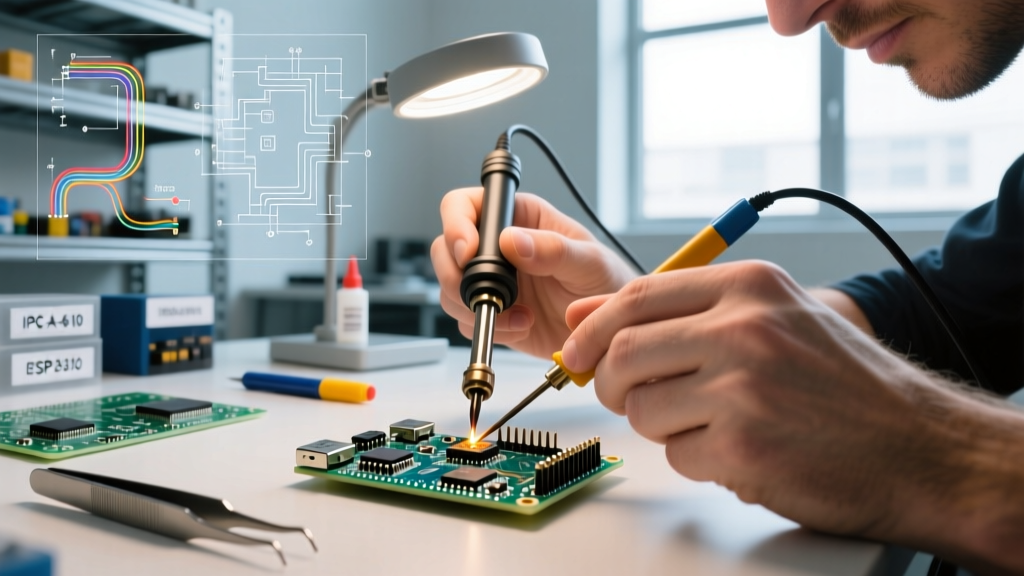
'You cannot achieve IPC-A-610 compliance if you cannot see the joint. The standard defines specific 'Target', 'Acceptable', and 'Defect' conditions for through-hole and surface mount solder fillets. For Class 2 (Dedicated Service) and Class 3, you must verify wetting angles, heel fillets, and the absence of micro-voids. I mandate that every bench purchasing request includes a minimum 10x to 30x stereomicroscope or a high-quality digital inspection camera like the AmScope SE400-Z. Furthermore, IPC requires shadow-free, high-CRI (Color Rendering Index) lighting to accurately judge flux residue and solder shine. A $200 bench lamp won't cut it; invest in a dual-arm LED ring light with a CRI above 90.'
Buyer's Guide: Building an IPC-Compliant Soldering Station
Translating expert advice into purchasing decisions, here is how to equip your bench to meet stringent IPC standards for soldering.
Category 1: The Soldering Station (J-STD-001 Thermal Control)
To prevent cold joints and thermal damage, your station must maintain tip temperature within ±5°C of the setpoint during active soldering.
- Prosumer/Class 2 Pick: Hakko FX-951 (~$250). Features active tip sensing and 70W power output. Excellent for standard SMD and through-hole components.
- Aerospace/Class 3 Pick: JBC CD-2BQE (~$550). The cartridge system integrates the heater directly into the tip, offering unmatched thermal recovery for heavy ground planes and multilayer PCBs.
- Budget/Entry Pick: Weller WE1010NA (~$120). While limited to 70W, its digital closed-loop feedback is vastly superior to analog dial stations for maintaining IPC-compliant thermal profiles.
Category 2: Solder Wire and Flux (J-STD-001 & J-STD-004)
Avoid generic spools. Look for specific alloy and flux designations on the manufacturer's datasheet.
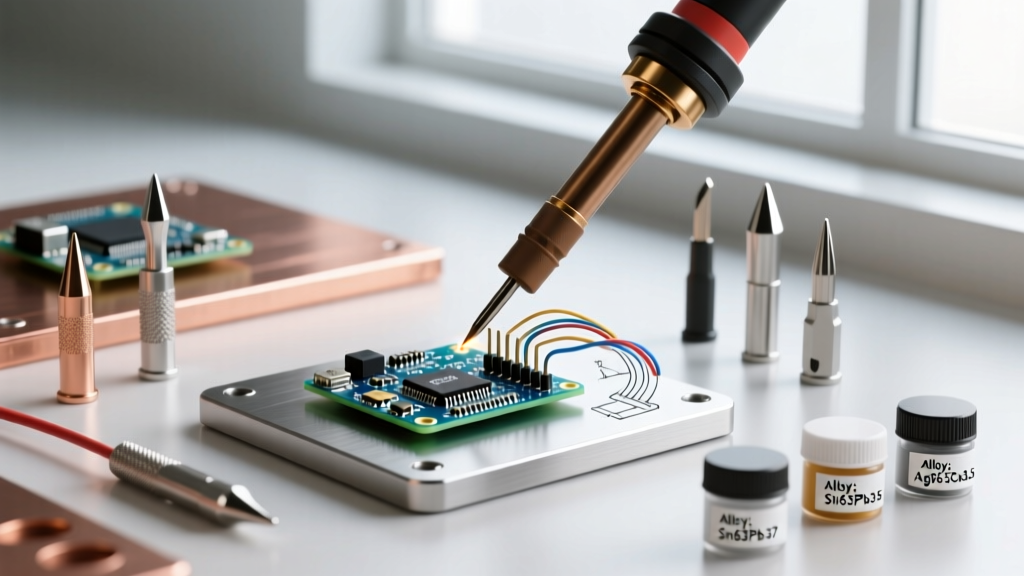
- Leaded (Sn63Pb37): Ideal for DIY, repair, and non-RoHS aerospace. Look for Kester 245 (ROL0 No-Clean) or Kester 44 (RA - requires cleaning for Class 3).
- Lead-Free (SAC305): Mandatory for commercial RoHS compliance. Requires higher tip temperatures (350°C - 380°C). Alpha Metals EcoRite is a top-tier choice.
- Liquid/Gel Flux: For rework (IPC-7711), use Chip Quik SMD291AX (tacky flux) to hold BGA components in place and ensure uniform wetting.
Category 3: Fume Extraction and Cleanliness
IPC standards mandate that flux residues must not interfere with electrical testing or cause corrosion. Furthermore, OSHA and IPC both emphasize operator safety regarding colophony fumes.
- Extraction: A localized HEPA and activated carbon extractor like the Hakko FA-400 (~$130) is the minimum baseline. For full compliance in enclosed spaces, upgrade to a Weller ZERO SMOG system.
- Cleaning: If using non-ROL0 flux, IPC requires thorough cleaning. Use MG Chemicals 824 IPA and lint-free Kimwipes, followed by an ultrasonic bath for complex SMD boards.
The 3-Class System: Which Level Are You Targeting?
When buying gear, align your budget with the IPC class your projects demand. Over-engineering a Class 1 toy is a waste; under-engineering a Class 3 pacemaker is a liability.
- Class 1 (General Electronic Products): Consumer electronics, toys, flashlights. Focus is on basic functionality. Standard 40W-60W irons and basic RA fluxes are generally acceptable. Visual inspection is casual.
- Class 2 (Dedicated Service Electronic Products): Laptops, routers, automotive infotainment. Extended life and sustained performance required. Requires closed-loop temperature control, ROL0 fluxes, and 10x magnification for inspection.
- Class 3 (High-Performance Electronic Products): Medical life-support, aerospace, military. Zero downtime tolerated. Mandates cartridge-style irons (JBC/Weller WX), strict thermal profiling, IPC-7711 certified rework procedures, and rigorous 30x microscopic inspection.
Frequently Asked Questions (FAQ)
Do IPC standards apply to hobbyists and DIYers?
While IPC standards are legally mandated only by specific contracts (like military or medical manufacturing), adopting IPC standards for soldering as a hobbyist dramatically increases the reliability of your custom PCBs, drones, and audio equipment. It also trains you in professional methodologies, making you highly employable in the electronics sector.
What is the most common IPC-A-610 defect found during inspection?
According to quality assurance data, 'disturbed joints' (moving the component while the solder is in the plastic/mushy state) and 'insufficient solder' (failing to meet the minimum fillet requirements for through-hole or gull-wing SMD leads) are the most frequent defects. Both are easily avoided by using a high-thermal-recovery iron and proper fixturing.
Can I use lead-free solder for Class 3 aerospace repairs?
Generally, no. Many aerospace and military applications are exempt from RoHS and strictly mandate Sn60Pb40 or Sn63Pb37 leaded solder to prevent 'tin whisker' growth, which can cause short circuits in high-vibration environments. Always consult the specific OEM engineering drawing or NASA workmanship standards which frequently overlay IPC requirements.
Final Thoughts
Mastering IPC standards for soldering is not about memorizing a 400-page manual; it is about understanding the physics of thermal transfer, the chemistry of flux, and the geometry of a perfect fillet. By investing in closed-loop soldering stations, verified ROL0 solder wires, and proper optical inspection tools, you elevate your workbench from a hobbyist's desk to a professional-grade assembly station. For further reading on industry benchmarks and training certifications, consult resources directly from IPC (Association Connecting Electronics Industries) and the Surface Mount Technology Association (SMTA).