
The Shift to High-Reliability Electronics Soldering in 2026
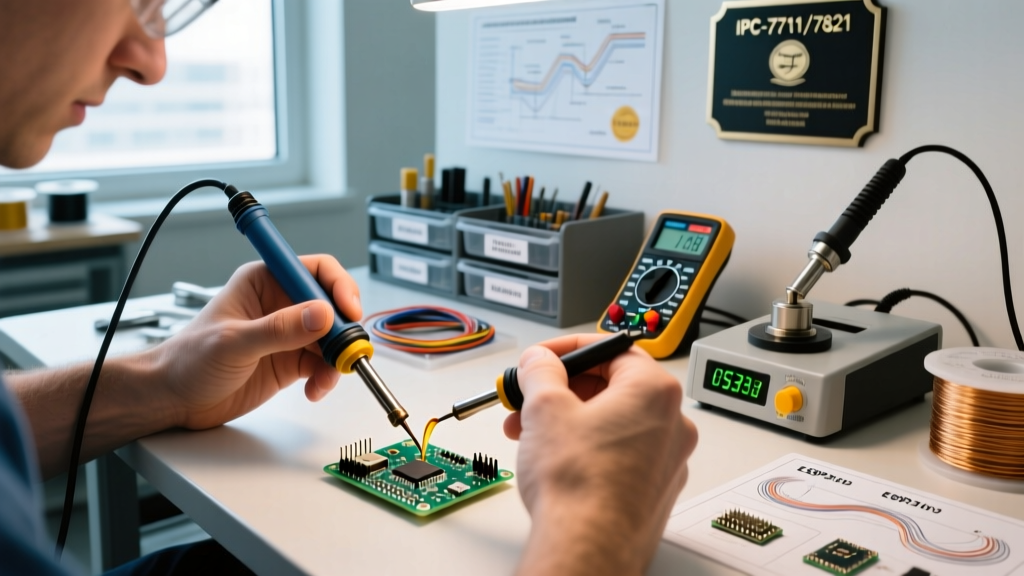
Industrial applications demand a completely different tier of precision electronics soldering compared to hobbyist or consumer repair environments. In 2026, as automotive EV systems, aerospace avionics, and implantable medical devices shrink in size while increasing in power density, the margin for thermal and mechanical failure has effectively reached zero. According to the IPC (Association Connecting Electronics Industries), Class 3 high-reliability assemblies require strict adherence to IPC J-STD-001 and IPC-A-610 standards. These mandates enforce rigorous criteria, such as a 75% minimum barrel fill for plated through-holes (PTH) and zero-tolerance for specific solder defects that might be deemed acceptable in standard commercial Class 2 assemblies.
Core Equipment Requirements for Industrial Electronics Soldering
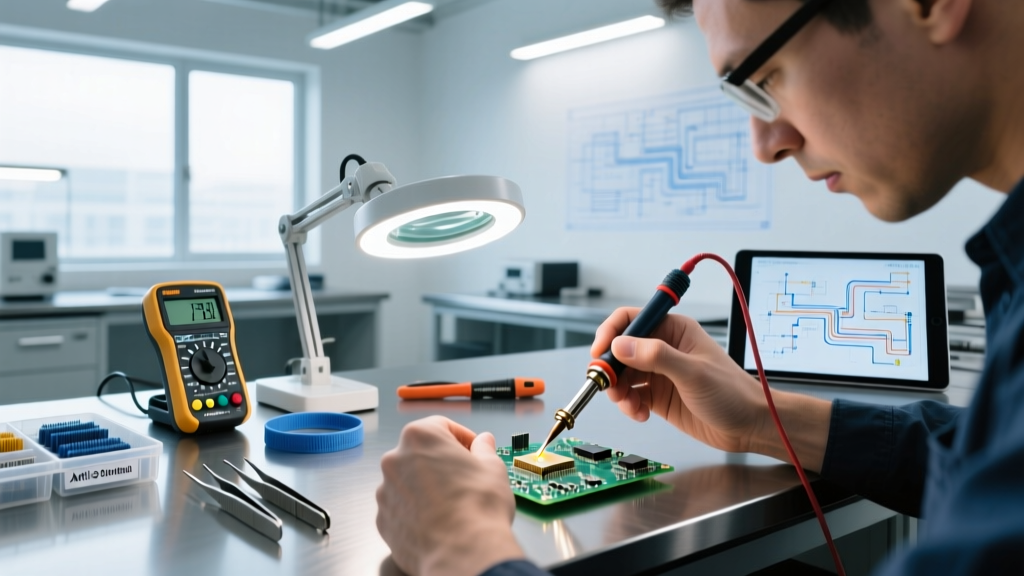
When outfitting a production floor or a high-reliability rework station, the choice of soldering equipment dictates throughput and yield. Active tip technology and closed-loop thermal sensing are no longer optional; they are baseline requirements for industrial electronics soldering.
1. JBC CD-2BQE General Purpose Station
The JBC CD-2BQE remains a dominant force in industrial environments. Priced between $650 and $750, it utilizes the T245 handle ecosystem. The standout feature is JBC's exclusive heating element integrated directly into the tip cartridge. This reduces the thermal transfer distance to under 5mm, allowing the station to recover from a 20°C temperature drop in under 1.5 seconds. Furthermore, the intelligent sleep/standby mode drops the tip temperature to 180°C when holstered, extending tip life by up to 500% compared to stations that idle at working temperatures.
2. Weller WX2021 (WXD2 Successor)
Weller’s WX2021 2-channel station (approx. $600-$680) is engineered for heavy thermal load applications, such as soldering thick ground planes in power electronics. Delivering 200W of total power, it pairs seamlessly with the WXMP (micro-pencil) and WXDP (desoldering) handpieces. The Weller Boost function allows operators to temporarily exceed maximum wattage to push through high-mass joints without stalling the thermal curve, a critical feature for multi-layer PCBs.
3. Hakko FX-9702 vs. Legacy Models
While the older Hakko FX-951 ($250-$300) has been a legendary workhorse, its ceramic heater technology struggles with rapid thermal recovery on dense boards. For high-volume industrial electronics soldering in 2026, the Hakko FX-9702 ($450-$550) offers superior thermal stability and a more responsive sensor loop, making it a viable alternative for complex mixed-technology boards where budget constraints preclude a full JBC ecosystem.
Alloy Selection: Moving Beyond Standard SAC305
The transition to RoHS-compliant lead-free solders forced the industry to adopt SAC305 (Sn96.5/Ag3.0/Cu0.5). However, industrial applications often require specialized alloys to combat thermal fatigue, drop-shock, or tin whisker growth.
| Alloy Designation | Composition | Melting Point | Primary Industrial Application | Key Characteristics |
|---|---|---|---|---|
| SAC305 | Sn96.5/Ag3.0/Cu0.5 | 217°C - 220°C | Consumer, Commercial IoT | Industry standard; good wetting; susceptible to drop-shock cracking. |
| SAC405 | Sn95.5/Ag4.0/Cu0.5 | 217°C - 220°C | Automotive Power Electronics | Higher silver content increases tensile strength and thermal fatigue resistance. |
| Sn63/Pb37 | Sn63/Pb37 | 183°C (Eutectic) | Aerospace, Military, Medical | RoHS exempt; prevents tin whiskers; superior thermal cycling reliability. |
| SnBiAg (Low Temp) | Sn57/Bi42/Ag1.0 | 138°C - 145°C | Heat-sensitive sensors, LED arrays | Low processing temp prevents PCB delamination; brittle, requires underfill. |
Flux Chemistry and Cleaning Protocols
In industrial electronics soldering, flux selection is governed by IPC J-STD-004 classifications. The choice between No-Clean and Water-Soluble fluxes depends entirely on the end-use environment and the risk of electrochemical migration.
- ROL0 / ROL1 (No-Clean, Low Activity): Standard for consumer and commercial IoT. Leaves a benign, non-conductive residue that does not require cleaning. ROL1 contains halides for better wetting on oxidized pads.
- ORM0 / ORH1 (Organic, Mid-to-High Activity): Used in automotive and industrial controls where heavy oxidation is present. Requires aggressive cleaning (e.g., saponifier or ultrasonic baths) to prevent electrochemical migration (ECM) and dendritic growth.
- Water-Soluble (OA): Mandatory for high-voltage power electronics and medical implants. Must be cleaned using heated DI (deionized) water with a resistivity of >18 MΩ·cm to ensure zero ionic contamination.
Critical Failure Modes in High-Reliability Assemblies
According to data compiled by the NASA Technical Standards Program and reliability engineers, specific failure modes plague industrial electronics soldering if process controls are lax.
Tin Whisker Growth: Pure tin finishes under compressive stress can grow microscopic crystalline structures (whiskers) that cause catastrophic short circuits in low-voltage, high-impedance circuits. The National Institute of Standards and Technology (NIST) and NASA NEPP programs heavily document this phenomenon. Mitigation requires using matte tin finishes, applying conformal coatings (like acrylic or polyurethane), or utilizing SnPb alloys where RoHS exemptions apply.
Voiding in Bottom-Termination Components (BTCs)
Components like QFNs and BGAs rely on thermal pads for heat dissipation. Voiding (trapped flux gases) exceeding 25% of the pad area severely degrades thermal transfer and mechanical shear strength. Mitigation requires utilizing vacuum reflow profiles or specialized void-reducing flux chemistries with lower outgassing thresholds.
Tombstoning and Wetting Imbalance
Common in 0201 and 01005 metric passive components, tombstoning occurs when surface tension on one pad overcomes the other during reflow. In manual electronics soldering, this is caused by uneven heating. Operators must apply the iron to both the pad and the component termination simultaneously, using a micro-pencil tip (e.g., JBC C245-945) and a tack-and-flow technique to ensure balanced wetting.
Buyer's Matrix: Matching Equipment to Industry Verticals
Selecting the right setup requires aligning your capital expenditure with the specific IPC class and thermal demands of your target market.
| Industry Vertical | IPC Class | Recommended Station Type | Preferred Alloy | Estimated Budget per Bench |
|---|---|---|---|---|
| Aerospace & Defense | Class 3 | JBC CD-2BQE / Weller WX2021 | Sn63/Pb37 (Exempt) | $1,200 - $1,800 (incl. fume extraction) |
| Automotive EV Systems | Class 2 / 3 | Weller WX2021 (High Wattage) | SAC405 / SAC-X Plus | $900 - $1,400 |
| Medical Implants | Class 3 | JBC-NASE (Nano Station) | Sn63/Pb37 or Bi-doped | $1,500 - $2,500 (Microscope required) |
| Commercial IoT / Consumer | Class 2 | Hakko FX-9702 / Weller W101 | SAC305 | $400 - $700 |
Final Considerations for 2026 Procurement
When procuring gear for industrial electronics soldering, do not overlook the hidden costs of fume extraction and ESD (Electrostatic Discharge) compliance. A high-end JBC or Weller station must be paired with an extraction arm capable of capturing sub-micron rosin and resin particles to meet OSHA and local air quality mandates. Furthermore, ensure all handpieces, mats, and station chassis are verified to ANSI/ESD S20.20 standards, maintaining a resistance to ground of < 1.0 x 10^9 ohms to protect sensitive MOSFETs and microcontrollers from catastrophic latch-up events.