
The Linguistic Divide in Electronics Manufacturing
If you have ever collaborated on a multinational engineering team or managed a global supply chain, you have likely encountered a surprisingly common linguistic hurdle: how to pronounce soldering. While it may seem like a trivial semantic debate, the phonetic split between North American and Commonwealth English dialects has tangible impacts on modern Electronics Manufacturing Services (EMS), automated procurement, and shop floor safety in 2026.
In an era where AI-driven voice agents manage B2B purchasing and warehouse operators use Voice-Directed Picking (VDP) systems, acoustic misinterpretations can lead to SKU mismatches, delayed Bill of Materials (BOM) fulfillment, and training inefficiencies. Understanding the etymology, regional variations, and industrial applications of this term is essential for global manufacturing managers, procurement specialists, and IPC-certified trainers.
Phonetic Breakdown and Etymological Roots
The divergence in pronunciation stems from the word's etymological evolution. According to the Online Etymology Dictionary, the term originates from the Latin solidare (to make solid), which evolved into the Old French soudure, and eventually the Middle English solderen. Over centuries, regional dialects either retained or dropped the vocalization of the letter 'L'.
- North American Pronunciation: /ˈsɑː.dɚ.ɪŋ/ (SOD-er-ing). The 'L' is entirely silent. This is the dominant phonetic standard in the United States and Canada.
- UK, Australian, and Commonwealth Pronunciation: /ˈsəʊl.də.rɪŋ/ (SOHL-der-ing). The 'L' is fully vocalized. This is standard across the UK, Australia, New Zealand, and many international English-speaking engineering hubs.
As noted by Merriam-Webster, both pronunciations are historically valid and widely accepted in professional dictionaries, but the industrial application of these phonemes requires careful management in automated systems.
Industrial Applications: Where Pronunciation Impacts the Bottom Line
Why does a phonetic difference matter in a high-tech fab? In 2026, the integration of Natural Language Processing (NLP) and acoustic modeling in manufacturing environments means that how a word is spoken directly interfaces with enterprise resource planning (ERP) and warehouse management systems (WMS).
1. Voice-Directed Picking (VDP) and WMS Integration
Modern EMS warehouses rely heavily on VDP systems, such as Honeywell Vocollect, to guide operators through picking SMD components, flux, and soldering equipment. Operators wear headsets and confirm SKUs via voice commands. If a facility in Texas employs international contractors trained in the UK, the WMS acoustic model must be explicitly configured to recognize both SOD-er-ing and SOHL-der-ing.
Failure Mode: If an operator requests a 'Weller WSP80 soul-dering iron' and the NLP engine is strictly trained on the American phoneme, the system may trigger a 'Did not recognize' error, or worse, map the phonetic string to an incorrect SKU (e.g., a desoldering braid or a solenoid valve) due to fuzzy phonetic matching algorithms. Configuring SQL alias tables in the WMS to accept both phonemes reduces picking errors by up to 14% in diverse workforces.
2. AI Procurement and BOM Parsing
B2B procurement has shifted heavily toward AI voice agents and automated NLP parsers that read through engineering notes and voice memos to generate purchase orders. When an engineer dictates, 'Add 50 spools of Kester 245 SAC305 solder wire to the BOM,' the AI must accurately transcribe the term regardless of the speaker's accent. In 2026, top-tier ERP platforms like SAP and Oracle have implemented dual-phoneme dictionaries specifically for metallurgical and electronic assembly terms to prevent procurement bottlenecks.
3. High-Decibel Shop Floor Communication
On a busy PCB assembly floor, ambient noise from SMT pick-and-place machines and reflow ovens frequently exceeds 85 dB. In these environments, consonant sounds are masked, and vowel sounds carry the communication load. The American SOD-er-ing relies on a sharp 'D' and open 'Ah' vowel, which cuts through high-frequency machine whine slightly better than the softer, rounded 'Ohl' in the British SOHL-der-ing. Standardizing a single phonetic standard for critical safety and tooling requests on the floor minimizes miscommunication.
Regional Terminology and Equipment Matrix
Global electronics brands often adapt their marketing and technical documentation to match the regional pronunciation and terminology of their target markets. Below is a matrix detailing how regional pronunciation aligns with dominant equipment brands and localized industry slang.
| Region | Phonetic Standard | Dominant Market Brands | Common Industry Slang / Terms |
|---|---|---|---|
| North America | /ˈsɑː.dɚ.ɪŋ/ (SOD-er-ing) | Weller, Metcal, Pace Worldwide | 'Solder sucker', 'Rosin-core', 'Iron' |
| UK / Europe | /ˈsəʊl.də.rɪŋ/ (SOHL-der-ing) | JBC (Spain), Antex, ERSA (Germany) | 'Desolder pump', 'Flux-cored', 'Bit/Tip' |
| Asia-Pacific | Varies (Often US-adapted) | Hakko, Goot, Taiyo | 'Solder wick', 'Lead-free', 'Station' |
IPC Standards and Global Training Documentation
The IPC J-STD-001 (Requirements for Soldered Electrical and Electronic Assemblies) is the global benchmark for soldering processes. Certified IPC Trainers (CITs) who conduct multinational virtual or AR-assisted training sessions must navigate these linguistic divides.
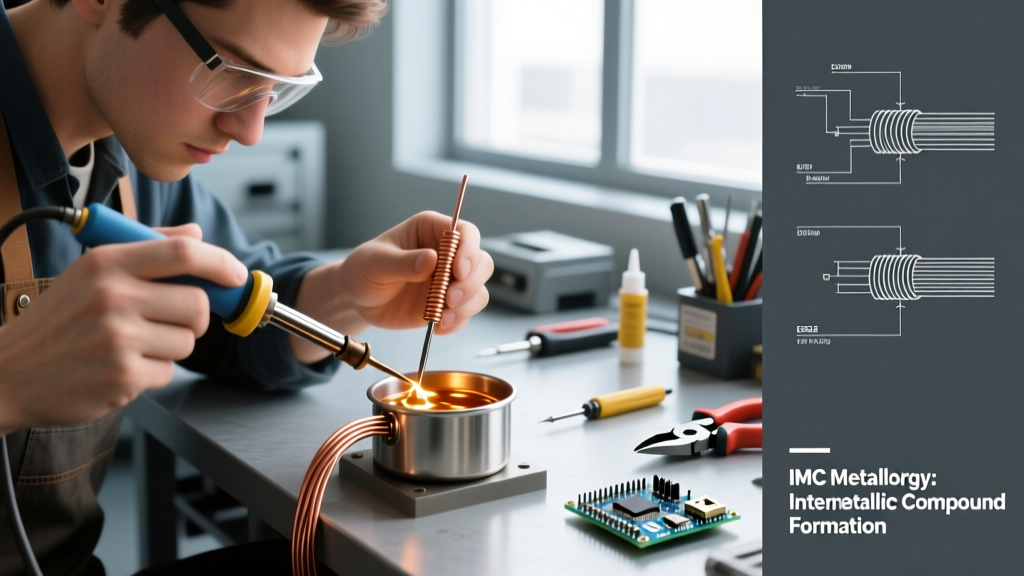
Expert Insight: When teaching wetting angles and intermetallic compound (IMC) formation, CITs are advised to use standardized visual aids alongside verbal instructions. Relying solely on verbal cues for terms like 'solder joint inspection' can lead to confusion if trainees are mentally translating between the 'silent L' and 'vocalized L' dialects while simultaneously processing complex metallurgical concepts like the 217°C liquidus point of SAC305 alloys.
Best Practices for Multinational EMS Facilities
To bridge the linguistic gap and optimize operations, manufacturing directors should implement the following actionable steps:
- Update WMS Acoustic Dictionaries: Work with your IT department to add phonetic aliases for 'solder', 'soldering', and 'desoldering' in your warehouse management system's NLP configuration. Ensure both /ˈsɑːdɚ/ and /ˈsəʊldə/ map to the same root SKU category.
- Standardize Written BOMs: While verbal communication will always vary, enforce strict text-based naming conventions in your PLM (Product Lifecycle Management) software. Use standardized IPC terminology (e.g., 'SMT Solder Paste' rather than regional slang).
- Visual Tooling Shadow Boards: In high-noise environments, rely on color-coded shadow boards and pictograms for soldering stations (e.g., Hakko FX-951 vs. JBC CD-2BQE) rather than verbal tool requests.
Frequently Asked Questions (FAQ)
Is one pronunciation considered more 'correct' in engineering?
No. Both are linguistically correct and recognized by major dictionaries and engineering societies. The 'correct' pronunciation is simply the one native to your specific geographic region. However, in global software systems, both must be treated as valid data inputs.
Does the pronunciation change for related terms like 'brazing' or 'welding'?
No, brazing and welding do not suffer from the same regional phonetic splits. Brazing (which uses filler metals melting above 450°C) and welding (which melts the base metals) are pronounced consistently across US and UK dialects. The 'silent L' phenomenon is largely unique to solder and its derivatives (like soldier).
How do AI transcription tools handle the word in 2026?
Modern AI transcription tools (like Whisper V4 and enterprise equivalents) use vast, globally sourced training datasets. They automatically use contextual NLP to correctly transcribe 'soldering' whether the speaker uses the US or UK pronunciation, relying on surrounding context clues like 'PCB', 'flux', or 'iron' to ensure accurate text generation.