
The Great Phonetic Divide: 'Sod-Der' vs. 'Soul-Der' in Global Manufacturing
When navigating the high-stakes environment of professional electronics manufacturing, clear communication is not just a courtesy—it is a critical safety and quality assurance metric. Whether you are managing a Surface Mount Technology (SMT) line, conducting rework on aerospace-grade PCBs, or procuring specialized alloys, the way your team speaks matters. One of the most common linguistic hurdles in global engineering teams is a surprisingly basic question: how to pronounce soldered.
In the United States, the standard pronunciation drops the 'L', resulting in 'sod-derd' (/ˈsɒd.ərd/). However, in the United Kingdom, Australia, and many Commonwealth nations, the 'L' is fully enunciated as 'soul-derd' (/ˈsɒl.dəd/). According to the Merriam-Webster Dictionary, the American phonetic shift occurred in the 19th century, while the Cambridge Dictionary notes the British retention of the Latin root 'solidare'. While this linguistic trivia is fascinating, its implications on the modern PCB assembly floor are profoundly practical.
Why Pronunciation Matters in High-Reliability Industry Applications
In consumer electronics, a mispronounced word might result in a confused glance. In high-reliability sectors like aerospace, medical devices, and automotive electronics, miscommunication can lead to catastrophic procurement errors, failed IPC Standards certifications, and compromised joint integrity.
1. IPC Certification and Multilingual Training Environments
When international engineering teams gather for IPC J-STD-001 (Requirements for Soldered Electrical and Electronic Assemblies) or IPC-A-610 (Acceptability of Electronic Assemblies) certification, instructors must bridge the phonetic divide. A trainer from the UK demonstrating a Class 3 soldered joint to a predominantly US-based team of technicians must navigate the 'soul-der' vs 'sod-der' barrier. In noisy training labs—where ventilation hoods and rework stations like the Metcal MX-5200 are running—phonetic clarity is essential. Mishearing 'soldered' as 'splattered' or 'shattered' over ambient noise can lead to incorrect defect identification during practical exams.
2. Voice-Directed Procurement and Warehouse AI
Modern component distributors and large-scale EMS (Electronics Manufacturing Services) providers utilize Voice-Directed Warehousing (VDW) systems. Technicians use headsets to request materials from inventory management AI. If a US-based procurement officer requests 'SAC305 soul-dered wire' using a voice-to-text interface calibrated for American English, the system may fail to parse the request, delaying the retrieval of critical Sn96.5Ag3.0Cu0.5 (SAC305) solder wire. Calibrating these AI dictionaries to recognize both phonetic variants is a mandatory IT setup step for global supply chains in 2026.
Phonetic Breakdown and Regional Industry Usage
To standardize communication across multinational engineering firms, it is vital to understand the exact phonetic breakdown and where each variant dominates the electronics sector.
| Region | Phonetic Spelling | IPA Notation | Primary Industry Impact |
|---|---|---|---|
| North America (US/Canada) | SOD-derd | /ˈsɒd.ərd/ | Dominates US-based EMS procurement, Silicon Valley hardware startups, and North American IPC training centers. |
| UK / Europe / Commonwealth | SOUL-derd | /ˈsɒl.dəd/ | Standard in European automotive PCB assembly, UK aerospace defense contracts, and Asian manufacturing hubs trained by British engineers. |
| Global Aviation / Military | Phonetic Alphabet | Sah-Lima-Delta | Used in high-noise environments (e.g., flight line maintenance) where standard pronunciation fails over comms. |
Overcoming Communication Barriers on the PCB Assembly Floor
Engineering managers and quality assurance (QA) directors must implement systems that neutralize linguistic friction. Here is how top-tier manufacturing facilities handle the pronunciation divide.
Standardizing SOPs for Global Teams
Written Standard Operating Procedures (SOPs) must remain the ultimate source of truth. While verbal communication on the SMT line will always vary by regional dialect, digital work instructions displayed on shop-floor monitors should use standardized, globally recognized terminology. Instead of relying on verbal hand-offs for rework instructions (e.g., 'The through-hole leads aren't soldered properly'), facilities should utilize digital defect codes mapped to IPC-A-610 standards, such as Condition 3: Insufficient Wetting.
Calibrating Voice-Picking Software for Component Retrieval
If your facility uses voice-picking AI for retrieving soldering consumables—such as Kester 245 no-clean flux or Weller WSP80 iron tips—you must configure the Natural Language Processing (NLP) engine to accept multiple phonetic inputs.
- Step 1: Access the VDW admin console and navigate to the phonetic dictionary module.
- Step 2: Add 'soul-der', 'sod-der', 'soldered', and 'sod-derd' as synonymous trigger words mapped to the SKU database for soldering alloys.
- Step 3: Implement a 'read-back' confirmation protocol where the AI repeats the exact SKU (e.g., 'Retrieving Indium SAC305 0.032 inch wire') rather than repeating the spoken word, ensuring the correct alloy is pulled regardless of the technician's accent.
Expert Insight: In high-mix, low-volume (HMLV) PCB assembly, a technician accidentally grabbing a leaded Sn63Pb37 wire instead of a lead-free SAC305 wire due to a voice-picking misinterpretation can result in thousands of dollars in scrapped aerospace boards and severe RoHS compliance violations.
The Role of Visual Communication in Rework Stations
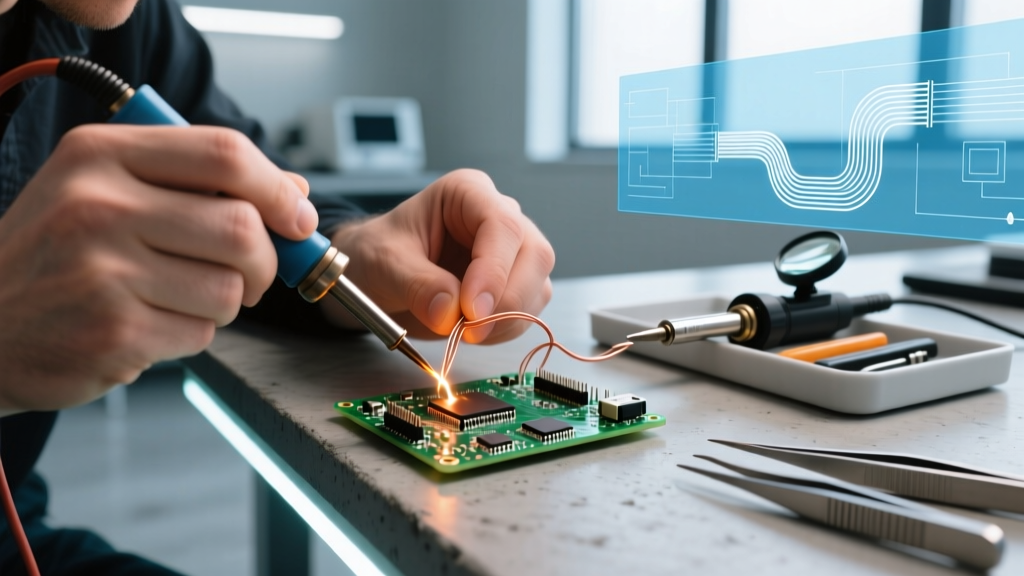
Because verbalizing 'how to pronounce soldered' or describing a specific soldered joint topology (like a concave vs. convex fillet) can be ambiguous across dialects, the industry has heavily pivoted toward visual communication. Modern rework stations are equipped with high-definition macro cameras. When a technician in Shenzhen needs to verify a soldered BGA (Ball Grid Array) pad with a QA engineer in Texas, they do not rely on verbal descriptions of the joint. They stream the 4K macro feed directly to the engineer's monitor, bypassing the phonetic divide entirely.
Frequently Asked Questions (FAQ)
Is one pronunciation considered more 'correct' in the engineering industry?
No. Neither 'sod-derd' nor 'soul-derd' is technically superior in an engineering context. Both are recognized by international standards bodies. The 'correct' pronunciation is simply the one that ensures clear, unambiguous communication within your specific regional team and supply chain.
How do international IPC instructors handle the pronunciation difference?
Certified IPC trainers are trained to recognize both dialects. They often address the difference explicitly on the first day of a J-STD-001 course to break the ice and ensure that non-native English speakers or international transfers are not penalized for using their regional phonetic variant during oral examinations.
Can voice-to-text software cause procurement errors with soldering supplies?
Yes. Uncalibrated voice-to-text software can misinterpret 'soul-der' as 'solder' or fail to recognize 'sod-der' entirely, leading to search failures in ERP systems like SAP or Oracle. IT departments must add regional phonetic aliases to the material master data records to prevent these procurement bottlenecks.
Final Thoughts on Shop Floor Linguistics
Understanding how to pronounce soldered across different global markets is more than an exercise in linguistics; it is a vital component of modern manufacturing operations management. As the electronics industry continues to globalize, and as AI-driven procurement and automated SMT lines become the norm, bridging the gap between 'sod-der' and 'soul-der' ensures that human operators and digital systems remain perfectly synchronized. By standardizing digital SOPs, calibrating warehouse AI, and relying on visual verification for critical IPC Class 3 joints, engineering teams can eliminate phonetic friction and focus on what truly matters: building flawless, high-reliability electronic assemblies.