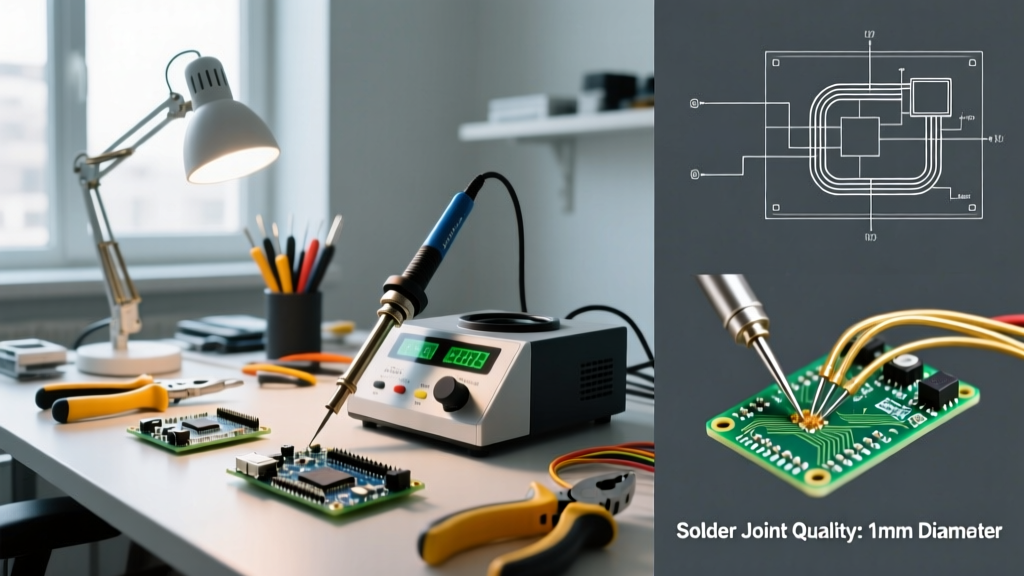

The Hidden Hazards of De Soldering
While soldering receives the lion's share of safety training in electronics manufacturing and DIY workspaces, de soldering introduces a unique matrix of thermal, chemical, and mechanical hazards. Removing components from a printed circuit board (PCB) requires higher thermal mass transfer, prolonged heat exposure, and aggressive mechanical force. In 2026, with the widespread adoption of dense, multi-layer HDI (High-Density Interconnect) boards and lead-free SAC305 alloys, the margin for error has vanished.
This guide outlines the critical safety best practices for de-soldering, protecting both the operator from respiratory and burn hazards, and the PCB from catastrophic thermal damage.
Thermal Management: Preventing Pad Cratering and Delamination
The most common failure mode during de soldering is pad lifting or 'cratering,' where the copper pad tears away from the FR-4 substrate. This occurs when mechanical force is applied before the solder has fully reached its liquidus state, or when localized heat exceeds the glass transition temperature (Tg) of the PCB laminate, which typically ranges from 130°C to 170°C for standard materials.
Temperature Profiling for Lead-Free Alloys
Standard lead-free SAC305 solder melts at approximately 217°C. However, a desoldering iron must be set significantly higher to overcome the thermal dissipation of the component leads and the board's internal ground planes.
- Single/Double Layer Boards: Set station to 350°C - 370°C.
- Multi-Layer Boards (4+ layers): Set station to 380°C - 400°C, but limit dwell time to 3 seconds per pad to prevent internal delamination.
- Thermal Shielding: Apply Kapton (polyimide) tape to adjacent plastic connectors and sensitive SMDs to reflect radiant heat and prevent localized melting.
Respiratory Protection and Fume Extraction
De soldering often requires the liberal application of extra flux to break down oxidized joints. When heated, rosin-based (colophony) flux vaporizes into a complex aerosol containing aliphatic aldehydes and hydrochloric acid. Chronic exposure to these fumes is a leading cause of occupational asthma.
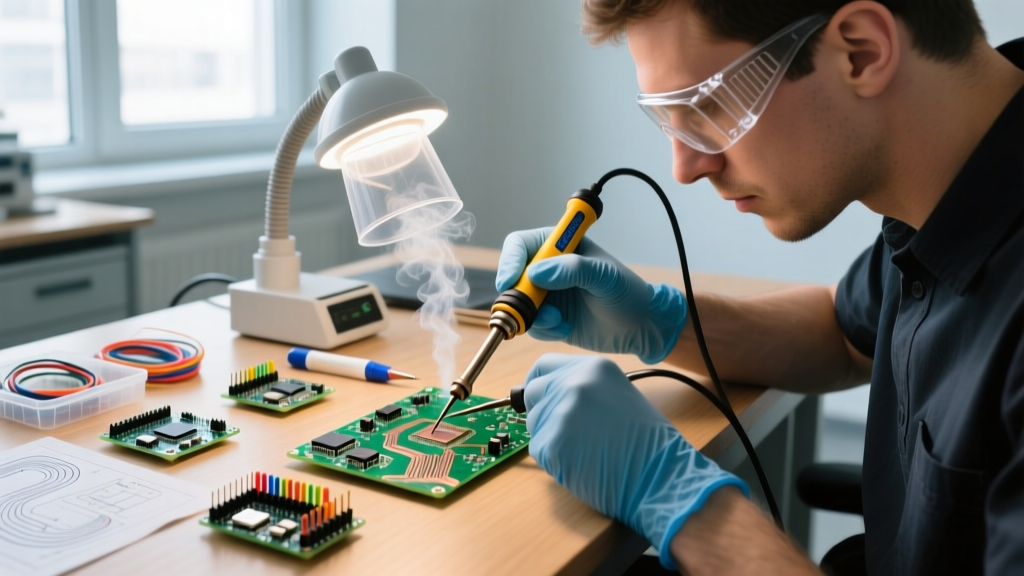
As highlighted by Harvard University's Environmental Health and Safety (EHS) guidelines, relying on ambient room ventilation is entirely insufficient. You must capture fumes at the source.
Soldering and de-soldering fumes contain colophony, a known respiratory sensitizer. Continuous exposure without localized extraction can lead to irreversible occupational asthma. — NIOSH Guidelines on Soldering Safety
Extraction Equipment Tiers
- Desktop Carbon Filters (e.g., Hakko FA-400): Priced around $75, these use activated carbon to adsorb VOCs. They must be positioned within 6 inches of the solder joint. Note: Carbon filters do not trap particulate matter; they must be replaced every 40-50 hours of active use.
- HEPA + Gas Extraction Systems (e.g., BOFA AD Oracle): Costing upwards of $1,200, these are mandatory for professional labs. They trap 99.997% of particulates at 0.3 microns and neutralize gases, venting clean air back into the room safely.
Burn Prevention and Tool Handling Matrices
Desoldering tools operate at extreme temperatures and involve sudden mechanical movements that can flick molten solder. Safety glasses rated to ANSI Z87.1 are non-negotiable to protect against solder splatter, particularly when using manual vacuum pumps.
De Soldering Tool Safety Comparison
| Tool Type | Popular Model (2026) | Approx. Cost | Primary Safety Hazard | Mitigation Strategy |
|---|---|---|---|---|
| Electric Desoldering Gun | Hakko FR-301 | $165 | Severe contact burns from oversized heating element; clogged nozzles causing pressure blowback. | Use silicone finger guards; clean nozzle with brass wool after every 5 uses; never point at skin. |
| Manual Vacuum Pump | Edsyn Soldapullt DS017 | $15 | Solder splatter upon sudden vacuum release; repetitive strain injury (RSI) from stiff spring. | Wear Z87.1 safety glasses; keep face >12 inches away; use ESD-safe, low-recoil variants if available. |
| Desoldering Braid (Wick) | Chemtronics Soder-Wick | $8 / roll | Thermal conduction burns through the copper braid to the operator's fingers. | Always hold the spool, never the flat braid; use a dedicated bobbin holder tool for leverage. |
| Low-Temp Alloy Injection | Chip Quik SMD291AX | $25 | Cross-contamination of alloys leading to brittle joints if not fully cleaned post-removal. | Use generous flux; follow up with 99% IPA and lint-free wipes to remove all residue. |
Chemical Safety: Flux and Solvent Handling
Post-removal cleaning is a critical step that introduces flammable chemical hazards. Isopropyl Alcohol (IPA) 99% is the industry standard for removing flux residue. However, IPA has a low flash point of 12°C (53°F).
Critical Burn & Fire Warning: Never apply IPA directly to a PCB immediately after de soldering. The residual thermal mass in the component pads can easily exceed the auto-ignition temperature of IPA vapors, or at minimum cause rapid, uncontrolled vaporization that spreads flammable mist. Always wait for the board to drop below 40°C before applying solvents.Furthermore, the Occupational Safety and Health Administration (OSHA) mandates strict handling protocols for leaded solder residues. If you are de-soldering legacy electronics (pre-2006) containing Sn63/Pb37 solder, you must wash your hands with cold water and soap immediately after the task. Hot water opens the pores, increasing dermal absorption of lead particulates.
Additionally, understand that 'no-clean' flux residues can actually be more corrosive than rosin if they are only partially activated by heat and left on the board. Always clean the board thoroughly if the thermal profile during desoldering was inconsistent.
ESD Protocols During Component Salvage
When the goal of de soldering is component salvage rather than simple removal, Electrostatic Discharge (ESD) safety becomes paramount. The act of pulling a plastic IC package across a fiberglass board can generate triboelectric charges exceeding 2,000V—well above the 100V threshold that destroys modern MOSFET gates. This often results in latent defects, where the component passes initial testing but fails in the field due to compromised gate oxide.
- Grounding: Wear a wired ESD wrist strap connected to a 1-megohm current-limiting resistor grounded to the workstation mat.
- Ionization: For environments with low humidity (<30%), use a benchtop ionizer to neutralize static charges on the PCB surface before applying desoldering braid.
- Tool Selection: Ensure your desoldering iron tip is grounded to the station's earth pin. Test tip-to-ground resistance monthly; it should read less than 2 ohms to ensure safe dissipation of static buildup.
Summary Checklist for Safe De Soldering
Before powering on your rework station, verify the following parameters to ensure a safe and successful operation:
- Fume extractor is powered on and positioned within 6 inches of the work zone.
- ANSI Z87.1 safety glasses and ESD wrist strap are secured.
- Iron temperature is matched to the board's layer count and solder alloy.
- Mechanical tweezers are ready to lift the component without prying against the PCB laminate.
- 99% IPA and lint-free wipes are staged at a safe distance from the heating element.
By treating de soldering as a distinct, high-risk discipline rather than a simple reversal of soldering, you ensure both personal safety and the structural integrity of your electronic assemblies.