
The "Hot Gun" Terminology Problem in Electronics
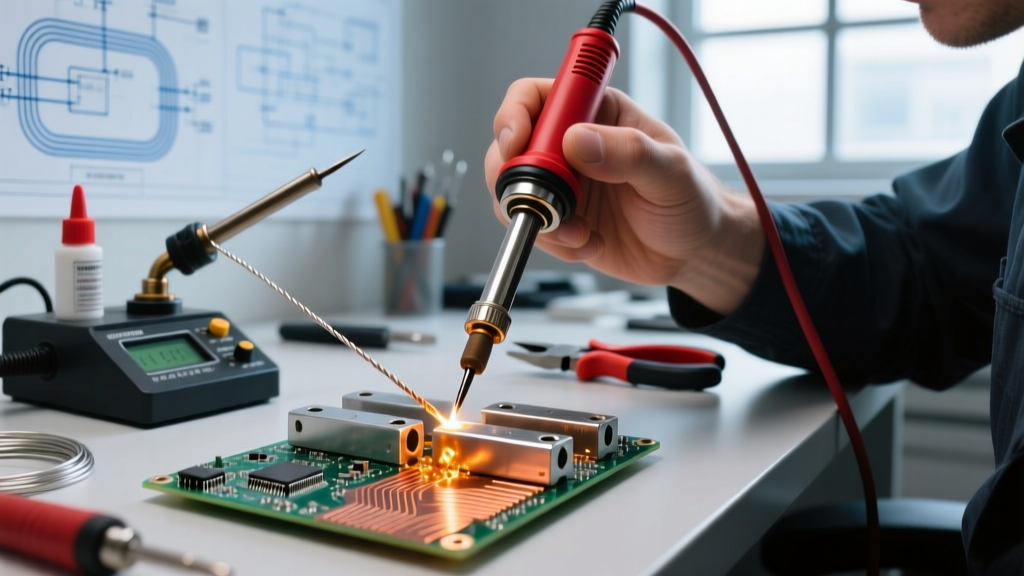
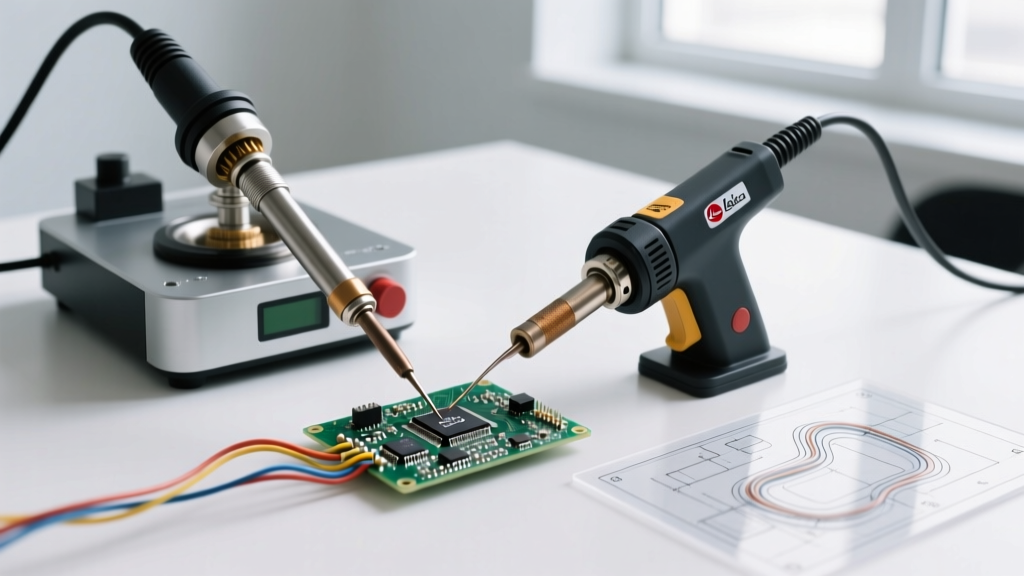
Walk into any electronics lab or browse DIY forums in 2026, and you will inevitably encounter the term hot gun soldering. However, this phrase is a notorious source of confusion because it conflates two fundamentally different soldering methods. When a beginner asks about "hot gun soldering," they are usually referring to one of two tools:
- Transformer Soldering Guns: The heavy, pistol-grip tools (like the classic Weller D550) used for massive wire lugs and thick gauge connections.
- Hot Air Rework Guns: The precision benchtop stations (like the Quick 861DW) that blow heated air to solder and desolder surface-mount devices (SMD).
Using the wrong "hot gun" for your specific project will result in catastrophic failure—from melting delicate plastic connectors to completely destroying sensitive Hall-effect sensors. This guide dissects both methods, comparing their physics, real-world applications, and specific failure modes so you can choose the exact right tool for your workbench.
Method 1: Transformer Soldering Guns (The Heavyweight)
The traditional soldering gun operates on a completely different physical principle than a standard soldering iron. Inside the pistol grip sits a massive step-down transformer. It converts 120V AC mains into a very low voltage (typically under 1V) but an extremely high current (hundreds of amps). This current passes through a thick copper wire loop (the tip), which heats up due to I²R (current squared times resistance) heating.
Real-World Specs & 2026 Market Leaders
- Weller D550 (260W/200W Dual Trigger): Still the industry benchmark in 2026, retailing around $115. It reaches soldering temperatures in roughly 4 to 6 seconds.
- Weller 9600 (130W/100W): A lighter alternative for 12 AWG to 16 AWG wires, priced near $85.
Where Transformer Guns Excel
Transformer guns are unmatched for high-thermal-mass connections. If you are soldering 8 AWG silicone wire to an XT90 battery connector, or attaching heavy copper ring terminals to a 4/0 AWG battery cable, a standard 60W soldering iron will suffer from severe heat sinking. The iron's tip will drop below the solder's melting point, resulting in a cold, grainy joint. A 260W transformer gun pushes massive thermal energy directly into the copper lug, melting 63/37 rosin-core solder instantly.
Critical Failure Modes & Edge Cases
WARNING: Magnetic Interference. Because the tip is essentially a single-turn secondary winding carrying hundreds of amps of 60Hz AC current, it generates a massive alternating magnetic field. Never use a transformer soldering gun near Hall-effect sensors, inductors, transformers, or magnetic storage media. The magnetic pulse can permanently magnetize components or induce voltage spikes that destroy nearby MOSFETs and microcontrollers.Additionally, the exposed copper loop tip oxidizes rapidly. Unlike iron-plated tips on standard stations, you must frequently dress the copper tip with a file and re-tin it to maintain thermal transfer efficiency.
Method 2: Hot Air Rework Guns (The SMD Precision Tool)
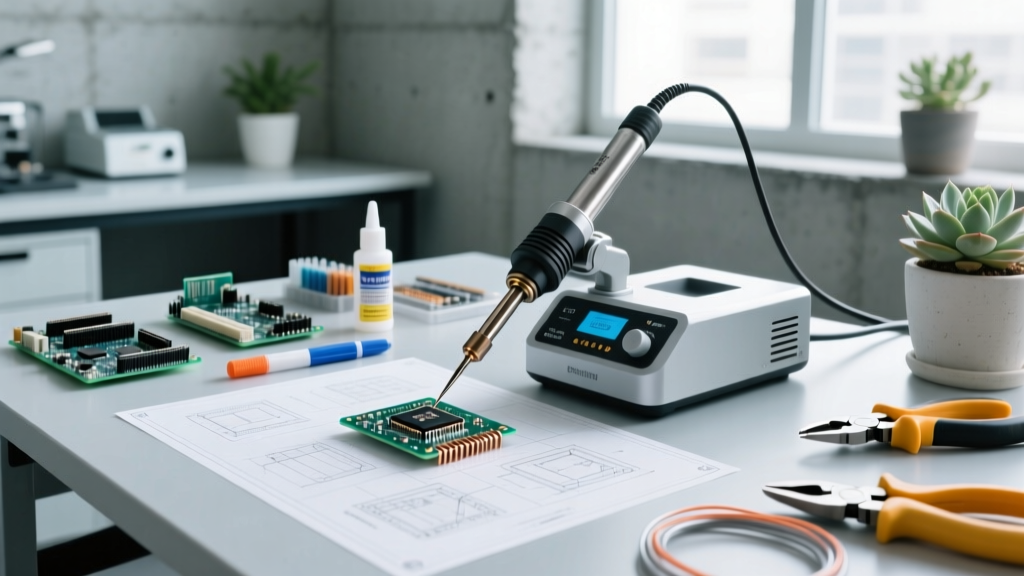
When modern engineers refer to a "hot gun" for PCB rework, they mean a Hot Air Rework Station. These devices use a ceramic heating element and a brushless micro-turbine to push precisely controlled, high-temperature air through specialized nozzles.
Real-World Specs & 2026 Market Leaders
- Quick 861DW: The undisputed king of the mid-tier bench. Priced around $285 in 2026, it features a brushless fan, 1000W heating element, and an airflow rate of up to 120 Liters/min. It stores programmable thermal profiles.
- Hakko FR-810B: A premium, heavy-duty option ($420+) favored in professional repair centers for its robust ESD-safe grounding and digital calibration.
Where Hot Air Guns Excel
Hot air is mandatory for Surface Mount Technology (SMT). You cannot use a physical iron tip to simultaneously heat the 64 pins of a QFP (Quad Flat Package) microcontroller or the hidden thermal pad beneath a QFN (Quad Flat No-leads) chip. By applying a 350°C airflow with a matched nozzle (e.g., a 10mm square nozzle for a 9mm chip), the entire component reaches reflow temperature simultaneously, allowing surface tension to perfectly align the part on its pads.
Critical Failure Modes & Edge Cases
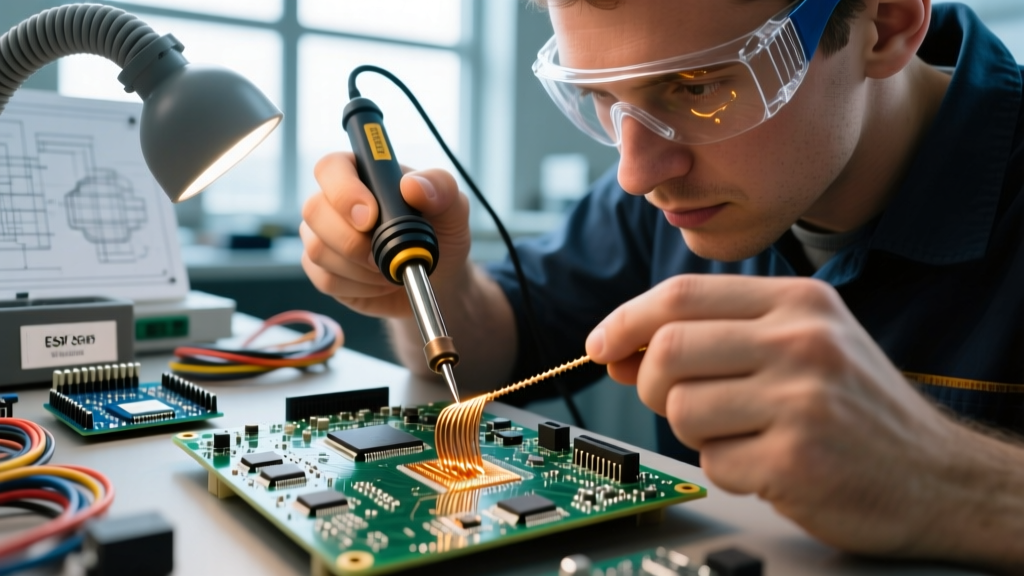
The most common beginner mistake with hot air is thermal shock and pad cratering. If you blast a cold PCB with 400°C air, the rapid expansion can delaminate the fiberglass substrate or rip the copper pads right off the board (pad cratering).
Pro-Tip: Always use a board pre-heater (set to 130°C) or a broad, low-airflow "warm-up" pass across the entire PCB for 30 seconds before focusing high-velocity hot air on the target component. Furthermore, always shield adjacent plastic connectors and BGA chips with high-temperature Kapton tape and aluminum foil heat shields.
Head-to-Head Method Comparison Matrix
| Feature | Transformer Soldering Gun | Hot Air Rework Station | Standard Soldering Iron (e.g., Pinecil V2) |
|---|---|---|---|
| Primary Use Case | Heavy gauge wire (10-4 AWG), large lugs | SMD/BGA rework, heat shrink, QFN/QFP | Through-hole, general SMD, 24-12 AWG wire |
| Heating Mechanism | High-current AC through copper loop | Forced convection (heated air) | Conduction (resistive ceramic heater) |
| Temperature Control | None (Fixed by trigger wattage) | PID Digital Control (100°C - 500°C) | PID Digital Control (50°C - 450°C) |
| Average 2026 Cost | $85 - $130 | $150 (entry) - $450 (pro) | $25 (entry) - $280 (pro) |
| Risk to PCB Traces | Extreme (melts boards, magnetic damage) | Moderate (pad lifting if un-preheated) | Low (if temp and dwell time are managed) |
| Required Consumables | Copper loop tips, heavy rosin flux | Nozzles, Kapton tape, tacky flux (e.g., Amtech) | Replaceable iron-plated tips, solder wire |
Real-World Scenarios: Which Method Wins?
Scenario A: Building a 60A Drone Power Distribution Board
The Task: Soldering 10 AWG silicone wires to massive copper pour pads on a 6-layer PCB. The Verdict: Hybrid Approach. A transformer gun will likely blow the pad off the PCB due to extreme localized mechanical stress and heat. A standard iron will freeze. The correct 2026 workflow is to use a high-wattage smart iron (like the 65W Pinecil V2 with a massive C4 or D24 tip) combined with a localized hot air gun set to 250°C to pre-heat the copper pour pad from the top. This prevents the iron's thermal mass from being drained by the ground planes.
Scenario B: Replacing a Blown SMD MOSFET on an ESC
The Task: Removing a dead 5x6mm SMD MOSFET with an exposed thermal pad, without destroying the tiny 0402 resistors situated 2mm away. The Verdict: Hot Air Rework Gun. Using a Quick 861DW with a 6mm round nozzle, set to 360°C and 40% airflow. The adjacent 0402 components are shielded with a piece of aluminum tape with a cutout for the MOSFET. A syringe of Amtech NC-559-V2-TF tacky flux is applied to hold the new component in place while the air reflows the solder paste evenly.
Safety, Fume Extraction, and Industry Standards
Regardless of whether you are using a transformer gun for heavy wiring or a hot air station for SMD rework, vaporized rosin and synthetic flux activators pose a severe respiratory hazard. According to guidelines from the Occupational Safety and Health Administration (OSHA), prolonged exposure to colophony (rosin) fumes can cause occupational asthma and chronic contact dermatitis. In 2026, a localized HEPA and activated carbon fume extractor (such as the Hakko FA-400 or a DIY blower with 3M 6001 cartridges) is non-negotiable for indoor electronics work.
Furthermore, if you are building aerospace, automotive, or medical electronics, your soldering methods must comply with strict visual and structural standards. The IPC (Association Connecting Electronics Industries) publishes the IPC-A-610 standard, which explicitly defines acceptable solder fillets, wetting angles, and thermal damage limits for both wire terminations and SMD connections. Similarly, the NASA Electronic Parts and Packaging (NEPP) Program maintains rigorous workmanship standards (like NASA-STD-8739.3) that explicitly forbid the use of transformer soldering guns on any flight hardware due to the risk of magnetic contamination and insulation damage from uncontrolled heat spikes.
Final Verdict: Stocking Your 2026 Workbench
The phrase "hot gun soldering" encompasses two entirely different disciplines of electronics manufacturing. If your primary focus is FPV drones, RC cars, automotive wiring, or solar battery banks, invest in a Weller D550 Transformer Gun for the heavy 8 AWG+ lugs, but rely on a high-mass standard iron for PCB work. If your focus is PCB repair, smartphone logic boards, or custom SMD assembly, a Quick 861DW Hot Air Rework Station is an absolute necessity. Understanding the distinct physics and failure modes of each tool is the hallmark of a true electronics expert.