
The Evolution of the Soldering Iron: A Buyer's Historical Perspective
When evaluating the history of tools soldering professionals and hobbyists rely on today, we see a fascinating trajectory of metallurgical and electrical engineering. Understanding this evolution is not merely an academic exercise; it directly informs how you should allocate your budget in 2026. The broad category of tools soldering encompasses everything from $25 open-source USB-C irons to $600 high-frequency induction stations. By tracing the technological lineage of these instruments, we can uncover why certain legacy designs fail under modern RoHS (Restriction of Hazardous Substances) lead-free requirements, and why integrated cartridge systems have largely rendered traditional ceramic heaters obsolete for high-density SMD (Surface Mount Device) work.
The Forge and the Copper Hatchet (Pre-1900s)
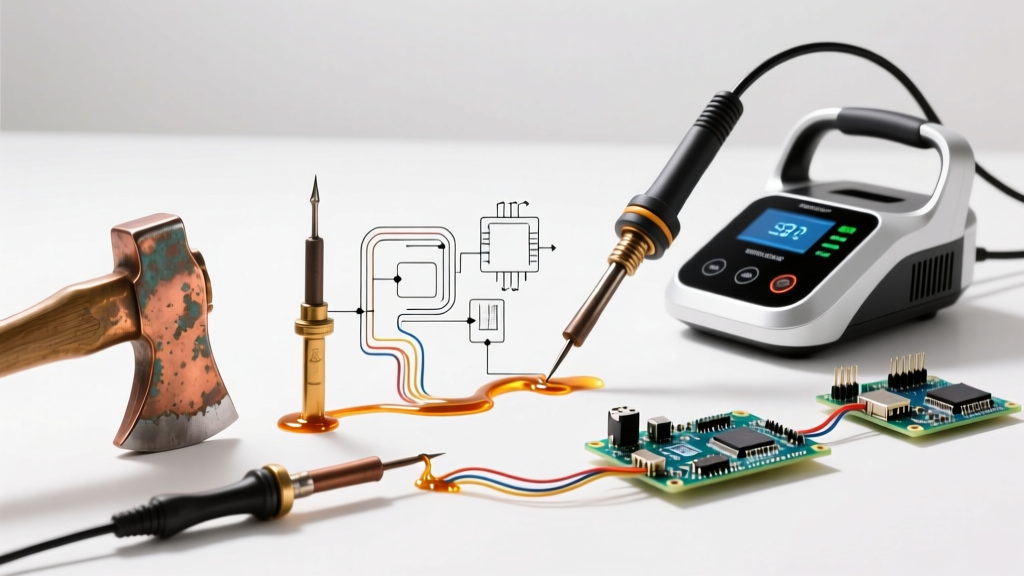
Long before the advent of electricity, tinsmiths and early electronics pioneers relied on the copper hatchet or 'copper bolt.' According to Wikipedia's historical archive on soldering irons, these tools were essentially large masses of copper forged into a wedge or hatchet shape, attached to an iron or wooden handle.
Copper was chosen for its exceptional thermal conductivity (approximately 400 W/m·K). However, these tools required constant reheating in charcoal forges. The primary challenge was temperature control. Artisans had to rely on visual and olfactory cues—specifically, observing the exact moment rosin flux began to smoke and flow—to gauge if the copper was at the optimal 250°C to 300°C range. If the copper overheated, it would rapidly oxidize, causing the solder to ball up and refuse to wet the joint, a failure mode known as 'burning the tip.'
The Mica-Wound Electric Era (1900s–1950s)
The early 20th century introduced the electric soldering iron, utilizing nichrome resistive wire wound around a fragile mica insulator. Brands like American Beauty popularized heavy-duty electric irons for stained glass and automotive wiring. While revolutionary, mica-wound heaters suffered from severe limitations:
- Extreme Thermal Lag: It often took 3 to 5 minutes for a 100W mica iron to reach soldering temperatures.
- Mechanical Fragility: Dropping the iron or applying excessive lateral pressure would shatter the mica core, snapping the heating element.
- Thermal Runaway: These early tools lacked thermostatic feedback. If left in a holder, the tip temperature would climb endlessly, destroying the iron plating and oxidizing the copper core within hours.
The Thermostatic Revolution: Weller and Ceramic Standards (1950s–2000s)
The modern era of precision electronics assembly began in the 1950s when Carl Weller invented the first temperature-controlled soldering iron. By utilizing a magnetic sensor and a bimetallic strip, Weller's designs could maintain a relatively stable tip temperature, preventing thermal runaway and extending tip life exponentially.
The Hakko 936 and the Ceramic Benchmark
By the 1990s, the Hakko 936 became the undisputed gold standard for electronics manufacturing and hobbyists alike. Priced around $80, it utilized a 60W ceramic heating element. However, the design inherently suffered from the 'air gap bottleneck.' The ceramic heater was a separate rod that slid into a hollow metal tip. This microscopic air gap between the heater and the tip acted as a thermal insulator. While the 936 could easily handle through-hole components, modern tools soldering large multilayer PCB ground planes struggled, as the thermal recovery time was too slow to prevent cold solder joints.
The RoHS Turning Point (2006): When the industry shifted to lead-free solder (SAC305), melting points jumped from 183°C (Sn63/Pb37) to 217°C–227°C. Required tip temperatures surged to 350°C+. Legacy ceramic irons like the Hakko 936 and Weller WES51 simply could not recover heat fast enough on heavy ground planes, leading to the development of advanced cartridge systems.
The Cartridge Paradigm: JBC and Integrated Heating (2000s–Present)
The most significant leap in professional soldering technology was the popularization of the integrated cartridge tip, pioneered by companies like JBC. In a cartridge system, the heating element, temperature sensor, and soldering tip are a single, unified unit.
According to JBC Tools' official technology documentation, this eliminates the air gap entirely. The result is staggering: a JBC C245 cartridge can heat from room temperature to 350°C in under 2 seconds. Furthermore, the station's microprocessor monitors the thermal draw in real-time, dumping up to 130W of instantaneous power into the tip the millisecond it touches a cold ground plane. While the initial investment for a JBC CD-2BQF station is high (typically $450 to $550 in 2026), and replacement tips cost between $45 and $60 each, the reduction in SMD rework and pad-lifting makes it the mandatory choice for professional BGA and 0402 component work.
Metcal and High-Frequency RF Induction
Parallel to JBC's cartridge evolution, Metcal introduced RF (Radio Frequency) induction heating. Instead of resistive wire, Metcal tips contain a ferromagnetic core heated by an alternating magnetic field. The temperature control is governed by the Curie point of the metal alloy; once the tip reaches its engineered Curie temperature, it loses its magnetic permeability, automatically stopping the heating process without the need for digital sensors. While incredibly reliable, the high cost of RF generators and proprietary tips has largely confined Metcal to high-volume manufacturing floors rather than the DIY or repair bench.
The Smart Era: USB-C PD and Open-Source Irons (2016–Present)
The latest revolution in the history of tools soldering is the democratization of high-performance thermal profiles via USB-C Power Delivery (PD) and Gallium Nitride (GaN) charging bricks. The TS100, and subsequently the Pine64 Pinecil V2, disrupted the market by packing a RISC-V microcontroller and PID (Proportional-Integral-Derivative) thermal algorithms into a $26 stick powered by a standard laptop charger.
Modern tools soldering surface mount components in the field no longer require bulky transformers. A 65W or 100W GaN charger paired with a Pinecil V2 running the open-source IronOS firmware provides heat-up times of roughly 6 to 8 seconds, rivaling $200 traditional ceramic stations. The ability to flash custom firmware, set precise voltage limits, and create custom thermal boost profiles via a smartphone app represents the current pinnacle of accessible soldering technology.
Comparative Matrix: Soldering Tool Evolution
| Era / Technology | Heating Method | Avg. Heat-Up Time | Thermal Recovery | Landmark Model | 2026 Market Status |
|---|---|---|---|---|---|
| Pre-1900s Forge | Charcoal / External | 10+ Minutes | Poor (Rapid Drop) | Copper Hatchet | Obsolete / Historical |
| Mica-Wound | Nichrome on Mica | 3 to 5 Minutes | Very Poor | American Beauty 100W | Niche (Stained Glass) |
| Ceramic Element | Resistive Ceramic Rod | 40 to 60 Seconds | Moderate (Air Gap Lag) | Hakko 936 / FX-888D | Budget / Hobbyist Standard |
| RF Induction | High-Frequency Magnetic | 5 to 8 Seconds | Excellent (Curie Limit) | Metcal MX-5200 | Industrial Manufacturing |
| Integrated Cartridge | Resistive Inside Tip | 1.5 to 2 Seconds | Superior (Instantaneous) | JBC CD-2BQF (C245) | Professional Repair / SMD |
| USB-C PD Smart | DC Resistive + PID | 6 to 9 Seconds | Very Good (Firmware Tuned) | Pinecil V2 / Sequre S60 | Field Repair / Maker Standard |
How Historical Context Informs Your 2026 Buying Decision
Understanding the limitations of past technologies prevents costly purchasing mistakes today. Here is a practical decision framework based on the evolution of soldering tech:
- Avoid Mica and Unregulated Irons: Never buy a $15 'plug-in' iron with a dial for electronics. The lack of a PID controller or thermostatic feedback will destroy sensitive ICs and lift PCB pads due to unregulated thermal spikes.
- Ceramic Stations for Through-Hole Only: If you primarily solder large through-hole components, wire harnesses, or basic Arduino kits, a $100 ceramic station (like the Hakko FX-888D) remains perfectly adequate. The air gap thermal lag is negligible when soldering low-mass leads.
- Cartridge Systems for Mixed/SMD Work: If your work involves 4-layer PCBs, heavy ground planes, or micro-SMD (0603/0402), you must invest in a cartridge system. The $400+ entry price of a JBC or Hakko FX-951 equivalent is offset by the elimination of thermal damage and the ability to swap tips in 3 seconds without waiting for cooldown.
- USB-C PD for Portability and Budget: If you are a hobbyist, drone repair technician, or field engineer, a $30 USB-C PD iron paired with a $40 100W Anker or UGREEN GaN charger offers 90% of the performance of a mid-tier benchtop station at a fraction of the cost and footprint.
FAQ: Historical Soldering Tool Trivia
Why did old soldering irons have wooden handles?
Before the invention of high-temperature thermoplastics like Bakelite and modern silicone grips, wood was the most accessible, heat-resistant insulator available to protect the user's hand from the radiant heat of the copper mass and the internal mica heater.
Who invented the first electric soldering iron?
While early resistive heating concepts were experimented with in the late 1800s, the American Beauty brand and subsequent Weller patents in the mid-20th century refined the electric iron into a reliable, commercially viable tool for the booming radio and television manufacturing industries.