
The Great Debate: Cordless Soldering Sticks vs. Benchtop Electric Irons
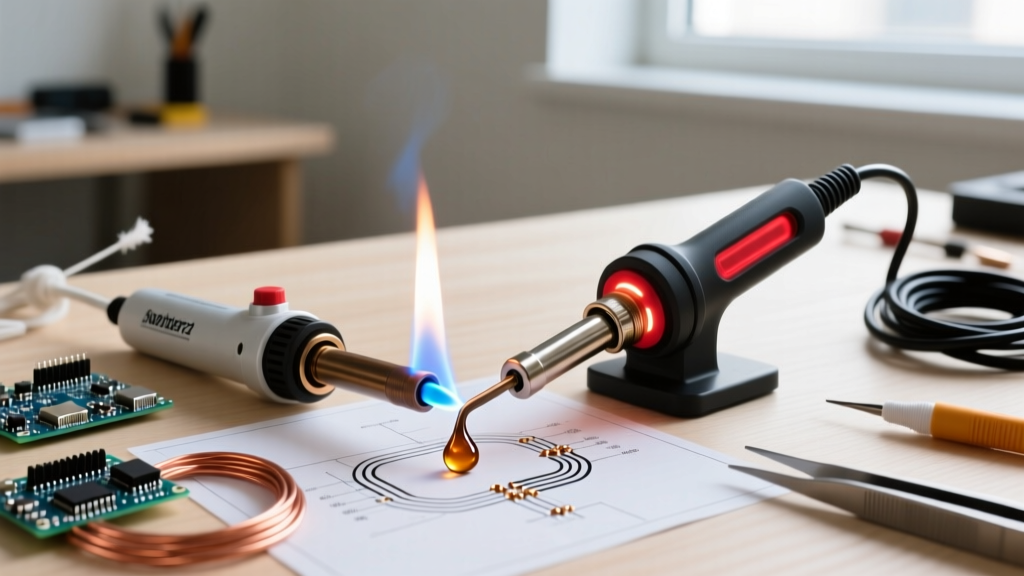
When building or repairing electronic assemblies, the heat source you choose dictates the quality of your metallurgical bonds. In 2026, the market is heavily divided between traditional temperature-controlled electric soldering stations and modern, cordless butane soldering sticks. While electric irons have long been the undisputed kings of the workbench, butane-powered soldering sticks have evolved from novelty torches into precision instruments capable of rivaling electric setups in specific scenarios.
But which method actually yields better results? To answer this, we must move beyond basic wattage claims and examine thermal recovery rates, catalytic degradation, and real-world failure modes. Whether you are reworking a 0402 SMD capacitor or splicing 10 AWG automotive wire, understanding the physics behind these tools is critical for meeting IPC J-STD-001 standards for soldered electrical assemblies.
The Core Mechanics: Catalytic Flame vs. Resistive Heating
To compare these methods fairly, we must first understand how they generate and transfer heat to the solder joint.
How Butane Soldering Sticks Work
High-end soldering sticks (like the Weller Portasol P2KC or Blazer Stingray) do not use an open flame to heat the tip. Instead, butane gas passes through a platinum or rhodium-coated catalytic mesh inside the tip assembly. The gas oxidizes on the mesh without a visible flame, generating intense, localized infrared and conductive heat. This allows the tip to reach 450°C (842°F) in roughly 30 to 45 seconds. Because there is no electrical resistance wire, the heat output is entirely dependent on gas flow and the chemical efficiency of the catalyst.
How Electric Soldering Irons Work
Modern electric stations (such as the Hakko FX-888D or the USB-C powered Pinecil V2) utilize a ceramic heating element wrapped around or inserted into the tip. A thermocouple embedded in the tip feeds real-time temperature data back to a PID (Proportional-Integral-Derivative) controller. When the tip touches a cold copper pad, the sensor detects the micro-drop in temperature and instantly pulses maximum wattage to the heater to recover the thermal baseline.
Head-to-Head Comparison Matrix (2026 Market Data)
The following table contrasts a premium butane soldering stick, a budget smart-iron, and a traditional benchtop station across critical performance metrics.
| Metric | Weller Portasol P2KC (Butane Stick) | Pinecil V2 (PD Smart Iron) | Hakko FX-888D (Benchtop Station) |
|---|---|---|---|
| Power Source | Butane Gas (Catalytic) | USB-C PD (65W+) | 120V/240V AC Mains |
| Max Tip Temp | ~450°C (842°F) | ~450°C (842°F) | ~480°C (896°F) |
| Thermal Recovery | Moderate (Manual gas adjustment) | Excellent (Closed-loop PID) | Excellent (Closed-loop PID) |
| Ground Plane Handling | Poor to Fair | Fair to Good | Excellent |
| Runtime | ~90 mins (Full tank) | Infinite (Tethered to power bank) | Infinite (Mains power) |
| Avg. Price (2026) | $55.00 - $65.00 | $28.00 - $35.00 | $105.00 - $120.00 |
| Replacement Tip Cost | ~$14.00 each | ~$4.50 each | ~$8.50 each |
When to Choose a Butane Soldering Stick
Butane soldering sticks are not replacements for benchtop stations; they are specialized field tools. You should invest in a high-quality soldering stick if your workflow aligns with the following scenarios:
- Automotive and Marine Wiring: Splicing 8 AWG to 4 AWG wires in tight engine bays or bilges where dragging an extension cord is a safety hazard. The cordless nature of the stick, combined with its ability to switch to an open-flame heat gun mode for shrinking thick-wall adhesive heat shrink, makes it unbeatable in the field.
- HVAC and Remote Telecom Repair: When working on remote cell towers or outdoor HVAC control boards where mains power is unavailable, a butane stick provides reliable 400°C heat without relying on battery-draining USB-C power banks in freezing temperatures (butane struggles in extreme cold, but premium sticks mitigate this better than lithium batteries).
- Emergency Prototyping: For quick, heavy-duty through-hole repairs where precision SMD work is not required, the rapid deployment of a stick is highly efficient.
When to Choose an Electric Soldering Station
If your primary focus is printed circuit board (PCB) fabrication, rework, or micro-soldering, electric irons are the mandatory choice. The NASA Workmanship Standard 8739.3 heavily emphasizes the need for controlled thermal profiles to prevent delamination of PCB substrates and thermal shock to sensitive silicon dies.
- SMD and BGA Rework: Soldering 0402 components or drag-soldering QFP-144 microcontrollers requires exact temperature stability. A butane stick's temperature can fluctuate by up to 40°C depending on gas pressure and ambient draft, risking cold joints or lifted pads.
- Multi-Layer PCBs with Heavy Ground Planes: When a solder joint connects to an internal ground plane, the copper acts as a massive heat sink. According to Hakko's technical guidelines on thermal recovery, a butane stick lacks the instantaneous wattage surge required to overcome this thermal mass. An electric station with a 70W+ heater will instantly detect the temperature drop and flood the joint with heat, ensuring a proper intermetallic bond without lingering and burning the flux.
Hidden Costs and Critical Failure Modes
Buyers often look at the initial purchase price, ignoring the long-term maintenance and failure modes inherent to each method.
The Butane Catalyst Poisoning Problem
The most common reason a premium $60 butane soldering stick suddenly fails to melt 60/40 rosin-core solder is catalyst poisoning. Cheap hardware-store butane contains impurities like isobutane, propane, and trace sulfur. When these burn on the platinum mesh, they leave a carbon-sulfur residue that blocks oxygen flow. The tip will still get hot (maybe 200°C), but it will no longer reach the 350°C required for lead-free SAC305 solder.
Expert Maintenance Protocol: To prevent catalyst poisoning, exclusively use 11x or highly refined butane (such as Colibri or Zippo Premium). Furthermore, you must 'purge' the tank before every refill. Turn the stick upside down and depress the fill valve with a small flathead screwdriver until the hissing stops. This vents trapped air and pressure, allowing a clean, dense liquid butane fill.
Electric Iron Tip Oxidation and Sheath Failure
Electric irons suffer from different failure modes. Leaving a Hakko or Pinecil at 400°C while not in use causes rapid oxidation of the iron-plated tip sleeve. Once the iron core is exposed, the solder will no longer wet to the tip. Additionally, cheap electric clones often suffer from ceramic heater sheath cracking due to aggressive thermal cycling, rendering the $15 handpiece useless.
Step-by-Step: Achieving a Perfect Joint with a Soldering Stick
Because butane sticks lack digital PID feedback, the operator must manually manage the thermal profile. Follow this sequence for heavy-gauge wire splicing:
- Pre-Heat the Gas: If working in an environment below 15°C (59°F), keep the butane stick in your inner jacket pocket for 10 minutes prior to use. Cold liquid butane will not vaporize efficiently, leading to flame-outs.
- Ignite and Wait: Turn the gas dial to 75% and ignite. Allow the catalytic mesh to fully engage for 45 seconds. The tip should glow a very faint, dull red in a shadowed area.
- Pre-Tin Both Surfaces: Apply flux and lightly tin the two wires separately. Do not attempt to bridge raw copper with a butane stick; the thermal recovery is too slow, and the flux will burn off before the copper reaches flow temperature.
- The Bridge: Bring the two tinned wires together. Apply the stick to the joint for 2-3 seconds. The existing solder will reflow and merge instantly. Remove the heat immediately to prevent melting the wire insulation.
The Final Verdict: Building a Complete 2026 Toolkit
The 'soldering stick vs. electric iron' debate is not about finding a single winner, but about assigning the right tool to the right environment. For the dedicated electronics hobbyist, a smart electric iron like the Pinecil V2 ($30) or a benchtop Hakko FX-888D ($110) is non-negotiable for PCB work, offering the precise thermal recovery required for modern surface-mount components.
However, every serious DIYer, automotive technician, and field engineer should keep a butane soldering stick in their mobile kit. The ability to deliver 450°C of cordless heat, switch to a localized blowtorch for seized bolts, and shrink heavy-wall tubing makes the $55 investment in a Weller Portasol an indispensable complement to your benchtop station. Master both methods, and you will be equipped to handle any metallurgical challenge the field or the lab throws at you.