
The Unseen Hero of the Workbench: A Brief History
When building a modern electronics lab, enthusiasts and professionals alike obsess over heating elements, microprocessor temperature control, and tip geometry. Yet, the humble stand for soldering is frequently treated as an afterthought. This is a critical mistake. The evolution of the soldering iron holder is deeply intertwined with the history of metallurgy, occupational health, and surface-mount technology (SMT). From dangerous asbestos-laden coils to intelligent telemetry hubs, understanding this evolution is essential for selecting the right equipment for your 2026 workbench.
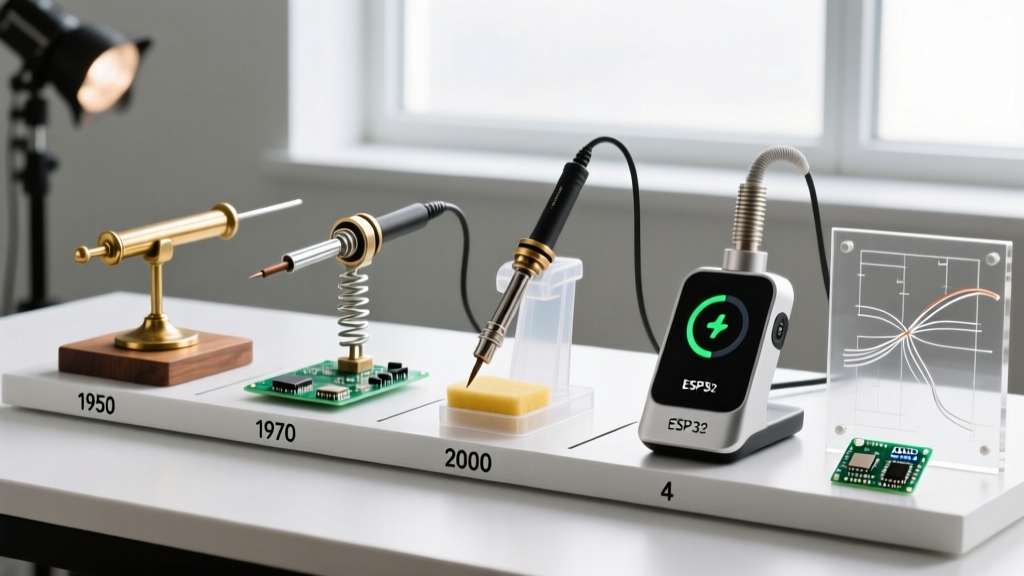
The Early Days: Stamped Steel and Hazardous Sponges (1950s–1970s)
In the mid-20th century, through-hole components dominated the industry. Irons like the legendary Weller WP35 were robust, heavy, and ran at fixed temperatures. The accompanying stand for soldering was typically a simple, stamped steel cone or a bent wire coil attached to a heavy cast-iron base.
The Asbestos and Cellulose Problem
Early stands featured a tray for a wet cellulose sponge. However, to prevent the sponge from catching fire when a 700°F (370°C) iron was carelessly dropped into the tray, manufacturers often treated these sponges with asbestos or other fire-retardant chemicals. Furthermore, the heavy thermal mass of early irons meant that wiping a hot tip on a room-temperature wet sponge caused a violent temperature drop.
Historical Edge Case: In the 1960s, it was common practice to use household sponges in soldering stands. The rapid cooling caused micro-fractures in the iron plating of the tips, leading to rapid corrosion and 'hollowing' of the copper core long before the industry understood the mechanics of thermal shock.
The Polyimide and Brass Sponge Revolution (1980s–2000s)
As the industry shifted toward early surface-mount devices (SMDs) and temperature-sensitive ICs, fixed-temperature irons were replaced by closed-loop stations like the iconic Hakko 936. This era brought a massive paradigm shift in how engineers cleaned and stored their tools.
Solving the Thermal Shock Dilemma
Metallurgists discovered that dropping a 350°C tip onto a wet cellulose sponge instantly drops the tip temperature by 80°C to 120°C. This thermal shock degrades the iron plating, leading to pitting and poor solder wetting. The solution was the introduction of the brass wire sponge.
- The Hakko 599B Tip Cleaner: Priced around $12 today, this coiled brass wire pad sits inside the stand's tray. It scrapes away oxidized flux residue without dropping the tip temperature, preserving the delicate iron plating.
- High-Temperature Silicone Bases: Stands transitioned from painted steel to high-temp silicone and thermoset plastics that wouldn't melt or off-gas when touched by a stray iron barrel.
The Fume Extraction Mandate (2010s–Present)
The most significant evolution of the stand for soldering occurred when occupational health organizations began strictly regulating rosin-based flux fumes. According to OSHA guidelines on lead and hazardous fumes, prolonged exposure to colophony (rosin) fumes can cause occupational asthma and severe respiratory sensitization.
Integrating Airflow into the Iron Rest
Standalone benchtop fume extractors were often placed too far away to capture the smoke plume effectively. Manufacturers responded by integrating extraction funnels directly into the soldering stand.
The Weller WDH10T Safety Rest (approximately $85) became an industry standard. It features a built-in funnel that connects via a 60mm hose to a Zero Smog extraction unit. By placing the capture hood exactly two inches from the resting iron, these stands achieve the 100–150 feet-per-minute (fpm) capture velocity required to pull away harmful particulates before they reach the operator's breathing zone. This design directly supports compliance with IPC standards for electronic assemblies, which mandate strict environmental and safety controls in professional manufacturing.
2026 Workbench Standards: Smart Stands and Telemetry
Today, the premium stand for soldering is no longer just a physical holder; it is an active electronic component of the soldering system. Brands like JBC Tools and Pace Worldwide have introduced 'smart' stands that communicate directly with the heating station via the tool's umbilical cord.
Hall Effect Sensors and Auto-Sleep
Modern intelligent stands, such as the JBC STD stand (priced around $145), utilize Hall effect sensors or mechanical micro-switches to detect when the handpiece is holstered.
- Instant Sleep Mode: The moment the iron is placed in the stand, the station drops the tip temperature to 180°C. This is below the melting point of most Sn63/Pb37 and SAC305 lead-free solders, effectively halting oxidation.
- Instant Wake: Lifting the iron triggers a massive power dump (often 130W+) to recover to 350°C in under two seconds.
- Auto-Off: If the iron remains in the stand for 30 minutes, the system cuts power entirely to prevent fire hazards and tip burnout.
Buyer's Matrix: Choosing the Right Stand Today
Whether you are a hobbyist repairing vintage audio gear or a technician reworking BGA chips, selecting the correct stand for soldering is vital. Use the matrix below to match your workflow requirements.
| Stand Type | Example Model | Avg. Price | Key Feature | Best Application |
|---|---|---|---|---|
| Basic Wire Coil | Generic OEM Wire Rest | $5 - $15 | Heavy cast base, simple coil | Occasional hobbyist, wire tinning |
| Brass Sponge Rest | Hakko 602 / 599B Combo | $20 - $35 | Thermal-shock-free brass wool | SMT soldering, precision PCB work |
| Active Fume Extractor | Weller WDH10T | $80 - $110 | Integrated 60mm extraction hood | Production lines, heavy flux use |
| Smart Telemetry Hub | JBC STD / Pace 1011 | $130 - $160 | Auto-sleep, tool detection | High-end rework, expensive tip preservation |
Critical Maintenance and Edge Cases
Even the most advanced stand for soldering will fail to protect your equipment if proper maintenance protocols are ignored. Here are expert-level maintenance rules for modern workbenches:
1. The 'Tinning Before Holstering' Rule
Never place an iron into its stand with a bare, clean tip. Always apply a thick blob of 63/37 rosin-core solder to the tip before holstering. This sacrificial layer oxidizes in the stand, protecting the actual iron plating underneath. When you pick the iron back up, simply wipe the sacrificial solder on your brass sponge and apply fresh solder.
2. Brass Sponge Hygiene
Unlike cellulose sponges, brass wool should never be washed with water. Water trapped in the dense brass coils will cause instant, catastrophic steam explosions and thermal shock the next time a hot iron is inserted. Instead, periodically remove the brass coil, tap it upside down over a trash bin to dislodge oxidized flux dust, and use a stiff nylon brush to clean the wires.
3. Filter Saturation in Extraction Stands
If you use a fume-extracting stand, remember that activated carbon filters do not last forever. While HEPA filters capture visible particulate matter, the carbon layer absorbs volatile organic compounds (VOCs) from no-clean and water-soluble fluxes. In a heavy-use environment, these filters saturate in 40 to 60 hours. Once saturated, the stand simply blows unfiltered air back into the room. Track your usage hours meticulously.
Final Thoughts on Workbench Safety
The journey of the stand for soldering from a hazardous wire loop to a microprocessor-controlled safety hub reflects the broader maturation of the electronics industry. Upgrading your iron rest is one of the most cost-effective ways to extend tip life, improve joint quality, and protect your long-term respiratory health. For further reading on occupational safety regarding soldering environments, consult the CDC NIOSH resources on lead and chemical exposure to ensure your lab meets modern safety benchmarks.