
The Pre-Electric Era: Blowpipes, Forges, and Copper Hatchets
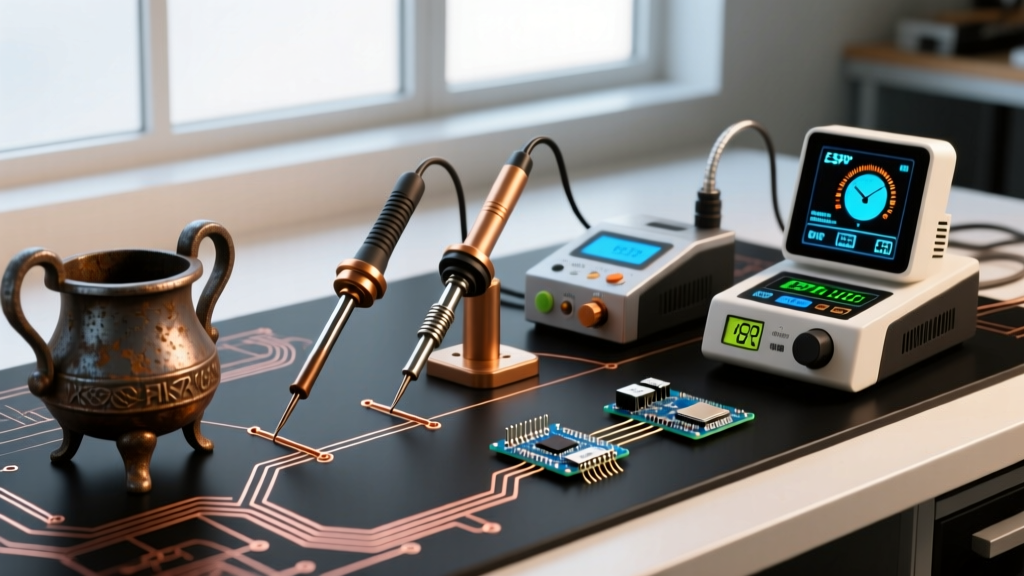
The act of joining metals with a lower-melting-point filler has been around since the dawn of metallurgy in ancient Mesopotamia, roughly 5,000 years ago. However, the modern soldering iron (frequently mistyped in early search engine queries as soldering irion) is a relatively recent marvel of thermal dynamics. Before the advent of electricity, artisans relied on charcoal forges and blowpipes to heat heavy copper 'hatchets' or bits. These primitive tools possessed massive thermal mass, allowing them to hold heat for large joints, but they offered zero temperature control. Once the copper bit dropped below the melting point of the tin-lead alloy (around 183°C for eutectic 63/37), the tool had to be returned to the fire, severely bottlenecking production.
The Electric Dawn: Resistance Heating and the Gun
The true evolution of the soldering iron began in the late 19th and early 20th centuries with the application of electrical resistance heating. The American Electrical Heater Company pioneered early electric irons, but the real paradigm shift occurred in 1941. Carl Weller, frustrated by the slow heat-up times of standard pencil irons used in radio repair, invented the soldering gun. By utilizing a step-down transformer, Weller's design delivered high current at low voltage directly to a heavy copper loop, achieving soldering temperatures in seconds. You can explore more about this pivotal moment on the Weller Tools History archive.
The Magnastat Breakthrough: Physics Over Electronics
While soldering guns dominated heavy-duty electrical work, delicate electronics required a steady, controlled temperature. In the 1950s, Weller introduced the Magnastat system. Instead of using fragile electronic sensors, the Magnastat relied on the Curie point principle. A magnetic core within the tip would lose its magnetism at a precise, factory-set temperature (e.g., 700°F / 371°C), breaking a mechanical switch. As the tip cooled, magnetism returned, re-engaging the heater. This elegant, purely physical feedback loop defined professional bench work for decades.
The Micro-Soldering Revolution: Ceramic Heaters vs. Cartridge Systems
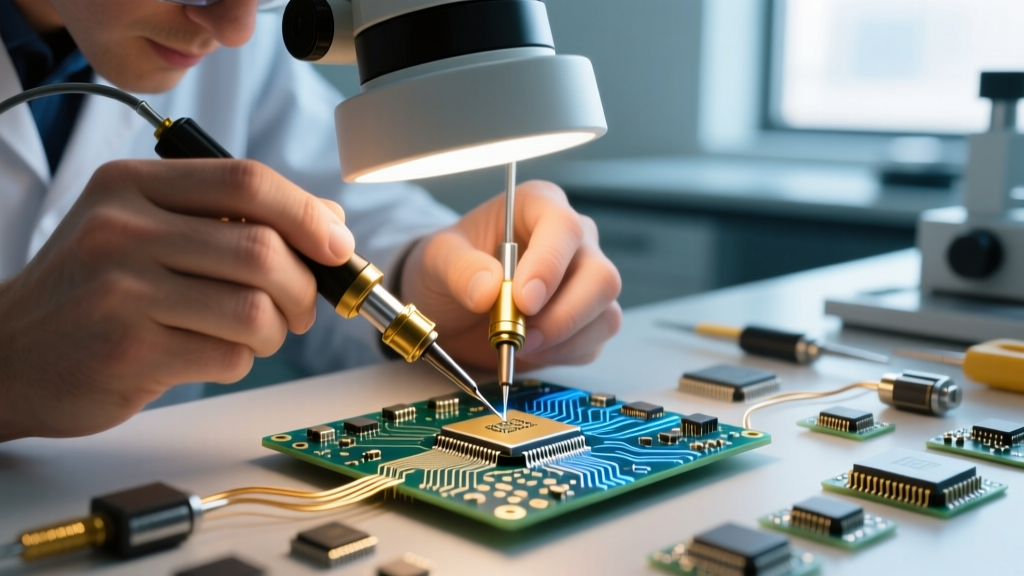
As surface-mount technology (SMT) shrank component sizes in the 1990s and 2000s, thermal recovery became more critical than raw wattage. Drag-soldering dense QFP (Quad Flat Package) chips required an iron that could replenish heat instantly without overshooting and damaging silicon dies.
The Air-Gap Problem: Hakko T18 and Traditional Ceramic
The legendary Hakko FX-888D (retailing around $110) uses the T18 tip series. In this design, a ceramic heating element and thermocouple reside in the wand, and the hollow copper tip slides over it. While cost-effective, this creates an unavoidable microscopic air gap between the heater and the tip. Under heavy thermal loads—such as soldering a 10 AWG wire to a large ground plane—the tip temperature plummets, and the ceramic sensor takes several seconds to detect the drop and compensate.
The Zero-Gap Solution: JBC Cartridge Technology
Spanish manufacturer JBC solved the air-gap problem by integrating the heater, sensor, and tip into a single, disposable cartridge (e.g., the C245 series). Because the thermocouple is located millimeters from the very edge of the tip, the JBC Exclusive System detects heat loss instantaneously. A high-end station like the JBC CD-2B ($550) can drive a 130W cartridge that recovers from a massive thermal drop in under 1 second, completely eliminating cold joints on multi-layer PCBs.
| Era | Defining Technology | Tip Style | Thermal Recovery Time | Modern Equivalent Cost |
|---|---|---|---|---|
| Pre-1900s | Charcoal Forge / Blowpipe | Solid Copper Hatchet | Minutes (Re-heating required) | N/A (Obsolete) |
| 1940s-1960s | Step-Down Transformer (Gun) | Loop / Heavy Copper | 2 - 5 Seconds | $40 - $150 |
| 1970s-1990s | Curie-Point Magnetic / Early PTC | Screw-on Solid Copper | 10 - 15 Seconds | $80 - $120 |
| 2000s-2010s | Ceramic Wand Heater (PID Control) | Hollow Sleeve (e.g., Hakko T18) | 5 - 8 Seconds | $100 - $250 |
| 2020s-2026 | Integrated Cartridge / USB-C PD | All-in-One Cartridge (e.g., JBC C245) | < 1 Second | $26 (USB-C) - $600 (Station) |
The 2026 Landscape: USB-C PD and AI-Assisted Thermal Profiling
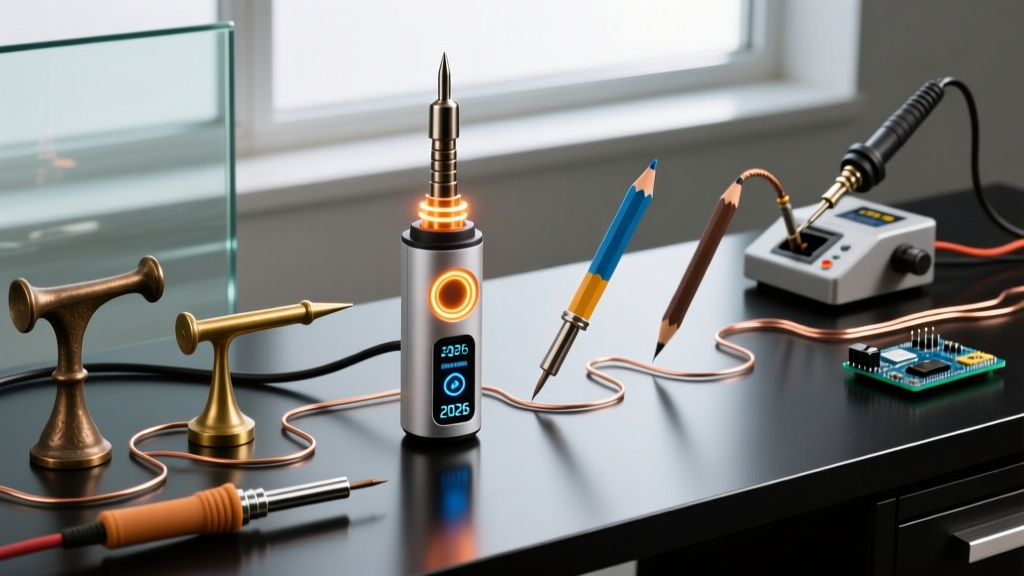
As we navigate 2026, the soldering iron market has bifurcated into ultra-portable smart irons and AI-driven bench stations. The proliferation of USB-C Power Delivery (PD 3.1) has allowed tools like the Pinecil V2 and TS101 to draw up to 100W from a standard laptop charger. Powered by RISC-V microcontrollers and open-source firmware like IronOS, these $30 irons offer PID tuning, Bluetooth app connectivity, and custom thermal profiles that rival $200 bench stations from a decade ago.
On the industrial side, compliance with IPC standards for lead-free assemblies (like SAC305, which melts at 217°C and requires process temperatures of 350°C-380°C) demands rigorous thermal logging. Modern 2026 flagship stations now feature AI-assisted thermal profiling, automatically adjusting power delivery based on the specific heat capacity of the connected joint, ensuring zero thermal shock to sensitive BGAs.
Expert Insight: 'Wattage does not equal temperature. Wattage is the rate of energy transfer. When soldering large ground planes, a 65W USB-C iron with a high-thermal-mass tip will often outperform a poorly calibrated 40W iron with a micro-pencil tip, simply because it can deliver the necessary joules into the copper pour before the flux burns off.'
Buyer's Guide: Matching the Era's Tech to Your Workbench
Choosing the right tool in 2026 requires matching the technology to your specific failure modes and edge cases:
- For Micro-SMD (0402 to 0805 components): You need low thermal mass and high precision. A JBC T245 station with a C115-112 bent conical tip is unmatched. Keep the station at 320°C to prevent pad delamination.
- For General Through-Hole & Wire Splicing: The Hakko FX-888D remains the undisputed workhorse. Use a T18-D24 chisel tip at 350°C for 60/40 leaded solder, or bump it to 380°C for lead-free.
- For Field Technicians & Drone Repair: The Pinecil V2 ($26) paired with a 65W GaN charger and a 65W DC barrel adapter is the ultimate mobile kit. Flash it with IronOS for rapid boot times and sleep-mode motion sensing.
- For Heavy-Duty Automotive (10 AWG+): Skip the pencil irons. Use a modern Weller soldering gun or a high-capacity JBC DD-2E station with a C470 cartridge capable of delivering 200W of instantaneous thermal recovery.
Frequently Asked Questions (FAQ)
Why do I sometimes see the term 'soldering irion' in older forums or parts catalogs?
This is simply a widespread typographical error that became embedded in early internet search algorithms and poorly translated drop-shipping catalogs. If you are searching for replacement tips or historical patents, always use the correct spelling: soldering iron.
Do I need to calibrate my soldering iron?
Modern cartridge systems (like JBC and high-end Metcal) do not require manual user calibration; the thermal offset is factory-tuned within the cartridge's internal chip. However, older ceramic wand stations (like the Hakko 936) feature a small potentiometer under the handle that requires periodic calibration using a tip thermometer to ensure the dial matches the actual tip temperature.
How often should I replace my soldering iron tip?
With proper care—using leaded solder when possible, avoiding abrasive brass sponges, and never leaving the iron at 400°C while idle—a quality T18 or C245 tip should last 6 to 12 months of daily use. If the iron plating pits or the solder refuses to wet the surface (de-wetting), the tip is oxidized through the plating and must be replaced immediately to prevent thermal transfer failure.