
The Origins: Lead Cames and the Forge
The art of joining colored glass with metal is nearly as old as the craft of glassmaking itself. When examining the history and evolution of soldering for stained glass, we must look back to the 12th century. In his seminal manuscript De diversis artibus, the monk Theophilus Presbyter documented the earliest methods of stained glass assembly. Artisans used lead cames—H-shaped strips of extruded or cast lead—to hold individual pieces of glass together. The joints where the cames intersected were soldered using a heavy, forge-heated copper block known as a 'soldering copper.' Because temperature control was non-existent, the artisan relied entirely on the thermal mass of the copper block and the visual cues of the melting tin-lead alloy to avoid melting the lead came itself.
The Tiffany Revolution: Copper Foil and the Soldering Copper
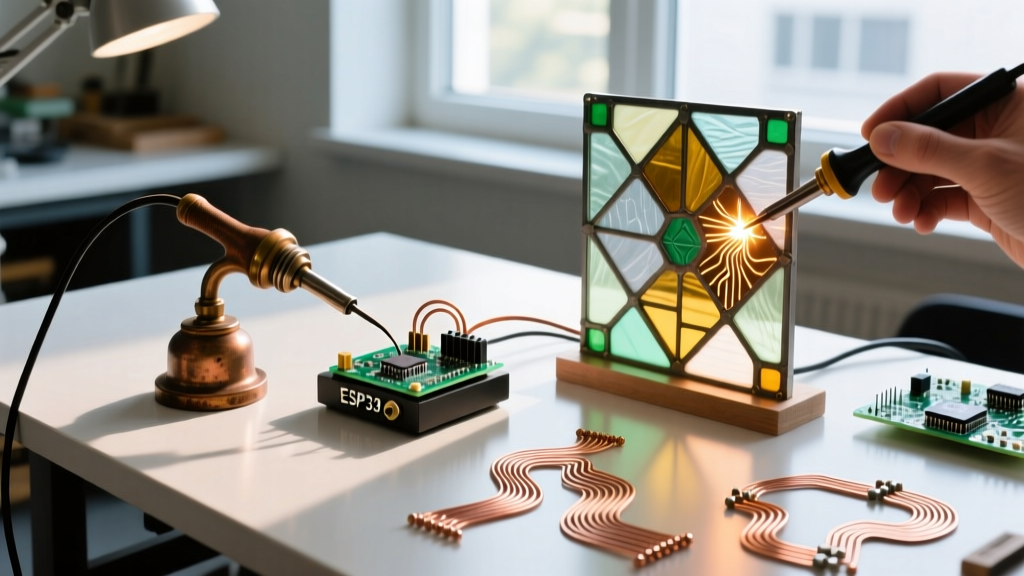
The most significant paradigm shift in stained glass construction occurred in the late 19th century, spearheaded by Louis Comfort Tiffany and his contemporaries at the Corning Museum of Glass and various New York studios. Tiffany introduced the copper foil method, wrapping the edges of individual glass pieces in thin, adhesive-backed copper tape. This allowed for intricate, curved, and three-dimensional designs that rigid lead cames could never achieve.
However, copper foil demanded a radical change in soldering technique. Instead of simply tacking lead intersections, artisans now had to lay down a continuous, smooth, domed bead of solder over the copper tape—now famously known as the 'Tiffany bead.' The traditional forge-heated soldering coppers were adapted with specialized pointed and grooved tips to drag the solder along the foil, but maintaining the precise heat required to prevent burning the adhesive or melting through the thin copper remained a persistent challenge.
'The transition from lead came to copper foil didn't just change the aesthetic of stained glass; it fundamentally altered the metallurgical and thermal requirements of the soldering process, demanding continuous heat application rather than intermittent tacking.'
The Electric Era: Rheostats and the Battle for Thermal Mass
The mid-20th century brought electrification to the stained glass studio, replacing forge-heated coppers with electric soldering irons. Early electric irons were rudimentary, often consisting of a simple nichrome heating element wrapped around a massive copper core. They offered raw wattage (typically 150W to 200W) but zero temperature regulation. Artisans would plug the iron into a standard light dimmer switch (a rheostat) to manually throttle the voltage and approximate temperature control.
This era highlighted a critical physics concept that still dictates tool selection today: thermal mass versus thermal recovery. Glass is an immense heat sink. When a soldering tip touches a copper-foiled glass seam, the glass rapidly absorbs the heat. In electronics soldering, a low-mass ceramic heater can recover instantly. In stained glass, a low-mass tip will stall, resulting in 'cold joints'—dull, grainy, and structurally weak seams.
Modern Workhorses: Weller 100PG vs. Hakko FX-601
Even in 2026, the debate between thermal mass and active temperature control defines the stained glass tool market. Here is how the two dominant paradigms compare:
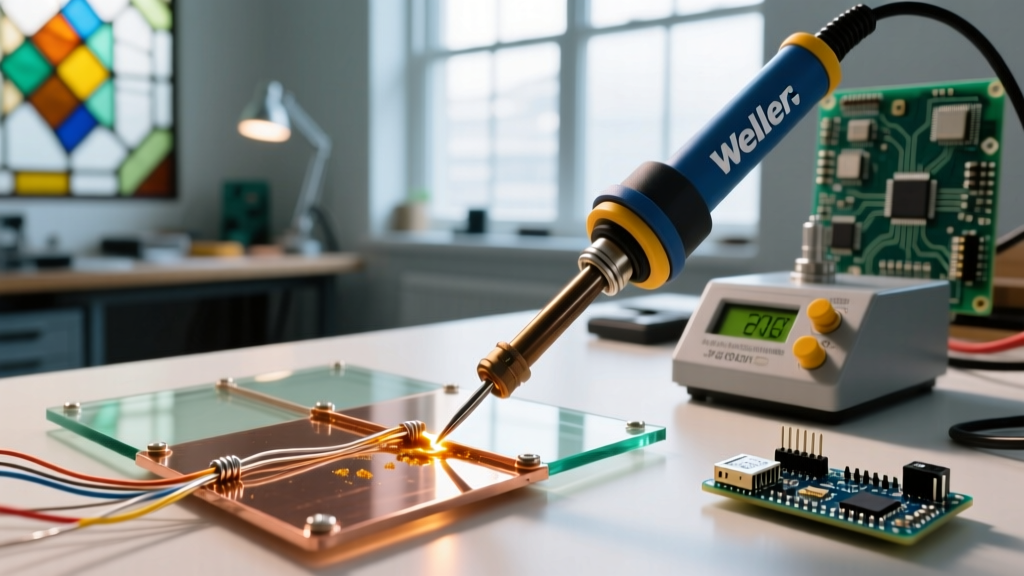
- Weller 100PG (Approx. $55 - $65): This heavy-duty 100W iron is a direct descendant of the classic soldering copper. It utilizes a massive CT5F7 (1/4-inch chisel) copper tip. While it lacks a digital PID temperature controller, its sheer thermal mass allows it to push through thick glass seams and multiple layers of foil without stalling. It is the undisputed king of the traditional Tiffany bead.
- Hakko FX-601 (Approx. $85 - $95): Originally designed for heavy electronics and automotive wiring, this 67W iron features an advanced ceramic heating element and a digital dial for precise temperature control (up to 460°F). While its thermal recovery is lightning-fast, its standard tips lack the physical mass of the Weller. Stained glass artists using the FX-601 often have to upgrade to custom high-mass tips or slow down their drag speed to prevent the heater from maxing out on large panels.
Metallurgical Evolution: From 60/40 Lead to Lead-Free Alloys
The solder alloy itself has undergone a quiet evolution. For over a century, 60/40 (60% Tin, 40% Lead) has been the absolute standard for stained glass. Unlike the 63/37 eutectic alloy used in PCB manufacturing—which transitions instantly from liquid to solid—60/40 has a slight 'plastic' or pasty range. This pasty state is highly desirable for stained glass, as it allows the artisan to manipulate and smooth the bead before it fully crystallizes.
However, environmental regulations and studio safety concerns have driven the development of lead-free alternatives. According to safety guidelines outlined by the Occupational Safety and Health Administration (OSHA), lead exposure in poorly ventilated studios is a severe health risk, prompting many educational institutions and commercial studios to mandate lead-free solders.
| Alloy Composition | Melting Point | Flow Characteristics | Cost per lb (2026) | Best Use Case |
|---|---|---|---|---|
| 60/40 (Sn/Pb) | 370°F (188°C) | Excellent; slight plastic range for doming | $35 - $42 | Traditional Tiffany beads, hobbyist studios |
| 50/50 (Sn/Pb) | 413°F (212°C) | Good; slightly stiffer, flatter bead | $32 - $38 | Lead came joints, structural tacking |
| SAC305 (Lead-Free) | 430°F (221°C) | Sluggish; requires high heat and aggressive flux | $55 - $68 | Mandated lead-free studios, outdoor pieces |
| 63/37 Eutectic | 361°F (183°C) | Instant freeze; poor for doming | $40 - $48 | Not recommended for stained glass |
Flux Chemistry: From Tallow to Water-Soluble Organics
Solder will not adhere to oxidized copper or lead without a chemical reducing agent. Historically, artisans used tallow (rendered animal fat) or simple rosin pastes. These early fluxes left behind corrosive, sticky residues that had to be painstakingly scrubbed with whiting (calcium carbonate) and ammonia.
Today, the Stained Glass Association of America and modern guilds heavily promote advanced water-soluble organic fluxes. Products like Novacan Super Sal Ammoniac or Gryphon Zip Flux utilize mild organic acids (often oleic or stearic acid bases) that activate precisely at soldering temperatures. They provide the necessary surface tension reduction to allow the solder to 'wet' the copper foil, yet they can be cleaned post-soldering with nothing more than warm water and a soft brush, eliminating the need for toxic solvents.
Health, Safety, and the Modern Studio
The evolution of soldering for stained glass is not just about better beads; it is about safer studios. The realization that vaporized flux fumes (colophony) are potent respiratory sensitizers, combined with the risks of lead dust, has revolutionized studio setups. In 2026, a professional stained glass soldering station is incomplete without an active HEPA and carbon-filtration fume extractor positioned within 12 inches of the workpiece. Furthermore, the industry has seen a shift toward silicone-finger guards and ergonomic, heat-resistant Kevlar sleeves to prevent the repetitive strain and minor burns that plagued previous generations of glassworkers.
2026 Buyer's Framework: What to Purchase Today
If you are entering the craft or upgrading your studio this year, your purchasing decisions should be guided by your specific artistic goals:
- For the Traditionalist (Domed Beads & Copper Foil): Invest in the Weller 100PG with a CT5F7 tip, paired with a heavy-duty rheostat (like the Studio Pro 100W controller, ~$45) to dial back the heat during delicate border work. Buy 60/40 solder and a premium oleic-acid flux.
- For the Mixed-Media Artist (Zinc Came, Jewelry, & Foil): The Hakko FX-601 is superior. Its ability to drop to 350°F for delicate zinc came soldering and ramp up to 420°F for heavy foil seams makes it the most versatile tool on the market. Pair it with a custom 3/16-inch chisel tip to increase thermal mass.
- For the Institutional/Educational Studio: You must prioritize lead-free compliance. Purchase SAC305 or Tin-Silver alloys, but be prepared to upgrade your irons to 120W+ models (like the Weller W100PG) to compensate for the higher melting points and poorer wetting characteristics of lead-free metals.
Understanding the historical evolution of these tools and materials transforms soldering from a mere mechanical step into a deeply informed artistic practice. By respecting the metallurgy and thermodynamics that artisans have wrestled with for centuries, today's glassworker can achieve flawless, enduring seams.