
The Shifting Landscape of the Workbench
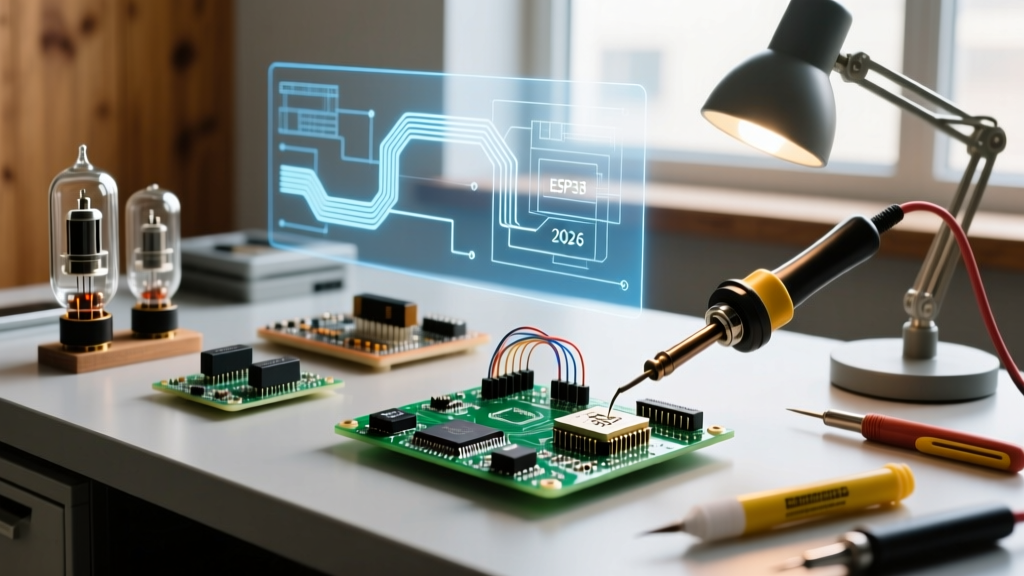
In 1955, a typical weekend DIY soldering project involved a 5-pound steel chassis, a handful of glass vacuum tubes, and a massive 100-watt Weller soldering iron. Fast forward to 2026, and the modern maker is assembling 2-gram ESP32-C6 IoT nodes using a 65W USB-C PD smart iron and 0402-sized surface mount components. The evolution of DIY soldering projects is not just a story of shrinking electronics; it is a fundamental shift in metallurgy, thermal dynamics, and tool engineering.
Understanding this history is critical for modern hobbyists. Whether you are restoring a vintage 1970s audio amplifier or designing a custom RISC-V development board, the tools and techniques required are vastly different. This guide explores the four distinct eras of DIY electronics assembly and provides a 2026 buyer’s framework to equip your bench for the full spectrum of historical and modern projects.
Era 1: Point-to-Point & The Rosin Revolution (1920s–1950s)
Before the printed circuit board (PCB) became a household staple, early DIY soldering projects relied on point-to-point wiring. Builders used turret boards, tag strips, and the physical leads of bulky resistors and capacitors to create structural and electrical connections.
The Flux Transition
In the early 1920s, hobbyists often mistakenly used acid-core plumbing solder for electrical work. The corrosive zinc chloride flux rapidly oxidized copper wires, leading to catastrophic high-resistance failures over time. The introduction of rosin-core (RMA - Rosin Mildly Activated) solder by companies like Kester in the 1930s revolutionized electronics. Rosin is non-conductive and non-corrosive at room temperature, only activating under the heat of the iron to strip oxidation.
- Typical Irons: Ungrounded, high-thermal-mass transformers (100W–250W).
- Solder Alloy: 50/50 or 60/40 Tin/Lead (SnPb).
- Primary Failure Mode: Cold joints and mechanical stress fractures due to heavy component weight and lack of board support.
Era 2: The Through-Hole & PCB Boom (1960s–1990s)
The mass adoption of phenolic and FR-4 fiberglass PCBs in the consumer market, driven by companies like Heathkit and RadioShack, changed DIY soldering projects forever. Components were now inserted through drilled holes and soldered to copper traces.
Temperature Control & The Eutectic Sweet Spot
As PCBs became common, hobbyists faced a new enemy: pad lift-off. Unregulated irons would overshoot 400°C, melting the adhesive bonding the copper trace to the fiberglass substrate. The invention of magnastatic temperature control (most notably the Weller WTCPN series) utilized a magnetic Curie-point sensor in the tip to maintain a strict thermal ceiling.
During this era, 60/40 SnPb became the undisputed king of DIY soldering projects. As a near-eutectic alloy, it melts and freezes at a single temperature (183°C / 361°F), eliminating the 'plastic' semi-molten phase that causes disturbed joints.
For extreme reliability in through-hole via filling, modern restorers still look to the stringent wetting and inspection criteria outlined by the NASA Electronic Parts and Packaging (NEPP) Program, specifically NASA-STD-8739.3, which remains the gold standard for high-reliability soldered connections.
Era 3: The RoHS Directive & SMD Transition (2000s–2015)
The early 2000s brought two massive disruptions to DIY soldering projects: the miniaturization of Surface Mount Devices (SMD) and global environmental legislation. The European Union’s Restriction of Hazardous Substances (RoHS) directive, enacted in 2006, banned lead in consumer electronics.
The Lead-Free Learning Curve
The industry standardized on SAC305 (96.5% Tin, 3.0% Silver, 0.5% Copper). While excellent for automated wave soldering, SAC305 was a nightmare for DIYers. Its higher melting point (217°C / 423°F) required hotter irons, which rapidly oxidized standard copper tips and increased the risk of thermal damage to sensitive silicon. Furthermore, lead-free solder exhibits poor wetting characteristics, requiring highly activated no-clean fluxes to prevent bridging on fine-pitch ICs.
Era 4: The Modern IoT & Micro-SMD Era (2016–2026)
Today’s DIY soldering projects are dominated by microcontrollers like the Raspberry Pi Pico 2 and high-density RF modules. Component sizes have shrunk from the relatively manageable 0805 (2.0mm x 1.25mm) down to 0402 (1.0mm x 0.5mm) and even 0201 (0.6mm x 0.3mm), which are practically invisible to the naked eye.
The Smart Iron Revolution
The most significant tool evolution in the last decade is the open-source smart iron. Devices utilizing rapid DC-DC buck converters and PID temperature algorithms have replaced heavy transformer-based stations. These irons can heat from room temperature to 350°C in under 8 seconds, drastically reducing the thermal dwell time on sensitive SMD pads.
Comparative Matrix: Four Generations of DIY Assembly
| Era | Dominant Tech | Standard Alloy | Typical Tooling | Avg. Component Size |
|---|---|---|---|---|
| 1920s–1950s | Point-to-Point | 50/50 SnPb (Acid/Rosin) | 150W Ungrounded Iron | Axial Leaded / Tubes |
| 1960s–1990s | Through-Hole PCB | 60/40 SnPb (Rosin) | Weller Magnastat (50W) | DIP ICs / 1/4W Resistors |
| 2000s–2015 | Early SMD / RoHS | SAC305 (Lead-Free) | Temp-Controlled Station | 1206 / 0805 / SOIC |
| 2016–2026 | High-Density IoT | Sn63/Pb37 or Sn42/Bi57.6 | USB-C PID Smart Iron | 0402 / 0201 / QFN/BGA |
2026 Buyer’s Guide: Equipping for the Full Spectrum
To tackle the vast array of DIY soldering projects available today—from repairing vintage analog synthesizers to assembling modern BGA (Ball Grid Array) sensor modules—your workbench must be versatile. Here is the definitive 2026 purchasing matrix for serious hobbyists.
1. The Smart Iron (For Precision SMD & Daily Use)
Top Pick: Pine64 Pinecil V2 (Approx. $26)
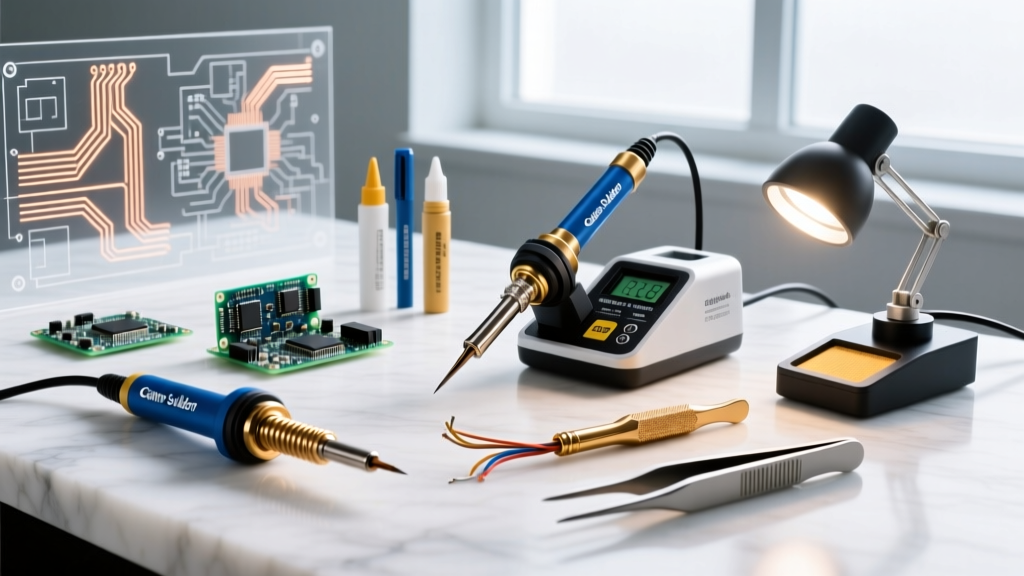
The Pinecil V2 is powered via USB-C Power Delivery (up to 20V/3A) or DC barrel jack. Its RISC-V processor runs a PID loop that samples tip temperature multiple times per second. Pro-Tip: Pair it with the TS-B2 or TS-J02 spatula tip for optimal thermal transfer to 0402 pads and ground planes.
2. The Hot Air Rework Station (For IC Removal & Reflow)
Top Pick: Quick 861DW (Approx. $250)
Hot air is non-negotiable for modern DIY soldering projects involving QFN or BGA packages. The Quick 861DW offers precise airflow control (120–1000 L/h) and programmable thermal profiles. When removing a 32-pin ESP32 module, set the station to 360°C with 40% airflow to prevent blowing adjacent 0402 capacitors off the board.
3. Metallurgy: Alloys & Pastes
While SAC305 is the commercial standard, modern DIYers have largely reverted to leaded alloys for hand-soldering due to superior wetting and lower thermal stress. For SMD stencil printing, Chip Quik SMD291AX (Approx. $35 per syringe) is the industry benchmark. It features a Type 4 solder powder suspended in a no-clean flux vehicle, specifically formulated to prevent 'tombstoning' (where surface tension pulls a component upright during reflow) on micro-components.
Low-Temperature Alternative: For heat-sensitive flex-PCBs or LED strips, utilize Sn42/Bi57.6 (Tin/Bismuth). This eutectic alloy melts at a remarkably low 138°C (280°F), virtually eliminating the risk of substrate delamination.
4. Magnification & Inspection
You cannot solder what you cannot see. Inspecting 0402 joints and checking for micro-bridges on 0.5mm pitch QFP ICs requires optical assistance.
Top Pick: AmScope SE400-Z Stereo Zoom Microscope (Approx. $180). Ensure you add a 0.5x Barlow lens to increase the working distance to roughly 160mm, giving you physical clearance to maneuver your iron and tweezers beneath the optics.
Final Thoughts on the Modern Workbench
The evolution of DIY soldering projects reflects the broader trajectory of computing: smaller, faster, and infinitely more complex. However, the fundamental physics of metallurgical wetting remain unchanged. By understanding the historical context of the components you are working with, and investing in modern, digitally controlled thermal tools, you can seamlessly bridge the gap between restoring a 1970s analog oscilloscope and prototyping a 2026 IoT wearable. For further reading on modern wetting standards and flux chemistries, consult the technical resources provided by the Association Connecting Electronics Industries (IPC).