
The Metallurgical Reality: Bridging Electronics and Precious Metals
As experts in electrical and electronics soldering, we spend our days analyzing thermal joints, capillary action, and alloy wetting on copper traces and PCBs. However, when consumers ask if they should have rings soldered together, they are stepping out of the realm of soft electrical soldering (using Sn60/Pb40 or SAC305 alloys at ~400°F) and into the high-temperature world of precious metal metallurgy. In the jewelry industry, this process is technically classified as brazing, not soldering, because the filler metal melts above 840°F (450°C).
Fusing an engagement ring and a wedding band into a single unit is a permanent structural modification. While it solves the annoyance of rings spinning independently and prevents friction wear, it introduces complex thermal risks and long-term mechanical complications. This decision framework will guide you through the metallurgical science, thermal hazards, and 2026 service costs to help you determine if fusing your bands is the right engineering choice for your jewelry.
Decision Matrix: Independent vs. Fused Band Architecture
Before committing to a thermal bond, evaluate how the physical behavior of your rings will change. The following matrix breaks down the mechanical and maintenance differences between keeping rings independent versus having them permanently joined.
| Evaluation Vector | Independent (Unsoldered) | Fused (Soldered Together) | Engineering Verdict |
|---|---|---|---|
| Friction Wear | High. Constant micro-movements grind away metal (galling) over 5-10 years. | Zero. The tangent line is fused, eliminating inter-band abrasion. | Fused wins for metal preservation. |
| Alignment | Poor. Bands spin independently, often hiding the engagement stone. | Perfect. The contour lock ensures the set always faces upright. | Fused wins for aesthetics. |
| Cleaning Access | Excellent. Ultrasonic waves and brushes reach the inner shanks. | Poor. The flush-soldered seam creates a blind pocket for sebum and debris. | Independent wins for hygiene. |
| Resizing Complexity | Low. Each band is cut, sized, and soldered individually. | High. Requires dual-cut alignment; risks structural hinging if poorly executed. | Independent wins for lifecycle flexibility. |
| Wearability | Flexible. Can wear the band alone for travel or manual labor. | Rigid. The combined set is thicker and cannot be separated. | Independent wins for versatility. |
The Science of the Joint: Hard Solder Alloys and Capillary Action
When you take your rings to a bench jeweler, they will not use the lead-free tin/silver pastes we use for electrical and PCB soldering. Instead, they use karat-matched hard solders. For example, if you are joining two 14k yellow gold bands, the jeweler must use a 14k gold solder alloyed with zinc, indium, or historically cadmium, to lower the melting point just below the melting point of the base rings.
Jewelers utilize a three-tier melting hierarchy to prevent previously soldered joints from melting during subsequent repairs:
- Hard Solder: Melts at ~1,450°F (788°C). Used for the primary structural seam when joining the two rings.
- Medium Solder: Melts at ~1,350°F (732°C). Used for secondary repairs or sizing.
- Easy Solder: Melts at ~1,250°F (677°C). Used for minor jump-ring closures or low-heat fixes.
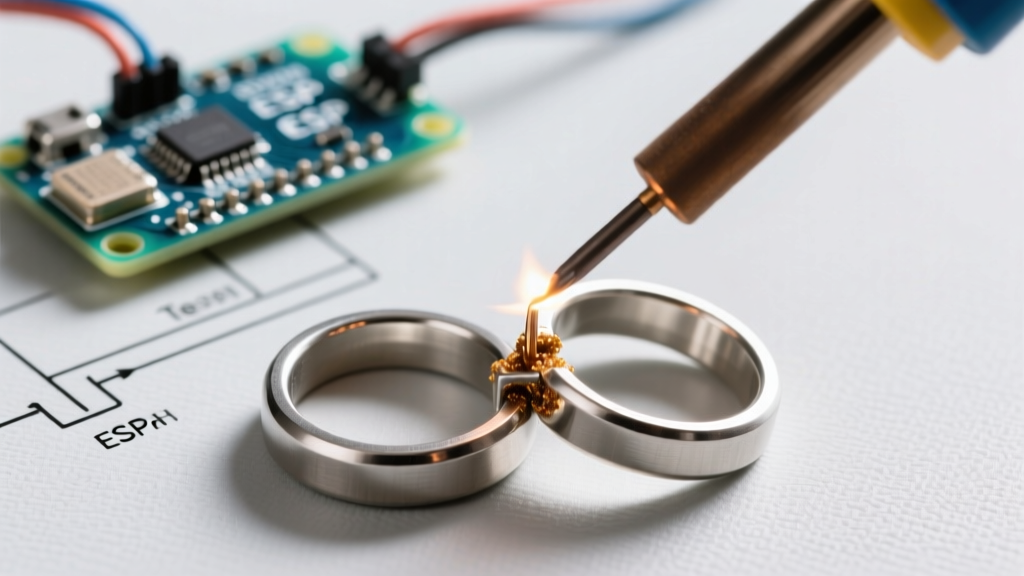
The joint relies entirely on capillary action. The jeweler must file a microscopic flat along the tangent line where the rings meet, apply a borax-based flux (like Handy Flux) to prevent oxidation, and use a micro-torch to draw the molten solder into the seam. If the gap is too wide, the solder will not wick, resulting in a brittle, porous joint that will snap under torsional stress.
Thermal Risks: Gemstone Survival and Laser Alternatives
The most critical risk when you have rings soldered together is thermal shock and gemstone combustion. According to research published by the Gemological Institute of America (GIA), different gemstones exhibit vastly different thermal tolerances.
Torch Soldering Hazards
A standard butane/oxygen micro-torch applies broad heat to the shank. While heat travels away from the stone via the metal band, the risk remains:
- Diamonds: Pure carbon. While they won't melt at soldering temperatures, they can oxidize (burn) if heated above 1,400°F in the presence of oxygen, turning cloudy white. Furthermore, internal inclusions can expand and fracture the stone during the rapid cooling (quenching) phase in the pickle pot.
- Moissanite & Treated Diamonds: Fracture-filled diamonds and moissanite will permanently cloud, scorch, or shatter under torch heat. Stones must be removed from their prongs before soldering.
- Emeralds & Opals: Highly included and water-bearing. Torch heat will cause catastrophic shattering.
The Nd:YAG Laser Welding Solution
To bypass thermal risks, modern bench jewelers use Pulse Arc or Nd:YAG laser welders (such as the Orion series). Laser welding localizes the thermal impact to a 0.5mm spot, fusing the rings together without raising the overall temperature of the band. This allows stones to remain safely in their settings. According to Jewelers Mutual insurance claims data, laser welding drastically reduces the incidence of thermal stone damage during bench repairs, though it commands a premium price.
2026 Cost Breakdown & Service Variables
Pricing for ring soldering varies heavily based on the metal's thermal conductivity, the required technique, and the complexity of the contour. Below is the current 2026 national average pricing matrix for bench jewelers in North America:
| Metal Configuration | Technique Required | Average Cost (2026) | Technical Notes |
|---|---|---|---|
| 14k / 18k Yellow Gold | Torch (Hard Solder) | $65 - $110 | Standard capillary brazing. Stones may need removal. |
| Platinum to Platinum | Laser Welding | $150 - $220 | Platinum requires 1,760°C. Torch risks melting the ring; laser is mandatory. |
| Mixed Metals (Gold + Platinum) | Specialized Brazing | $180 - $250 | High risk of galvanic corrosion and differential thermal expansion. |
| Eternity Bands (Diamonds all around) | Laser Welding | $200 - $300 | Impossible to use a heat sink; requires precision laser spot-welding. |
The Resizing Complication: A Long-Term Engineering Flaw
From a structural engineering perspective, soldering two independent rings together creates a composite beam. While this increases rigidity, it severely complicates future resizing. Human finger sizes fluctuate due to weight changes, pregnancy, and arthritis.
If you need to resize a soldered set up or down by more than a quarter-size, the jeweler must perform a dual-cut operation. They must saw through both bands, insert or remove metal, and re-solder the seams. If the jeweler fails to perfectly align the tangent lines during the re-solder, the rings will develop a 'hinge effect'—a microscopic pivot point at the seam that will eventually fatigue and snap under daily torsional loads. Furthermore, if the original solder joint was done poorly with excessive porosity, the acid bath used during the resizing cleanup can eat away at the internal joint, weakening the entire assembly.
Alternative Mechanical Fastening Frameworks
If the metallurgical risks or resizing complications give you pause, consider these non-destructive mechanical alternatives to keep your rings aligned:
- Sizing Beads (Speed Bumps): A jeweler solders two small metal beads to the inner shank of the engagement ring. This creates friction against the wedding band and your finger, preventing spinning without fusing the bands.
- Contour / Interlocking Bands: Purchase a wedding band that is custom-milled to physically interlock with the engagement ring's profile, utilizing mechanical tension rather than thermal fusion.
- Ring Guards / Spacers: Silicone or metallic O-rings placed between the bands can increase friction and lock them together temporarily for travel or heavy manual labor.
Expert Verdict: Should You Do It?
You should have rings soldered together if: your bands are made of the exact same metal and karat, your finger size has been stable for over five years, you possess a simple shank design without eternity stones, and you are frustrated by the daily friction wear and misalignment. The cost ($65-$110) is a worthy investment to prevent decades of galling and metal loss.
You should keep them independent if: your set features mixed metals (e.g., a platinum engagement ring and a 14k gold band), your bands contain heat-sensitive gemstones like emeralds or fracture-filled diamonds, or you anticipate significant lifestyle changes that might require resizing. In these edge cases, the thermal risks and structural complications of a dual-band composite joint far outweigh the aesthetic benefits of a fused set.