
The Thermodynamics of Soldering Surfaces
In precision metalwork, jewelry fabrication, and advanced electronics prototyping, a soldering block is not merely a protective mat; it is an active thermal component in your workflow. The surface you choose dictates heat sink rates, thermal reflection (albedo), and the chemical environment surrounding your joint. Selecting the wrong material can lead to cold solder joints, carbon embrittlement, or catastrophic thermal shock.
According to thermal management guidelines referenced by the American Welding Society (AWS), the substrate beneath a brazed or soldered joint can absorb up to 40% of the applied thermal energy if its specific heat capacity and thermal conductivity are mismatched to the task. This decision framework will help you navigate the material science of soldering surfaces, ensuring you select the exact block required for your specific alloy, flux, and production volume in 2026.
The 2026 Soldering Block Decision Matrix
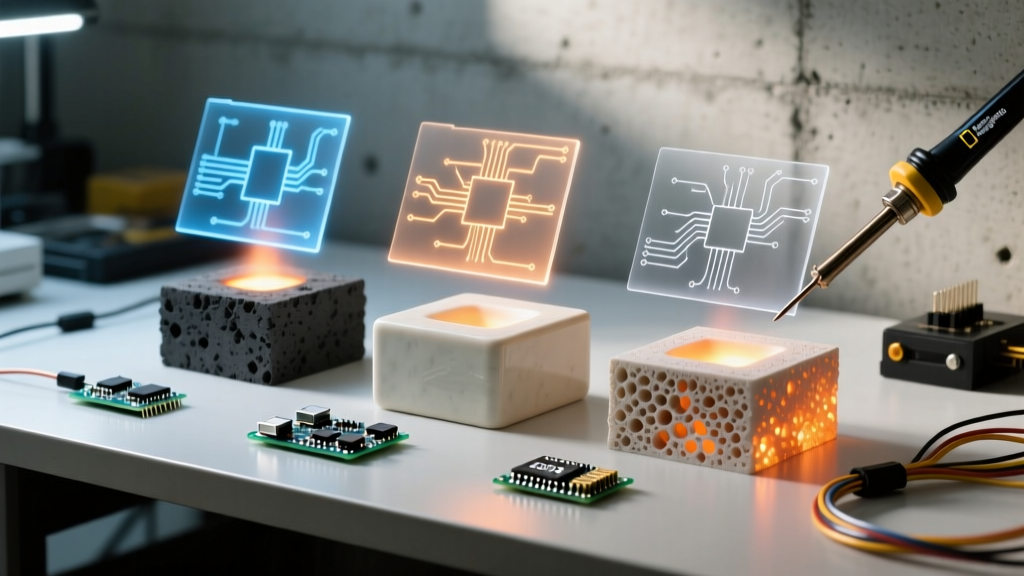
Before diving into specific use cases, review the core material properties. This matrix compares the four dominant soldering block materials used by professionals today.
| Material | Thermal Reflectivity | Max Temp Limit | Machinable? | Avg Cost (2026) | Best Application |
|---|---|---|---|---|---|
| Hardwood Charcoal | High (Reflects) | 1,200°C | Yes (Files) | $18 - $35 | Silver soldering, granulation |
| Honeycomb Ceramic | Low (Absorbs) | 1,400°C | No | $12 - $25 | Pin-holding, general brazing |
| Magnesia (MgO) | Medium | 1,500°C | Yes (Carves) | $10 - $20 | Custom jigs, bezel setting |
| Solderite (Vermiculite) | Low | 1,100°C | Yes (Very Soft) | $8 - $15 | Soft solder, quick prototyping |
Material Deep-Dives & Edge Cases
1. Hardwood Charcoal Blocks (The Heat Reflector)
Charcoal is the traditional gold standard for silversmiths and jewelers. Because carbon is a poor conductor of heat compared to metals, a charcoal block reflects radiant heat back into the workpiece rather than acting as a heat sink. This allows you to reach the flow temperature of hard silver solder (typically 700°C–780°C) much faster, reducing oxidation and scale formation on the metal.
- Pros: Excellent heat reflection; creates a localized reducing atmosphere that minimizes firescale; can be filed flat when gouged.
- Cons: Messy (leaves carbon dust); fragile if dropped; outgasses when first heated.
- Edge Case / Failure Mode: Carbon Embrittlement. Never use charcoal when soldering titanium, high-carbon steel, or nickel alloys. The carbon from the block can migrate into the heated metal lattice, causing severe brittleness and joint failure. For these metals, switch to ceramic.
- Maintenance: You must maintain a flat surface. Use a dedicated charcoal file or 80-grit sandpaper on a flat board to level the surface after heavy use. Expect to pay around $25 for a high-density, kiln-burned hardwood block from suppliers like Rio Grande.
2. Honeycomb Ceramic Boards (The Pin-Matrix)
Honeycomb ceramic blocks are engineered for complex 3D assemblies. The extruded ceramic grid allows you to insert nickel-steel T-pins to suspend workpieces in mid-air. This is critical when soldering intricate assemblies where laying the piece flat would cause gravity to pull the joint apart before the flux activates.
- Pros: Exceptional thermal shock resistance; allows 360-degree torch access; T-pins act as minimal heat sinks compared to locking tweezers.
- Cons: Absorbs heat (requires slightly more torch time); flux vitrification (glass buildup) in the pores.
- Edge Case / Failure Mode: Flux Vitrification. Borax-based fluxes (like Stay-Silv) will melt and fuse into the ceramic pores at high temperatures, creating a glass-like surface that repels future heating. To mitigate this, use a dedicated wire brush to scrub the block weekly, or designate one side of the block exclusively for high-flux operations.
3. Magnesia & Solderite Blocks (The Machinable Jigs)
Magnesia (Magnesium Oxide) and Solderite (compressed vermiculite) are soft, chalk-like blocks. Their primary advantage is machinability. If you are running a production batch of 50 identical ring shanks or wire hinges, you can carve custom grooves and recesses into these blocks using a dental bur or a simple carving tool.
- Pros: Fully customizable; holds workpieces securely without pins; extremely lightweight.
- Cons: Highly fragile (will shatter if dropped on a hard floor); degrades quickly under direct, concentrated flame.
- Pro-Tip: To extend the life of a carved Magnesia jig, spray the carved recess with a light coat of graphite spray before soldering. This prevents the molten solder from bonding to the block if it flows past the joint.
Step-by-Step Selection Flowchart
Use this rapid decision tree to select the correct soldering block for your current project:
- What metal are you joining?
- Titanium, Steel, or Nickel-Silver: Stop. Avoid Charcoal. Choose Honeycomb Ceramic to prevent carbon contamination.
- Sterling Silver, Gold, or Copper: Proceed to Step 2.
- What is the geometry of the assembly?
- Flat, 2D joints (e.g., bezel to backplate): Choose Charcoal for maximum heat reflection and speed.
- Complex 3D structures (e.g., prong settings, hinges): Choose Honeycomb Ceramic with T-pins.
- Is this a one-off repair or a production run?
- Production run (10+ identical pieces): Carve a custom jig in Magnesia.
- One-off repair: Stick to Charcoal or Ceramic.
Critical Failure Modes & Troubleshooting
Even with the right block, improper handling can ruin your workpiece. The metalsmithing community at Ganoksin frequently documents the following thermal failures:
Thermal Shock Cracking
Ceramic and Magnesia blocks are susceptible to thermal shock. If you quench a hot ceramic block in water, or place a red-hot steel quenching pan directly onto a cold Magnesia block, the rapid differential expansion will cause micro-fractures. Over time, the block will split in half. Solution: Always allow blocks to air-cool to below 100°C before introducing water or cold metals.
The "Pinging" Phenomenon
When soldering on a hard, reflective surface like charcoal, small granules of silver or gold can sometimes "ping" or pop off the workpiece due to rapid localized boiling of trapped flux moisture. Solution: Pre-heat the entire assembly gently with a soft, sweeping flame to drive off moisture from both the flux and the porous soldering block before focusing the heat on the joint.
Solder Adhesion to the Block
If your solder flows through the joint and bonds to the soldering block, you will tear the surface of the block (and potentially your workpiece) when removing it. Solution: Apply a microscopic layer of rouge or titanium dioxide powder to the block surface beneath the joint. Solder will not adhere to these oxides, allowing the piece to lift away cleanly once cooled.
Final Verdict: Building Your Arsenal
No single soldering block covers every scenario. For a professional or serious hobbyist bench in 2026, the optimal investment is a three-block system: a Hardwood Charcoal block ($25) for rapid flat soldering, a Honeycomb Ceramic board ($18) for 3D pinning and non-ferrous metals, and a Magnesia block ($12) reserved exclusively for carving custom production jigs. By matching the thermal properties of the block to the metallurgical requirements of your joint, you eliminate cold joints, reduce firescale, and drastically improve your first-pass yield rate.