
The Need for Speed: Redefining Quick Soldering in 2026
In high-volume electronics manufacturing, aerospace harness assembly, and rapid prototyping, time is the most expensive commodity. However, quick soldering is frequently misunderstood by novices as simply moving the iron faster. In reality, professional quick soldering is a discipline rooted in thermal management, advanced metallurgy, and process optimization. Rushing a joint without the right equipment guarantees cold solder joints, tombstoning, and catastrophic pad delamination.
To separate myth from methodology, we convened a panel of three industry veterans for this 2026 expert roundup. Their insights reveal how modern cartridge-tip technology and specialized flux chemistries allow technicians to complete reliable through-hole and SMD joints in under two seconds each.
Meet the Expert Panel
- Marcus Thorne, IPC-A-610 Certified Trainer: Specializes in high-reliability PCB assembly and teaches advanced soldering at a leading European technical institute.
- Sarah Jenkins, EMS Line Manager: Oversees a high-mix, high-volume surface mount technology (SMT) and hand-soldering rework floor in North America.
- David Lin, Aerospace Wire Harness Specialist: Builds custom telemetry harnesses compliant with NASA and military standards, where speed must never compromise structural integrity.
Thermal Recovery: The True Engine of Quick Soldering
According to Marcus Thorne, the biggest bottleneck to quick soldering is waiting for the iron to reheat. "If you are using a traditional ceramic heater with a separate thermocouple, there is a physical lag between the sensor and the tip," Thorne explains. "When you touch a heavy ground plane, the tip temperature plummets, and the heater struggles to catch up. This forces the technician to dwell on the pad, risking thermal damage to the FR4 substrate."
The solution adopted by professionals in 2026 is the cartridge-style integrated heater tip. In these systems, the heating element, temperature sensor, and soldering surface are a single unified piece of copper and iron plating. This reduces thermal resistance to near zero.
2026 High-Recovery Soldering Station Comparison
| Model | Wattage | Tip Technology | Recovery Time (to 350°C) | Approx. Price (2026) | Best Application |
|---|---|---|---|---|---|
| JBC CD-2BQE | 130W | C245 Cartridge | < 2 seconds | $480 - $520 | Precision SMD & 0402 components |
| Weller WX2021 | 200W | WXP120 Iron | < 3 seconds | $620 - $680 | Heavy ground planes & thick wires |
| Hakko FX-951 | 70W | T15/T18 Composite | ~ 5 seconds | $260 - $290 | General through-hole & budget EMS |
| Pine64 Pinecil V2 | 65W (PD) | T12 Compatible | ~ 8 seconds | $28 - $35 | Field repair & hobbyist quick-work |
"For true quick soldering on multi-layer boards, I mandate the JBC C245 or Weller WX series on my floor. The sub-3-second recovery means the technician applies heat, feeds solder, and removes the iron in one fluid motion. Dwelling is eliminated." — Sarah Jenkins, EMS Line Manager
Flux Chemistry: The Unsung Hero of Speed
You cannot achieve quick soldering with marginal flux. David Lin points out that in aerospace harness manufacturing, wire strands must wick solder instantly to meet NASA-STD-8739.3 requirements. "If your flux boils off before the solder flows, you are left with a dry, oxidized joint. For quick work, you need a flux with a high thermal activation threshold and excellent wetting agents."
Expert Flux Recommendations for High-Speed Work
- Amtech NC-559-V2-TF (Tacky Flux): Ideal for SMD drag soldering. Its high viscosity keeps it in place while the rapid heat of a cartridge tip activates the rosin esters, allowing the solder to flow across 20+ pins in seconds.
- Kester 245 Liquid Flux (Water-Washable): Preferred for heavy through-hole and wire tinning. The aggressive organic acids strip oxidation instantly, allowing the solder to wet the copper in under 1.5 seconds.
- Chip Quik SMD291AX (No-Clean Gel): Excellent for quick rework on QFP and SOIC packages where cleaning is not an option. The halide-free formulation prevents corrosion even when left on the board post-soldering.
Mastering the Drag Soldering Technique
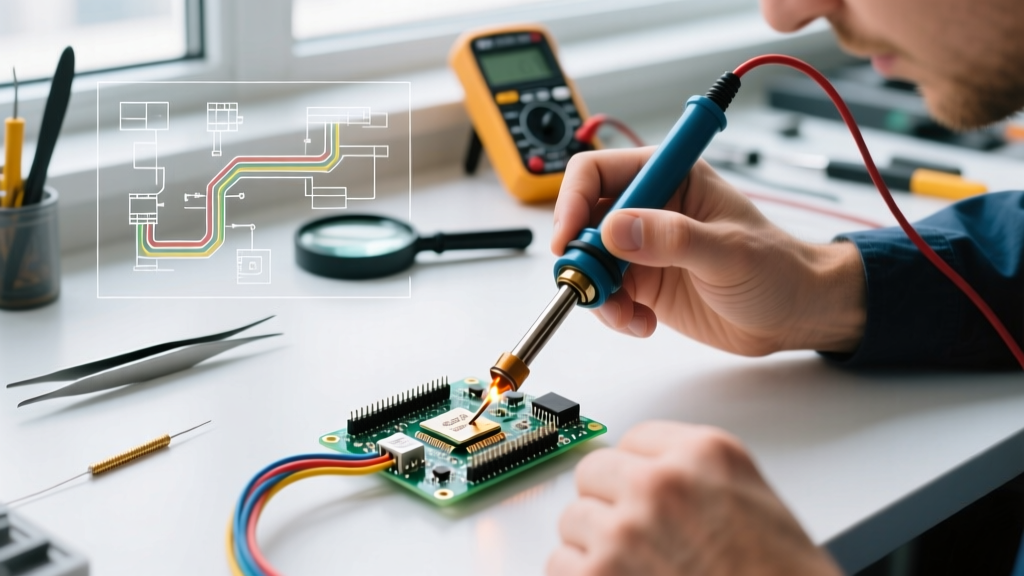
For surface mount ICs with fine pitch (0.5mm or 0.65mm), placing solder on each pin individually is a waste of time. Sarah Jenkins trains her technicians in the drag soldering method, which can solder a 44-pin TQFP chip in under 15 seconds.
Step-by-Step Drag Soldering Protocol
- Prep the Pads: Apply a microscopically thin layer of tacky flux to the PCB pads using a precision syringe.
- Align and Tack: Place the IC and use a fine conical tip (e.g., JBC C245-I) to tack two opposite corner pins, ensuring perfect alignment.
- Load the Tip: Switch to a mini-wave or hoof tip (e.g., JBC C245-K). Melt a generous bead of 63/37 SnPb or SAC305 lead-free solder directly onto the iron tip.
- The Drag: Set the station to 340°C. Tilt the board at a 15-degree angle. Touch the loaded tip to the first pin of the row and smoothly drag it across to the last pin. The flux breaks the surface tension, and the solder naturally wicks onto the pads, leaving the spaces between the pins clean.
- Wick the Excess: If a bridge forms at the final pin, press a high-quality copper desoldering braid (like Chemtronics 80-1-5) against the bridge and touch it with the iron for exactly one second.
Failure Modes: When Quick Soldering Goes Wrong
Speed without discipline leads to catastrophic failures. Marcus Thorne categorizes the most common defects seen when technicians attempt quick soldering without proper thermal recovery or flux preparation.
- Cold Solder Joints: Caused by moving the iron away before the flux has fully activated and the solder has formed an intermetallic compound (IMC). The joint looks dull and grainy. Under vibration, these joints crack and fail.
- Pad Delamination: Paradoxically, using an underpowered iron forces the technician to hold it on the pad for 5+ seconds. This prolonged, lower-temperature soak penetrates the FR4 substrate, breaking the epoxy bond and lifting the copper pad. A high-wattage iron at 360°C for 1.5 seconds is actually safer for the board than a 40W iron at 300°C for 6 seconds.
- Solder Wicking: When soldering wires to terminals, applying heat to the wire rather than the terminal causes the solder to wick up the wire strands under the insulation, creating a stiff, brittle point that will snap under mechanical stress.
Safety and Fume Management in High-Speed Environments
Quick soldering inherently requires more flux activation in a shorter period, generating dense plumes of volatile organic compounds (VOCs) and fine particulate matter. According to occupational safety guidelines outlined by OSHA and industrial hygiene standards, prolonged exposure to rosin-based solder fumes can trigger occupational asthma and respiratory sensitization.
In 2026, no professional quick-soldering station is complete without a localized HEPA and activated carbon fume extractor. Units like the Metcal BVX-200 or Weller WFE 2X feature articulated extraction arms that must be positioned exactly 2 to 3 inches from the soldering point. Relying on ambient room ventilation is no longer considered acceptable practice in any high-throughput environment.
Frequently Asked Questions (FAQ)
Can I use lead-free solder for quick soldering?
Yes, but it requires higher temperatures (typically 350°C to 380°C) and a station with exceptional thermal recovery, like the Weller WX2021. Lead-free alloys (SAC305) do not wet as quickly as 63/37 SnPb, so relying on high-quality liquid or gel flux is mandatory to maintain speed.
Is quick soldering suitable for beginners?
Beginners should focus on joint quality and proper wetting angles before attempting to optimize for speed. Quick soldering is an advanced workflow that assumes the technician already understands how to read the visual cues of melting flux and flowing solder.
How often should I change tips when soldering quickly?
High-speed soldering at elevated temperatures accelerates tip oxidation and iron leaching. With proper maintenance—using brass wool instead of wet sponges, and turning the station down to 150°C during idle periods—a premium cartridge tip should last between 40 and 60 hours of active use.
Final Verdict
Quick soldering in 2026 is not about frantic hand movements; it is the result of investing in low-thermal-resistance equipment, utilizing aggressive, high-quality fluxes, and mastering fluid techniques like drag soldering. By upgrading to a cartridge-based station and respecting the chemistry of the solder joint, technicians can drastically increase their throughput while maintaining strict adherence to IPC reliability standards.