
The Shift to Permanent Prototyping: Why Solderable Breadboards Matter
Transitioning a circuit from a temporary solderless breadboard to a permanent prototype is a critical milestone in hardware development. While custom PCB fabrication has become faster and cheaper, the solderable breadboard remains an indispensable tool for rapid iteration, legacy hardware repairs, and low-volume analog testing. To determine the best options available in 2026, we convened a panel of industry experts: Dr. Aris Thorne (Senior PCB Materials Engineer), Sarah Jenkins (Hardware Startup Founder), and Marcus Vance (IPC-Certified Avionics Technician). Together, they evaluated substrate materials, plating quality, and real-world failure modes of the market's leading prototyping boards.
The Material Science Debate: FR4 vs. Phenolic Resin
Before selecting a specific brand, Dr. Thorne emphasizes understanding the substrate material. 'The biggest mistake hobbyists and junior engineers make is buying cheap phenolic boards for high-temperature soldering,' Thorne explains. 'Phenolic resin (often sold as FR-2) degrades rapidly above 260°C, leading to catastrophic pad delamination. For any modern lead-free soldering process, FR4 (woven fiberglass with epoxy resin) is non-negotiable.'
| Property | FR4 (Glass Epoxy) | Phenolic (FR-2 / Paper) | G-10 (Glass Epoxy, Non-Flame Retardant) |
|---|---|---|---|
| Typical Cost (4x6 inch) | $8.00 - $15.00 | $3.00 - $6.00 | $7.00 - $12.00 |
| Max Operating Temp (Tg) | 130°C - 170°C | 105°C - 120°C | 130°C - 150°C |
| Drill Wear & Tear | High (Abrasive fiberglass) | Low (Soft paper composite) | High |
| Pad Adhesion Strength | Excellent | Poor (Prone to lifting) | Excellent |
| Best Use Case | SMT rework, Lead-free soldering | Quick point-to-point wiring | High-voltage isolation testing |
Expert Picks: Top Solderable Breadboards for 2026
Based on rigorous testing and field deployment, our panel selected three distinct categories of solderable breadboards that dominate the prototyping landscape this year.
1. Adafruit Perma-Proto (Best for Breadboard Layout Translation)
Expert: Sarah Jenkins, Hardware Startup Founder
Model: Adafruit PID 1609 (Full-Size)
Price: ~$7.50 USD
Substrate & Plating: FR4 with ENIG (Electroless Nickel Immersion Gold)
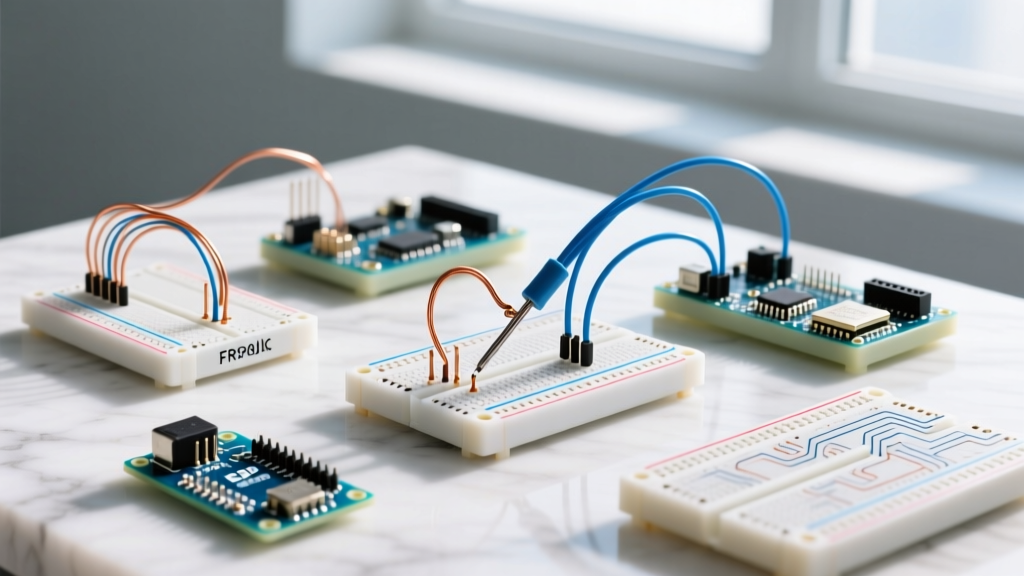
'When you have a working circuit on a standard 830-point solderless breadboard and need to make it permanent without redesigning the layout, the Adafruit Perma-Proto is the undisputed champion,' says Jenkins. The board features a 1:1 mapping of standard breadboard power rails and terminal strips. Jenkins highlights the ENIG gold plating as a massive advantage over cheaper HASL (Hot Air Solder Leveling) finishes. 'Gold doesn't oxidize. You can leave this board on your bench for six months, come back, and it will still take solder beautifully without aggressive flux.'
Expert Insight: 'The Perma-Proto includes pre-routed power rails that mimic the red and blue lines of a solderless board. It cuts my prototyping time by 40% because I don't have to run jumper wires for VCC and GND across the entire board.' — Sarah Jenkins
2. Vector Electronics 8016 (Best for Heavy-Duty Stripboard)
Expert: Marcus Vance, IPC-Certified Avionics Technician
Model: Vector Electronics 8016 (Epoxy Glass Stripboard)
Price: ~$14.50 USD
Substrate & Plating: FR4 with 1oz Copper, Pre-drilled 0.042" holes
For analog audio circuits and high-current power supplies, stripboard (Veroboard) is preferred over perfboard because it allows for continuous ground planes and power buses. Vance swears by the Vector 8016 series. 'Cheap stripboards have uneven copper thickness and drill burrs that cause micro-shorts when you try to cut the tracks,' Vance notes. 'Vector uses precision-punched holes and a consistent 1oz copper weight. When you use a spot-face cutter to break a track, the cut is clean, and the remaining copper doesn't peel.'
Vance also points out that the 8016 series complies with rigorous mechanical shock standards, making it ideal for automotive and aerospace prototyping where IPC J-STD-001 soldering requirements must be met.
3. Busboard Prototype Systems PS3216 (Best Universal Perfboard)
Expert: Panel Consensus
Model: Busboard PS3216
Price: ~$9.95 USD
Substrate & Plating: FR4, Plated Through-Hole (PTH)
If your design relies heavily on wire-wrapping or point-to-point component mounting rather than mimicking a breadboard layout, a universal perfboard with Plated Through-Holes (PTH) is required. The Busboard PS3216 features a 32x16 hole matrix with individual circular pads on both sides. The PTH plating ensures that solder flows through the barrel of the hole, creating a mechanically robust joint that survives repeated thermal cycling.
Expert Soldering Techniques and Failure Mode Prevention
Even the highest quality solderable breadboard will fail if subjected to poor thermal management. Our experts outlined the most common failure modes and how to avoid them, referencing standard through-hole soldering practices.
Failure Mode 1: Pad Delamination (The 'Phenolic Lift')
- The Cause: Applying a 350°C+ soldering iron tip to a phenolic (FR-2) board for more than 3 seconds per joint. The adhesive bonding the copper to the paper-resin core breaks down.
- The Fix: Switch to FR4 immediately. If you must use phenolic, lower your iron temperature to 300°C and use a high-activity rosin flux (RA) to reduce dwell time.
Failure Mode 2: Thermal Shock and Barrel Cracking
- The Cause: On PTH boards like the Busboard PS3216, applying extreme heat to a cold board can cause the copper barrel inside the hole to crack, severing the electrical connection between the top and bottom pads.
- The Fix: Pre-heat the board using a bottom-side preheater (set to 100°C) before applying the iron, especially when soldering large ground pins that act as heat sinks.
Failure Mode 3: Solder Bridges on Stripboard
- The Cause: When cutting tracks on a stripboard like the Vector 8016, microscopic copper swarf remains in the groove, causing intermittent short circuits under high humidity.
- The Fix: After cutting a track with a 4mm spot-face cutter, scrub the groove with a fiberglass scratch pen and inspect under a 10x loupe before applying conformal coating.
Expert Troubleshooting Matrix
| Symptom | Probable Cause | Expert Solution |
|---|---|---|
| Solder balls up and refuses to wet the pad | Oxidized HASL finish or contaminated flux | Apply fresh No-Clean or RA flux; increase iron temp by 15°C; use a brass sponge to clean the tip. |
| Pad lifts off the board during desoldering | Substrate Tg exceeded; adhesive failure | Use a vacuum desoldering pump (e.g., Hakko FR-410) to remove heat and solder simultaneously; do not pry the component. |
| Intermittent connection on PTH boards | Inner barrel crack from thermal shock | Insert a copper wire through the hole and solder on both sides to bypass the internal barrel. |
Frequently Asked Questions (FAQ)
Can I use surface mount (SMD) components on a solderable breadboard?
Yes, but it requires specific adapters. Boards like the Adafruit Perma-Proto have standard 0.1" spacing, which is too wide for most SOIC or QFP SMD chips. Experts recommend purchasing SOIC-to-DIP adapter breakout boards, soldering the SMD chip to the adapter, and then pinning the adapter into the solderable breadboard. Some specialized perfboards feature 'dog-bone' pads that accommodate both 0.1" headers and 0.05" SMD footprints, though these are harder to route manually.
What is the best solder alloy for prototyping on FR4 boards?
For hobbyist and rapid prototyping, 63/37 Tin-Lead (Sn63/Pb37) remains the gold standard due to its eutectic properties (melts and solidifies at a single temperature of 183°C), preventing cold joints caused by micro-movements during cooling. However, if your prototype is destined for commercial deployment in 2026, you must practice with lead-free alloys like SAC305 (96.5% Sn, 3.0% Ag, 0.5% Cu) to ensure your manufacturing partner's reflow profiles will translate to your hand-soldered prototype.
How do I clean flux residue off a Perma-Proto board?
If you use a No-Clean flux, you can leave it on the board, though it may feel tacky. For Rosin-based fluxes, clean the board using 99% Isopropyl Alcohol (IPA) and a stiff-bristled ESD-safe brush. Avoid using acetone, as it can degrade the silkscreen markings and potentially soften certain plastic connector housings mounted to the board.