
The Forge and the Flame: Ancient Origins of Soldering
Long before the advent of printed circuit boards and microcontrollers, the fundamental need to join metals drove the earliest innovations in metallurgy. According to historical records documented by Encyclopedia Britannica, the earliest forms of soldering date back over 5,000 years to ancient Egypt and Mesopotamia, where artisans used blowpipes to direct charcoal fire heat onto gold and copper joints. However, when discussing the direct ancestors of modern electronics assembly, we must look at the traditional copper hatchet iron.
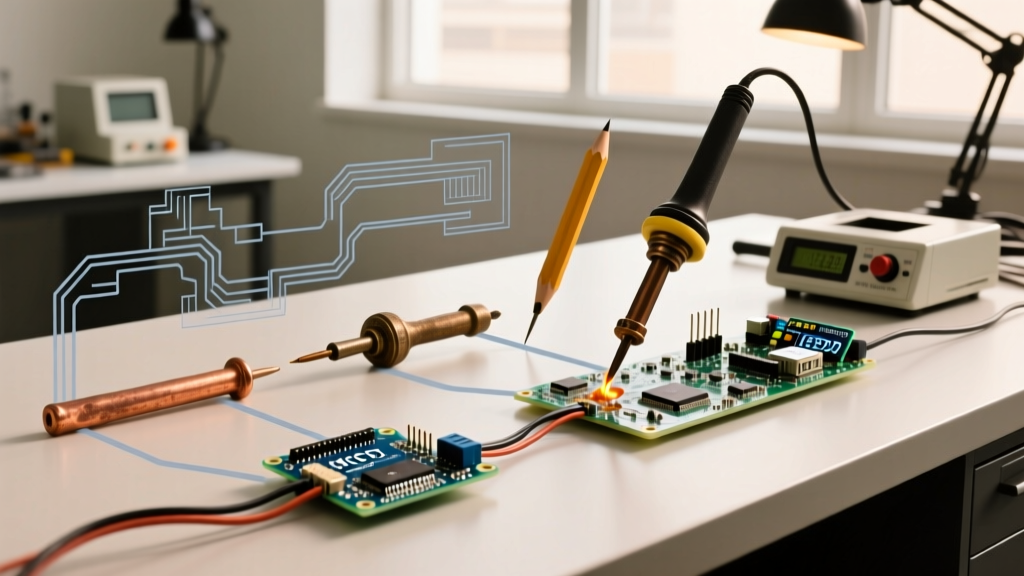
For centuries, tinsmiths and early electrical workers relied on solid copper irons heated directly in a coal or gas forge. The user had to constantly rotate between multiple irons to maintain working temperatures. The primary failure mode of these early tools was severe tip erosion. Because tin has a high solubility for copper, the molten solder would literally dissolve the copper tip at a rate of roughly 1 to 2 microns per second at 350°C. Workers had to frequently file and re-tin their irons, making the process labor-intensive and highly inconsistent.
The Electric Revolution: Birth of the Plug-In Iron (1900s-1960s)
The transition from fire-heated copper to electrically heated elements marked the first major leap in the types of soldering tools available to technicians. In the early 20th century, companies like the American Electrical Heater Company introduced the first plug-in soldering irons. These tools utilized a nichrome resistance wire wrapped around a copper core, insulated by mica.
The Thermal Runaway Problem
While revolutionary, these early electric irons lacked any form of temperature regulation. A standard 150W iron would heat up continuously until it reached a thermal equilibrium dictated by ambient air dissipation. If left in a stand, the tip could easily exceed 450°C, rapidly oxidizing the iron plating and burning the flux core of the solder wire. Conversely, when applied to a large ground plane on an early radio chassis, the thermal mass of the board would instantly drain the heat from the tip, resulting in classic 'cold solder joints' characterized by a dull, grainy finish and poor intermetallic bonding.
The Temperature-Controlled Era: Soldering Stations (1970s-1990s)
As the semiconductor industry boomed, components became increasingly sensitive to electrostatic discharge (ESD) and thermal shock. The industry required precise thermal profiles, leading to the invention of the modern soldering station. This era fundamentally redefined the types of soldering tools used in professional environments.
Meeting modern reliability requirements, such as those outlined in the IPC-A-610 standards, is impossible without precise thermal control. The intermetallic layer between copper and tin-lead requires exact time-temperature profiles to avoid brittle fractures.
The Weller Magnastat and Hakko PID Systems
In the 1970s, Weller introduced the WES51 station, which utilized a Magnastat curie-point thermostat. A magnetic rod inside the heater would lose its magnetism at a specific, engineered temperature (the Curie point), physically breaking a switch and cutting power. This provided incredibly reliable, albeit fixed, temperature control without complex electronics. By the 1980s and 1990s, brands like Hakko popularized the 936 station, which used ceramic heating elements and early PID (Proportional-Integral-Derivative) controllers. These stations allowed users to dial in exact temperatures, typically between 200°C and 480°C, drastically reducing thermal damage to early DIP and SOIC integrated circuits.
The Surface Mount Shift: Cartridge and Induction Tech (2000s-2015)
The miniaturization of electronics and the mass adoption of Surface Mount Technology (SMT) exposed the fatal flaw of traditional soldering stations: thermal lag. In older designs, the heating element, temperature sensor, and copper tip were three separate physical components. Heat had to travel through mechanical joints, creating thermal resistance.
- Integrated Cartridge Systems: Brands like JBC revolutionized the market with the C245 and C115 cartridge systems. By embedding the heater and thermocouple directly inside the consumable tip, thermal recovery times dropped from 15 seconds to under 2 seconds. A 130W JBC station could instantly deliver maximum power to a 0402 capacitor pad without overshooting the temperature of a nearby delicate BGA chip.
- RF Induction Soldering: Metcal introduced systems that bypassed traditional resistance heating entirely. Using radio-frequency induction, the tip itself acted as the heating element. The tip was coated with a specific ferromagnetic alloy; when it reached its Curie temperature, it lost its magnetic permeability, automatically halting the induction heating. This provided unmatched thermal stability for high-density aerospace PCBs.
The Modern Frontier: Smart Irons and Laser Systems (2016-2026)
As we navigate 2026, the types of soldering tools have bifurcated into hyper-accessible smart tools for hobbyists and ultra-precise optical systems for industrial micro-assembly.
The Open-Source Smart Iron Revolution
The proliferation of USB-C Power Delivery (PD) protocols and open-source hardware has democratized high-end soldering. The Pinecil V2, for example, utilizes a Bouffalo Lab RISC-V microcontroller to manage a 65W PD power delivery profile. Priced around $26, it offers PID tuning, sleep modes, and firmware updates via a simple USB connection—a feature set that would have cost over $300 in a traditional station just a decade ago. Similarly, the FNIRSI HS-01 brings 100W of PD-powered heating to the field, proving that portability no longer requires a compromise in thermal recovery.
Laser and Micro-Flame Precision
At the extreme high end of the spectrum, laser soldering systems from manufacturers like Finetech have become essential for flexible circuits, micro-BGA rework, and heat-sensitive optical sensors. These systems use closed-loop pyrometers to measure the exact surface temperature of the solder joint in real-time, modulating a diode laser beam (often 980nm wavelength) to maintain a perfect reflow profile. While these systems carry price tags upwards of $30,000 to $50,000, they represent the absolute pinnacle of non-contact thermal energy transfer in modern electronics manufacturing.
Evolution Matrix: Types of Soldering Tools Through Time
| Era | Primary Tool Type | Heating Mechanism | Temp Control | Avg Cost (2026 USD) |
|---|---|---|---|---|
| Pre-1900s | Forge-Heated Copper Iron | External Coal/Gas Fire | None (Visual/Spit test) | N/A (Historical) |
| 1920s-1960s | Plug-In Resistance Iron | Nichrome Wire Element | None (Thermal Equilibrium) | $15 - $30 |
| 1970s-1990s | Analog Soldering Station | Ceramic/Mica Element | Curie-Point / Basic PID | $80 - $150 |
| 2000s-2015 | Cartridge / Induction Station | Integrated Tip / RF Field | Advanced Digital PID | $300 - $600 |
| 2016-2026 | Smart PD Iron / Laser System | USB-C PD / Diode Laser | RISC-V Closed-Loop / Pyrometer | $26 (Iron) / $40k+ (Laser) |
How History Informs Your 2026 Buying Decision
Understanding the evolution of these tools is not just an academic exercise; it directly dictates what you should purchase today. If you are repairing modern multi-layer PCBs with heavy ground planes and microscopic 0201 components, buying a vintage-style Hakko 936 clone is a disservice to your work. The thermal lag inherent in 1990s separated-element designs will force you to dwell on pads longer, increasing the risk of pad lifting and delamination.
For the modern DIYer or field technician, a USB-C PD smart iron or an entry-level cartridge station (like the Pine64 Pinecil or a budget JBC T245 clone) offers the best intersection of price, thermal recovery, and tip longevity. Conversely, if you are setting up a professional rework lab for automotive or aerospace electronics, investing in RF induction or high-end cartridge systems is mandatory to ensure compliance with stringent IPC Class 3 reliability standards. The history of soldering is a continuous march toward faster thermal recovery and tighter temperature tolerances—ensure your workbench reflects the current state of the art.