
The True Economics of Assembly Soldering in 2026
The landscape of electronics manufacturing has shifted dramatically. As supply chains localize and prototyping cycles compress, engineering teams are forced to re-evaluate their assembly soldering strategies. The decision to bring printed circuit board assembly (PCBA) in-house versus outsourcing to a turnkey contract manufacturer (CM) is no longer just a question of volume; it is a complex financial calculation involving capital depreciation, consumable volatility, and the hidden costs of rework.
In this comprehensive cost analysis, we break down the exact financial realities of assembly soldering in 2026. From the capital expenditure of inline selective soldering systems to the per-gram cost of Type 5 solder paste, this guide provides the actionable data you need to calculate your true break-even point.
The 2026 Break-Even Rule of Thumb: For standard Class 2 commercial assemblies, in-house automated assembly soldering typically reaches cost-parity with outsourced turnkey PCBA at approximately 2,500 to 3,500 units per month, assuming a fully depreciated reflow line and optimized stencil yields.
In-House Assembly Soldering: Capital Expenditure (CapEx) Breakdown
Setting up an in-house assembly soldering line requires significant upfront capital. The equipment you choose dictates your throughput, yield, and long-term maintenance costs.
Reflow Soldering Systems
For low-volume prototyping and pilot runs, benchtop reflow ovens like the Manncorp MC-301 (priced around $6,500) offer adequate thermal profiling for boards up to 12x12 inches. However, scaling to mid-volume production requires a multi-zone inline convection oven. A workhorse like the Heller 1809 (9-zone reflow oven) commands a market price between $45,000 and $55,000. If your assembly soldering process requires nitrogen inerting to reduce BGA voiding to below 10%, you must add $12,000 to $18,000 for an on-site nitrogen generator and the associated plumbing infrastructure.
Wave and Selective Soldering for Mixed-Technology
If your designs still incorporate through-hole components (THC) alongside surface mount devices (SMD), you must factor in wave or selective soldering. Traditional wave solder machines, such as the ERSA POWERFLOW, start around $85,000. However, the modern standard for complex mixed-technology boards is selective soldering. Systems like the ERSA VERSAFLOW 335 can exceed $130,000. While expensive, selective soldering eliminates the need for costly wave-solder pallets (which cost $300-$500 each to machine from synthetic stone) and drastically reduces thermal shock to adjacent SMD components.
Operational Costs: Consumables, Stencils, and Profiling
CapEx is only the entry fee. The operational expenditure (OpEx) of assembly soldering is dominated by consumables, which are subject to commodity market fluctuations, particularly the price of tin and silver.
Solder Paste and Flux Chemistry
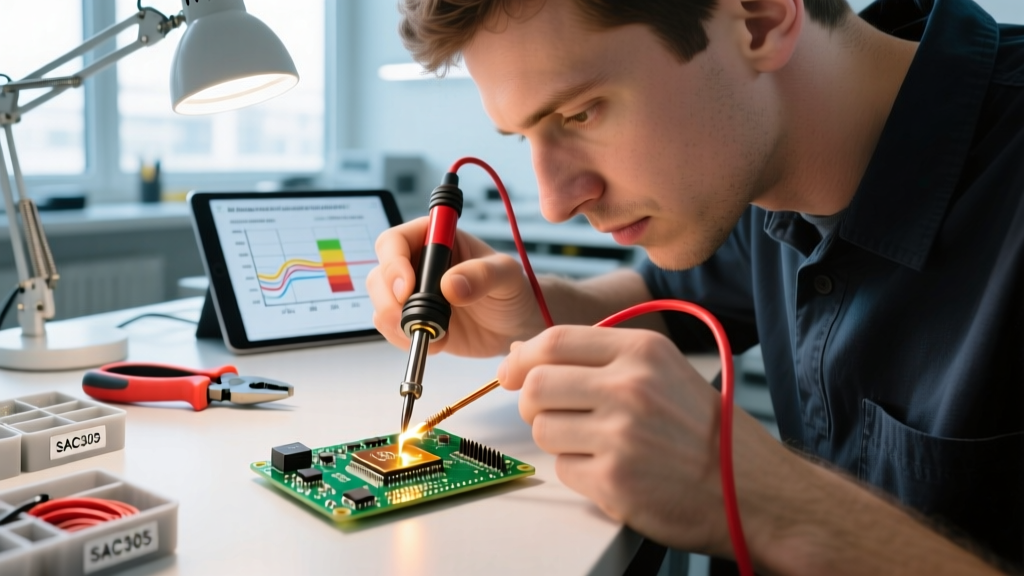
For high-reliability assemblies, SAC305 (96.5% Tin, 3.0% Silver, 0.5% Copper) remains the industry standard. In 2026, a 500g jar of premium Type 4 or Type 5 powder solder paste—such as Alpha Assembly OM338 or Indium 8.9HF—costs between $130 and $165. Type 5 powder is mandatory for ultra-fine-pitch components (0.3mm pitch BGAs and 01005 passives) to prevent solder balling and bridging. Furthermore, if your process requires post-reflow cleaning, you must budget for aqueous cleaning agents like Kyzen E5611, which costs roughly $45 per gallon.
Stencil Engineering and Aperture Reduction
The stencil is the most critical variable in assembly soldering yield. A standard laser-cut stainless steel stencil costs $120 to $180. However, to prevent solder bridging on 0201 components and micro-BGAs, engineers must specify electroformed or nano-coated stencils (e.g., Photo Stencil NanoSlic), which push the cost to $280 to $350 per stencil. Adhering to IPC-7525 stencil design guidelines for area reduction and aspect ratios is non-negotiable; a poorly designed stencil will increase your scrap rate by 15% or more, entirely erasing any margins gained by insourcing.
The Outsourcing Alternative: PCBA Turnkey Pricing
Outsourcing your assembly soldering to a turnkey CM shifts CapEx to OpEx. In 2026, CMs typically charge a non-recurring engineering (NRE) and setup fee of $150 to $350 per new part number. This covers stencil procurement, pick-and-place machine programming, and thermal profiling.
The per-board assembly cost is highly dependent on component count and package complexity. A standard board with 150 SMD pads and no BGAs might cost $8.00 to $12.00 per unit in quantities of 1,000. However, CMs apply heavy premiums for double-sided assemblies, BGA/X-ray inspection requirements, and conformal coating. Furthermore, consigned assembly (where you supply the components) often incurs a 10% to 15% handling and kitting surcharge, as the CM assumes the liability of component oxidation and moisture sensitivity level (MSL) baking.
Cost Comparison Matrix: In-House vs. Outsourced
The following table models the estimated cost per unit for a 4-layer, mixed-technology PCBA (120 SMD pads, 15 through-hole connectors, 1 BGA) across different production volumes. In-house costs assume the CapEx is amortized over a 3-year period.
| Production Volume | Outsourced Turnkey (Est. Per Unit) | In-House Assembly Soldering (Est. Per Unit) | Cost Variance |
|---|---|---|---|
| 100 Units (Prototype) | $45.00 | $112.00 | Outsourcing is 60% cheaper |
| 1,000 Units (Pilot) | $18.50 | $22.00 | Outsourcing is 16% cheaper |
| 5,000 Units (Mid-Volume) | $16.00 | $11.50 | In-House is 28% cheaper |
| 20,000 Units (Mass) | $14.50 | $8.20 | In-House is 43% cheaper |
The Hidden Margin Killer: Rework and Scrap Rates
Financial models often ignore the cost of failure. According to data published by the Surface Mount Technology Association (SMTA), the average first-pass yield for a well-calibrated SMT line is 96% to 98%. This means 2 to 4 out of every 100 boards will require rework.
The True Cost of BGA Rework
Touching up a misaligned 0603 resistor costs pennies in labor. Reworking a 0.8mm pitch BGA is a financial hazard. Proper BGA rework requires a specialized optical alignment rework station, such as the Finetech FINEPLACER or ERSA HR 550, which costs between $25,000 and $40,000. If a board fails IPC-A-610 Class 3 acceptance criteria due to BGA pad cratering or head-in-pillow (HiP) defects, and the board contains a $150 FPGA or a custom ASIC, the entire board becomes scrap. In-house assembly soldering requires you to absorb 100% of this scrap cost, whereas turnkey CMs typically absorb scrap rates up to 3% within their base pricing.
Decision Framework: When to Bring Assembly Soldering In-House
Do not default to in-house assembly soldering simply to 'save money.' Insourcing is a strategic move that should only be executed when specific criteria are met:
- Intellectual Property (IP) Protection: If your PCBA contains proprietary RF layouts or unpatented hardware security modules, the cost of in-house assembly soldering is justified as an IP protection measure.
- High-Mix, Low-Volume Iteration: If your engineering team spins board revisions weekly, the 2-to-3-week lead times of outsourced CMs will bottleneck your R&D. In-house prototyping lines pay for themselves in accelerated time-to-market.
- Vertical Integration: If you are manufacturing electro-mechanical assemblies where the PCBA must be immediately potted, conformally coated, and tested in a single continuous workflow, breaking the chain to ship to a CM introduces unacceptable logistics costs.
- Stable, High-Volume Run Rates: If you have a flagship product moving >5,000 units a month with fewer than two ECOs (Engineering Change Orders) per year, the amortized cost of an inline Heller reflow oven and ERSA selective solder machine will yield massive margin improvements.
Final Verdict
Assembly soldering in 2026 is a high-stakes operational decision. Outsourcing remains the undisputed champion for prototyping, low-volume runs, and highly complex boards requiring advanced X-ray and 3D SPI (Solder Paste Inspection) infrastructure. However, for companies with stable, mid-to-high volume production runs and strict IP requirements, investing in automated in-house assembly soldering equipment provides a definitive, compounding return on investment that outsourcing simply cannot match.