
Diagnostic Troubleshooting Matrix for DIY Extractors
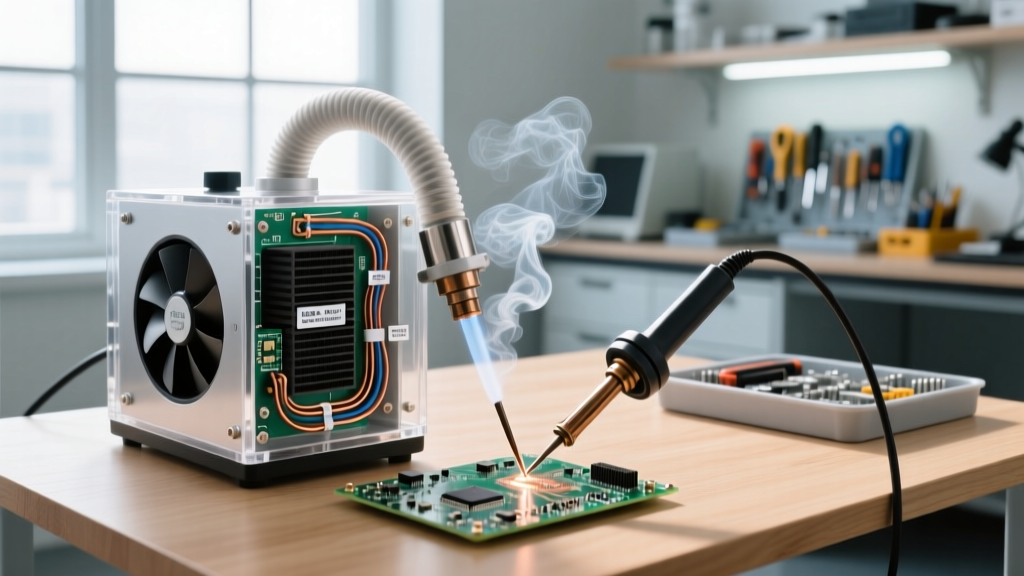
Building a DIY soldering fume extractor is a highly rewarding project that protects your respiratory health from hazardous colophony (rosin) and volatile organic compounds (VOCs). However, hobbyist builds frequently fail to achieve adequate capture velocity due to a misunderstanding of fluid dynamics and static pressure. According to the NIOSH guidelines on soldering fumes, inadequate ventilation can lead to occupational asthma and severe respiratory sensitization over time.
Before tearing down your build, use this diagnostic matrix to identify the root cause of your extraction failures.
| Symptom | Probable Root Cause | Expert Fix & Hardware Recommendation |
|---|---|---|
| Weak suction at the nozzle; smoke escapes laterally. | Using a high-CFM, low-static-pressure axial fan (standard PC case fan) against a dense carbon bed. | Replace with a centrifugal blower (e.g., Dayton 1TDR7) or a high-static axial fan like the Delta FFB1212EHE (120mm, 8.0 mmH2O static pressure). |
| Airflow is strong, but sweet/chemical odors persist in the room. | Activated carbon saturation, incorrect carbon mesh size, or air bypassing the filter media. | Switch to 4x8 mesh coconut-shell activated carbon. Ensure the filter cassette has EVA foam gaskets to force air through the carbon, not around it. |
| Extractor vibrates loudly and produces a high-pitched whine. | Acoustic resonance transferred from the motor to the DIY enclosure (usually acrylic or thin MDF). | Isolate the fan using rubber anti-vibration mounts (e.g., Noctua NA-AV2) and apply mass-loaded vinyl (MLV) strips to the enclosure panels to dampen resonance. |
| Visible white smoke exits the exhaust port. | Missing or degraded HEPA pre-filter; carbon bed only handles VOC gases, not sub-micron particulate. | Install an H13 HEPA filter before the carbon stage to trap 0.3-micron rosin particulates, preventing the carbon pores from clogging with physical dust. |
Fan & Motor Dynamics: Axial vs. Centrifugal Blowers
Why is my high-CFM PC fan failing to pull air through carbon?
The most common mistake in a DIY soldering fume extractor build is prioritizing Cubic Feet per Minute (CFM) over static pressure (measured in mmH2O or inches of H2O). Standard PC cooling fans are designed to move large volumes of air in open spaces. When you place a dense bed of activated carbon or a HEPA filter in front of an axial fan, the airflow drops by up to 80% because the fan blades cannot overcome the resistance (static pressure) of the filter media.
For a desktop extractor pushing air through a 1-inch thick carbon filter, you need a fan with a maximum static pressure rating of at least 4.0 mmH2O. If you are using flexible ducting longer than 3 feet, centrifugal blowers (often called squirrel cage fans) are mandatory. Blowers generate high pressure at the expense of raw volume, allowing them to push air through restrictive ducting and dense filter matrices without stalling.
Should I use PWM speed control on my extractor fan?
Yes, but with a caveat. Using a 4-pin PWM fan (like the Noctua NF-A14 industrialPPC-3000) allows you to dial down the noise when doing light THT (through-hole) work and ramp up to 100% when soldering large ground planes or using heavy flux. However, running a carbon filter at low speeds reduces the residence time of the air inside the carbon bed. If the air moves too fast, the VOCs won't be adsorbed; if it moves too slow, the fumes might escape the capture zone. Aim for a minimum exhaust velocity of 100 FPM (feet per minute) at the filter face.
Filter Media: Activated Carbon & Particulate Capture
What type of activated carbon effectively neutralizes rosin flux?
Not all activated carbon is created equal. For soldering fumes—which consist primarily of aliphatic aldehydes, abietic acid, and other complex VOCs—you must use coconut shell-based activated carbon. Coal-based carbon is better suited for heavy industrial solvents and odors, but coconut shell carbon has a micro-pore structure that perfectly matches the molecular size of rosin flux off-gassing.
Furthermore, pay attention to the mesh size. Avoid fine carbon powder or 12x40 mesh, as these will create too much static pressure resistance and choke your fan. The optimal specification for a DIY extractor is 4x8 mesh or 6x12 mesh granular activated carbon. This provides an excellent balance of surface area for adsorption and low airflow restriction.
Is a HEPA filter strictly necessary for soldering?
While activated carbon handles the invisible, odor-causing VOC gases, it does absolutely nothing to stop the visible white smoke. That smoke is composed of sub-micron particulate matter. The EU-OSHA wiki on soldering fumes notes that these fine particulates can penetrate deep into the alveolar regions of the lungs. To protect your carbon bed from physically clogging with sticky rosin dust, and to protect your lungs from particulate, an H13 or H14 HEPA pre-filter is highly recommended. Place the HEPA filter on the intake side (before the carbon) to act as a physical shield.
Ducting, Capture Velocity, and Enclosure Sealing
How close must the extraction nozzle be to the solder joint?
Capture velocity follows the inverse square law. If you double the distance between your soldering iron tip and the extraction nozzle, the suction force drops to 25% of its original strength. For a typical DIY desktop extractor utilizing a 4-inch (100mm) duct opening, the nozzle must be positioned no more than 2 to 3 inches (5 to 7.5 cm) away from the solder joint to effectively capture the thermal plume before it disperses into your breathing zone.
Pro-Tip: Utilize a flexible, segmented aluminum arm or a 3D-printed articulated hose with a magnetic base. This allows you to position the capture nozzle precisely within the 2-inch optimal zone without obstructing your line of sight or hand movements.
How do I eliminate air leaks in my DIY enclosure?
Air is lazy; it will always take the path of least resistance. If your DIY enclosure (whether built from wood, acrylic, or 3D-printed PETG) has unsealed seams, the fan will pull room air through those cracks rather than pulling soldering fumes through the dense carbon filter. Seal all internal joints using high-temperature silicone gasket maker or hot glue. For the filter cassette drawer, apply self-adhesive closed-cell EVA foam tape around the perimeter to create an airtight compression seal when the drawer is closed.
2026 Maintenance Schedule & Saturation Testing
Activated carbon does not last forever. Once the micro-pores are filled with VOC molecules, the carbon becomes inert, and your extractor will simply recirculate contaminated air back into the room. As of 2026, bulk 4x8 coconut carbon costs roughly $15 to $25 per pound, making regular replacement economically viable for hobbyists.
- Weekly (Visual & Olfactory Check): Inspect the HEPA pre-filter for yellow/brown rosin buildup. If you can smell the distinct 'sweet' scent of flux at the exhaust port, your carbon is fully saturated and must be replaced immediately.
- Monthly (Weight Test): Weigh your carbon filter cassette on a digital kitchen scale. Activated carbon adsorbs gases, which increases its physical weight. If the cassette has gained more than 15-20% of its original tare weight, the carbon is nearing saturation.
- Quarterly (Deep Clean): Wipe down the interior of the extraction ducting and fan blades with isopropyl alcohol (IPA) to remove sticky flux residue that can unbalance the fan motor and cause premature bearing failure.
- Annually (Motor Inspection): Check the fan motor bearings. If you are using sleeve-bearing fans in a high-heat environment, they may seize. Upgrade to dual-ball-bearing or fluid-dynamic bearing (FDB) fans for a 5+ year lifespan in continuous DIY use.
By understanding the physics of static pressure, selecting the correct filter media, and adhering to strict capture-distance rules, your DIY soldering fume extractor will perform on par with commercial units costing upwards of $600, while keeping your workspace safe and compliant with modern health standards.