
The True 'Soldered Meaning' in Electrical Safety
When beginners and DIY electronics enthusiasts search for the soldered meaning, they are usually looking for a simple dictionary definition. However, in the realm of electrical safety and reliable circuit design, the 'soldered meaning' of a connection goes far beyond melting metal. It defines a precise metallurgical bond that ensures low electrical resistance, mechanical stability, and long-term thermal safety.
A mechanically wrapped wire might conduct electricity temporarily, but a properly soldered joint creates an intermetallic compound (IMC) layer between the copper substrate and the tin-based alloy. If this IMC layer is compromised by improper heat or contaminated surfaces, the 'soldered meaning' shifts from a secure bond to a latent fire hazard. In 2026, with DIY electronics pushing higher currents through compact enclosures, understanding the safety standards behind a soldered joint is non-negotiable.
Industry Standard Definition: According to IPC Standards, a soldered connection is only considered acceptable when it exhibits proper wetting, a smooth concave fillet, and evidence of adequate heat transfer without damaging the underlying substrate or component leads.
Decoding the Visual Meaning of Solder Joints
To ensure safety, you must be able to visually decode what a solder joint is telling you. The IPC-A-610 standard (Acceptability of Electronic Assemblies) categorizes joints into distinct classes. For most DIY and commercial applications, Class 2 (Dedicated Service) is the target, while aerospace and medical devices require Class 3 (High-Performance). Below is a diagnostic matrix to help you interpret the visual 'soldered meaning' of your work.
| Joint Type | Visual Meaning | Safety & Functional Implication | IPC Status |
|---|---|---|---|
| Ideal (Eutectic) | Smooth, concave, shiny surface with visible wetting angles. | Low resistance, high mechanical strength, optimal IMC formation. | Acceptable |
| Ideal (Lead-Free) | Smooth, concave, but slightly dull or grainy appearance. | Normal for SAC305 alloys; structurally sound despite dullness. | Acceptable |
| Cold Joint | Lumpy, convex, extremely dull, or frosty surface. | High resistance leading to I²R heat buildup; severe fire risk. | Defective |
| Disturbed | Wrinkled, torn, or crystalline surface texture. | Micro-cracks in the IMC layer; causes intermittent arcing. | Defective |
| Overheated | Burnt flux residue, pitted surface, or lifted copper pads. | PCB delamination, weakened trace adhesion, short-circuit risk. | Defective |
Thermal Safety: What the Soldered Meaning Implies for Heat
The most dangerous misinterpretation of the soldered meaning occurs when a DIYer assumes that 'more heat equals a better connection.' In reality, excessive heat destroys the structural integrity of the printed circuit board (PCB) and the component's internal semiconductor junctions.
Temperature Profiles by Alloy
Different solder alloys require specific thermal profiles to form a safe intermetallic bond. Using the wrong temperature setting on your soldering station is a primary cause of defective joints.
- Sn60Pb40 (60/40 Leaded): Melts at 183°C–190°C. Ideal iron tip temperature: 300°C to 320°C. This alloy remains the gold standard for DIY beginners due to its wide plastic range and excellent wetting properties.
- SAC305 (Lead-Free): Melts at 217°C–220°C. Ideal iron tip temperature: 350°C to 380°C. Requires higher thermal mass and aggressive flux chemistry. Prolonged exposure at these temperatures will delaminate standard FR-4 PCBs (which have a glass transition temperature, Tg, of roughly 130°C–150°C).
- Sn42Bi58 (Low-Temp Bismuth): Melts at 138°C. Ideal iron tip temperature: 200°C to 220°C. Used for heat-sensitive components and step-soldering, but never use on boards that will undergo mechanical stress, as bismuth alloys are highly brittle.
The Fire Hazard of Cold Solder Joints
A cold solder joint fails to form a proper IMC layer, leaving microscopic gaps filled with flux residue and oxides. Electrically, this acts as a resistor. If a 10A current passes through a joint with just 0.5 ohms of unintended resistance, Ohm's law and Joule heating dictate that the joint will dissipate 50 watts of heat (P = I²R). This localized heating will melt surrounding insulation, ignite nearby plastics, and cause catastrophic failure. Always verify high-current soldered splices using a multimeter like the Fluke 87V to measure millivolt drops across the joint under load; a safe joint should show less than 1mV of drop at nominal current.
Chemical Meaning & Fume Safety: The Hidden Byproducts
The 'soldered meaning' also encompasses the chemical reactions occurring during the process. Flux is required to strip oxidation from copper, allowing the molten solder to wet the surface. However, the vaporized flux carries severe health implications that DIYers often ignore.
OSHA Compliance and Respiratory Sensitizers
Rosin-based (colophony) fluxes are known respiratory sensitizers. Repeated inhalation of colophony fumes can lead to occupational asthma, a condition that is irreversible. The OSHA guidelines on hazardous materials and international safety bodies strictly regulate exposure limits to these particulates. Furthermore, if you are still using leaded solder (Sn60Pb40), lead dust and residue pose severe neurological risks, requiring strict hand-washing protocols and localized ventilation.
Fume Extraction Buyer’s Guide (2026 Edition)
To maintain a safe environment, you must capture fumes at the source. Here is how entry-level and professional extractors compare:
- Hakko FA-400 (Approx. $55): A basic desk-level fan with a charcoal filter. Verdict: Only moves fumes away from your face; does not filter sub-micron rosin particulates effectively. Acceptable only for occasional, low-volume hobby work.
- Edsyn FumeCube (Approx. $350): A sealed HEPA and activated carbon extraction unit with a flexible capture arm. Verdict: Captures 99.9% of particulates down to 0.3 microns. Essential for daily DIYers, enclosed workspace users, and anyone working with aggressive no-clean or water-soluble fluxes.
Buyer’s Guide: Tools That Guarantee a Safe 'Soldered' Result
You cannot achieve a safe metallurgical bond with a fixed-wattage, unregulated plug-in iron. When the tip touches a large ground plane, the temperature plummets, resulting in a cold joint. You need a station with active thermal feedback.
Top Tier: Weller WE1010NA ($115 - $130)
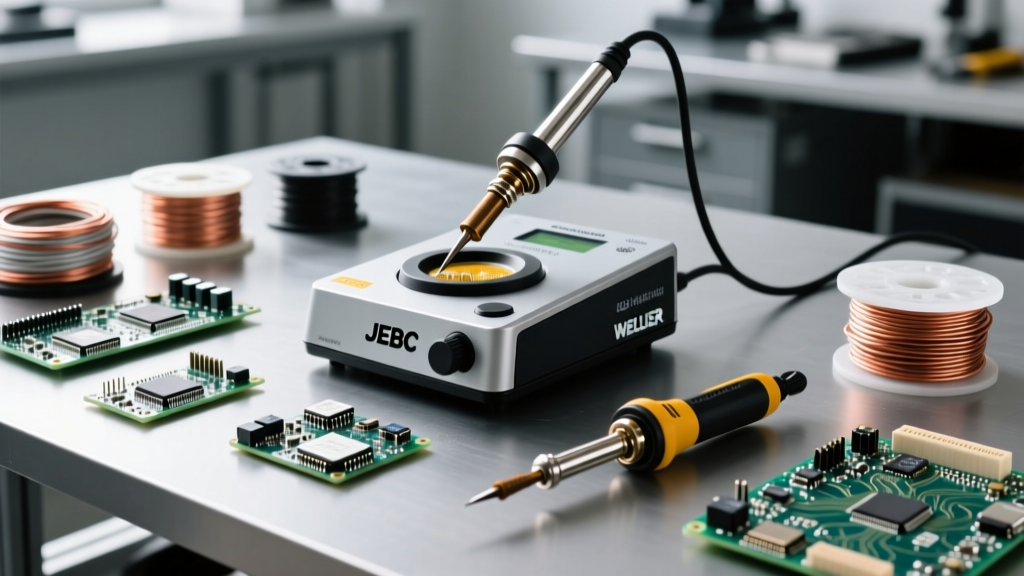
The Weller WE1010NA delivers 70 watts of power with a digital PID controller. Its proprietary ETA tip technology measures the temperature directly at the tip's surface, recovering from thermal drops in under two seconds. This rapid recovery is the key to preventing disturbed joints caused by lingering on a pad while the iron struggles to reheat.
Premium Pick: Hakko FX-951 ($350 - $400)
For advanced DIYers building high-density motor controllers or battery management systems (BMS), the Hakko FX-951 utilizes composite cartridge tips where the heating element and sensor are integrated into the tip itself. This eliminates thermal lag entirely, ensuring that heavy-gauge wires (like 10 AWG silicone leads) are soldered in under four seconds, preventing heat from wicking up the wire and melting the internal insulation.
FAQ: Quick Answers on Soldered Meanings
Does a shiny joint always mean it is safe?
Not necessarily. While leaded (Sn60Pb40) joints should be shiny, modern lead-free alloys like SAC305 naturally cool with a dull, slightly grainy finish. Judging a lead-free joint by the 'shiny' standard will lead to false rejections and unnecessary, damaging rework.
What does 'wetting' mean in soldering?
Wetting is the physical phenomenon where molten solder flows and adheres to the base metal, forming a contact angle of less than 90 degrees. If the solder beads up like water on a waxed car (a contact angle >90 degrees), it has not wetted the surface, meaning no electrical or mechanical bond exists.
Is 'No-Clean' flux safe to leave on a PCB?
Despite the name, no-clean flux residues can become conductive in high-humidity environments or under high-voltage gradients, leading to electrochemical migration (dendrite growth). For high-impedance analog circuits or high-voltage DIY projects, always clean the board with 99% isopropyl alcohol and a lint-free swab after soldering.
Final Thoughts on Soldering Safety
Understanding the true soldered meaning transforms you from a casual hobbyist into a reliable builder. By respecting IPC visual standards, managing thermal profiles with precision equipment like the Weller WE1010NA, and protecting your lungs with proper HEPA extraction, you ensure that every joint you create is safe, durable, and electrically flawless.