
The Precision Metallurgy of Joining Rings
For many couples, the daily friction between two separate rings leads to accelerated wear, bent shanks, and the annoyance of constant spinning. Getting an engagement ring and wedding band soldered together is the definitive solution to create a single, unified bridal set. However, from a metallurgical and technical perspective, 'soldering' jewelry is vastly different from joining copper wires or PCBs. It requires precise thermal management, specialized filler alloys, and a deep understanding of gemstone thermodynamics.
In 2026, professional jewelers primarily rely on two distinct thermal joining methods: traditional micro-torch soldering and pulsed Nd:YAG laser welding. While electronics hobbyists might view soldering strictly through the lens of tin-lead or SAC305 alloys, precious metal soldering involves complex solidus and liquidus temperature curves. This guide breaks down the technical specifications, failure modes, and cost structures of both methods to help you make an informed decision at the jeweler's bench.
Method 1: Traditional Micro-Torch Soldering
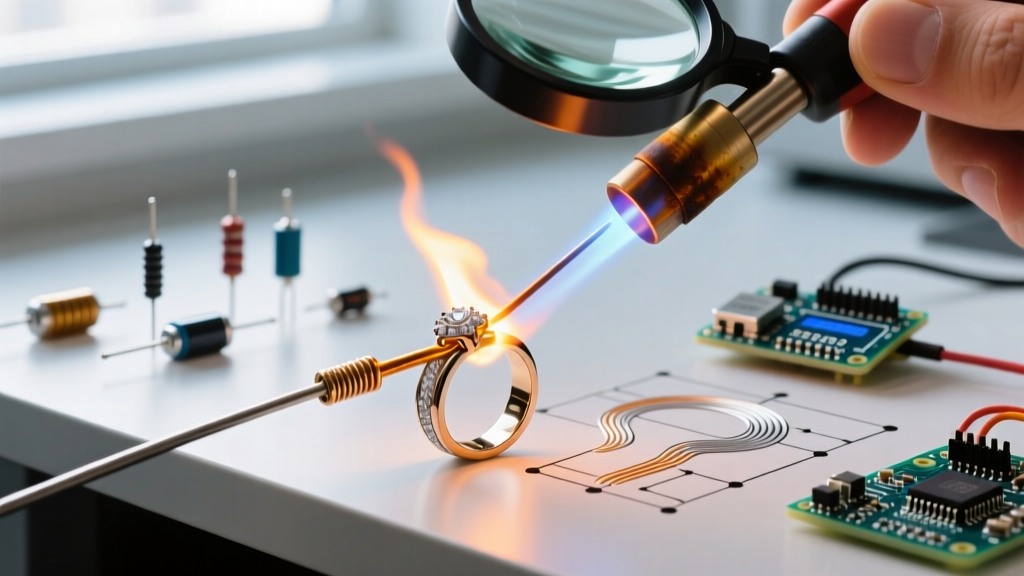
The industry standard for decades, torch soldering utilizes a micro-torch (such as the Smith Little Torch) burning a mixture of acetylene and oxygen to achieve pinpoint flame control. This method relies on capillary action to draw molten precious metal solder into the joint between the two ring shanks.
Filler Alloys and Thermal Curves
Unlike electronics solder that melts at 217°C (SAC305), gold and platinum solders require much higher temperatures. Jewelers use graded solders to allow for multiple repairs without melting previous joints:
- Hard Solder: Flows at ~1,475°F (802°C). Used for the primary join of the engagement ring and wedding band.
- Medium Solder: Flows at ~1,425°F (774°C). Reserved for secondary sizing or repair work.
- Easy Solder: Flows at ~1,375°F (746°C). Used for minor catch repairs.
The joint is coated in a flux—typically a saturated solution of boric acid and denatured alcohol, or a commercial fluorspar paste—to prevent oxidation and allow the molten alloy to flow cleanly into the seam.
Failure Modes and Gemstone Risks
The primary risk of torch soldering is the expansive Heat Affected Zone (HAZ). According to research published by the Gemological Institute of America (GIA), while pure diamonds can withstand high temperatures, many modern diamonds undergo fracture-filling or HPHT (High Pressure High Temperature) color treatments. Exposing these treated stones to 1,400°F without specialized heat-shielding putty (like Kool Jewel) can cause irreversible graphitization, clouding, or shattering. Furthermore, organic gems like pearls, opals, and emeralds will instantly fracture under torch heat and must be physically removed from their settings before soldering, adding significant labor costs.
Method 2: Pulsed Nd:YAG Laser Welding
Laser welding has revolutionized precision metallurgy. Instead of a broad flame, a pulsed Nd:YAG (Neodymium-doped Yttrium Aluminum Garnet) laser fires highly concentrated light energy in millisecond bursts. As detailed in the technical documentation from The Welding Institute (TWI), this creates a localized plasma pool that fuses the metals autogenously (without filler) or with a microscopic wire filler.
Technical Advantages
The laser's HAZ is typically less than 1 millimeter. This allows a technician to weld an engagement ring and wedding band together mere millimeters away from a pave diamond setting without transferring destructive heat to the stones or annealing the surrounding prongs. The pulse width can be adjusted from 0.5ms to 20ms, allowing the operator to control the exact depth of penetration into the gold or platinum shank.
Limitations
Laser welding requires exacting alignment and clean, oxide-free metal surfaces. Because the beam is highly reflective off polished white gold and platinum, the joint area must often be lightly abraded or coated with a laser-absorbing marker to ensure proper energy coupling. Additionally, the equipment cost for a benchtop laser welder (such as the Orion Pulse or Sun Laser systems) exceeds $15,000, which is reflected in the consumer pricing.
Galvanic Corrosion in Mixed-Metal Sets
A critical, often overlooked factor is mixing metals. If you are joining a 14k white gold engagement ring with a Platinum 950 wedding band, you are creating a bimetallic couple. When exposed to moisture and salts (sweat), this can trigger galvanic corrosion, where the less noble metal (gold alloy) acts as an anode and degrades over time. Laser welding exacerbates this if a pure platinum filler wire is used to bridge the gap. Expert jewelers will typically use a specialized bi-metal transition solder or recommend electroplating the interior of the unified set with rhodium to seal the galvanic cell.
Method Comparison Matrix (2026 Data)
| Feature | Micro-Torch Soldering | Nd:YAG Laser Welding | Mechanical Sizing Beads (Alternative) |
|---|---|---|---|
| Average Cost | $45 - $85 | $95 - $175 | $30 - $50 |
| Heat Affected Zone | Large (Requires heat shielding) | Microscopic (< 1mm) | None (Cold process) |
| Stone Removal Required? | Often (for heat-sensitive gems) | Rarely | Never |
| Joint Durability | Excellent (Full capillary seam) | Excellent (Fusion weld) | Poor (Rings still rub/spin) |
| Mixed Metal Viability | Moderate (Requires specific alloys) | High (Precise filler control) | High (No metallurgical bond) |
Step-by-Step Bench Process: The Torch Method
For the traditionalist approach, here is the exact sequence a master jeweler follows to ensure structural integrity:
- Shank Alignment: Both rings are bound tightly together using iron binding wire to prevent shifting during thermal expansion.
- Flux Application: The seam is painted with boric acid flux to dissolve existing oxides and lower the surface tension of the molten solder.
- Pre-heating: The entire ring set is gently warmed with a broad, reducing flame to drive off moisture and prevent thermal shock.
- Solder Flow: A microscopic chip of 14k Hard solder is placed at the seam. The jeweler switches to a pinpoint oxidizing flame, heating the metal adjacent to the joint until the solder reaches its liquidus state and flashes into the seam via capillary action.
- Quench and Pickle: The set is quenched in water and dropped into a warm sulfuric acid or citric acid 'pickle' bath to strip the flux and oxidation scale.
Expert Bench Tip: Always ensure both ring shanks share a similar profile (e.g., both flat or both comfort-fit) before soldering. If a flat shank is soldered to a heavily domed comfort-fit band, the point of contact is reduced to a microscopic tangent line, resulting in a weak solder joint prone to shearing under torsional stress.
Final Verdict: Which Method Should You Choose?
If your engagement ring and wedding band soldered together project involves a simple, unadorned gold or platinum shank without heat-sensitive gemstones near the base, traditional torch soldering remains the most cost-effective and structurally sound method. The capillary action creates a seamless, full-length bond that is virtually invisible when polished.
However, if your bridal set features intricate pave diamonds, channel-set emeralds, or mixed-metal combinations (like rose gold and platinum), laser welding is non-negotiable. The precision of the Nd:YAG laser eliminates the risk of catastrophic gemstone failure and allows for localized filler deposition without annealing the surrounding structural integrity of the ring. While the upfront cost is roughly double that of torch soldering, the elimination of stone-removal labor and the preservation of delicate settings make it the superior technical choice for modern, complex jewelry architectures.