
The Hidden Chemistry: Why Solder Fumes Demand Extraction
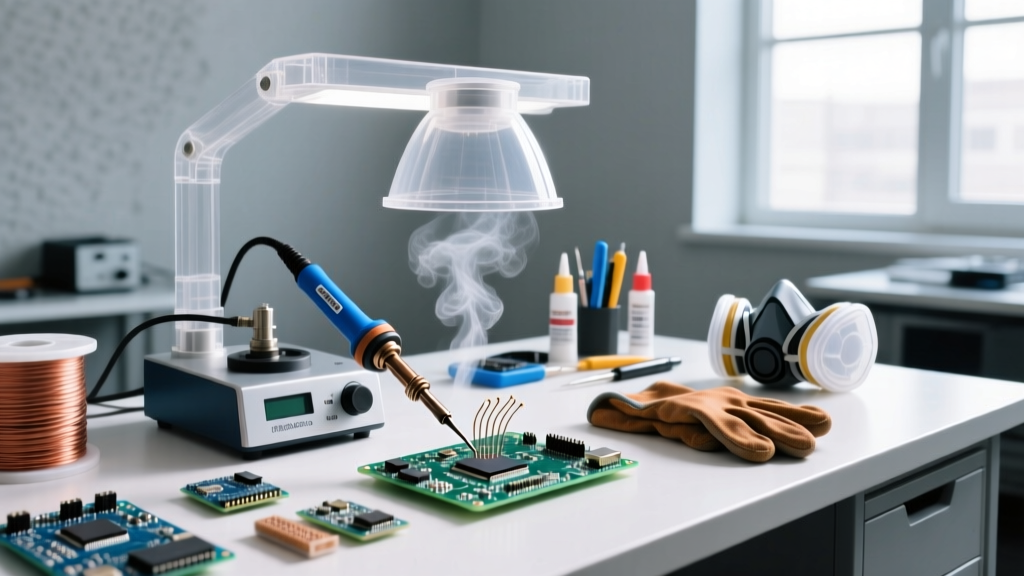
When tackling electronics projects, the visible plume rising from your soldering iron is often dismissed as harmless vapor. However, occupational health studies paint a different picture. The smoke generated during DIY fume extractor soldering or bare-iron soldering is not vaporized metal; it is atomized flux. According to the UK Health and Safety Executive (HSE), rosin (colophony) core flux is a known respiratory sensitizer that can cause occupational asthma and chronic contact dermatitis. Even lead-free solders, which require higher iron temperatures (typically 350°C to 380°C), produce more aggressive VOCs and particulate matter than traditional leaded alloys.
Expert Insight: A common myth is that lead vaporizes during hand soldering. Lead's boiling point is 1,749°C. Your 380°C iron is nowhere near hot enough to vaporize lead. The danger lies entirely in the aerosolized flux resins and activators, making activated carbon filtration—not just particulate HEPA—the mandatory standard for bench safety.
The Physics of Airflow: Static Pressure vs. Volume
The most frequent point of failure in amateur DIY fume extractor builds is selecting the wrong fan. Makers often repurpose standard PC case fans designed for high airflow (CFM) but lacking static pressure (mm H2O). When you place a dense activated carbon filter in front of a high-airflow fan, the aerodynamic resistance causes the fan to stall, resulting in near-zero extraction.
For a DIY fume extractor soldering setup, you need a high static pressure fan. Industrial-grade PWM fans are engineered to push or pull air through restrictive radiators and dense filter media without stalling. This distinction is the difference between a bench accessory that actually protects your lungs and one that merely pushes smoke around the room.
Bill of Materials (BOM): 2026 Component Sourcing
To build a commercial-grade extractor for under $50, source the following specific components. Prices reflect current 2026 market averages for electronics hobbyists.
- The Fan: Noctua NF-F12 industrialPPC-2000 PWM (120mm). Cost: ~$22. This fan delivers a massive 4.02 mm H2O static pressure, easily pulling air through dense carbon mesh.
- The Filter: Universal Cut-to-Fit Activated Carbon Pre-Filter (4mm to 8mm pellet mesh, such as the Winix 114290 or generic equivalents). Cost: ~$14. Avoid thin 'carbon-impregnated' sponges; you need physical carbon pellets to adsorb VOCs.
- The Housing: 3D-printed PETG/ABS enclosure (files available on Thingiverse/Printables) OR an upcycled steel 50-cal ammo can. Cost: $0 - $12.
- Power Supply: 12V 2A DC Switching Power Adapter with a 5.5mm x 2.1mm barrel jack. Cost: ~$8.
- Sealing & Hardware: 1/8-inch EVA foam weatherstripping tape, M4 screws, and a female DC panel-mount jack. Cost: ~$6.
Step-by-Step Build: Assembling the Extractor
Follow these precise engineering steps to ensure maximum filtration efficiency and prevent air bypass.
Step 1: Housing Fabrication and Intake Geometry
If 3D printing your housing, design the intake plenum to be slightly larger than the 120mm fan footprint, tapering inward to create a venturi effect that increases air velocity at the filter face. If using an ammo can, cut a 115mm circular intake hole on the side and a corresponding exhaust hole on the lid. Deburr all edges to prevent cutting the filter media.
Step 2: Filter Sizing and the 'Zero-Bypass' Seal
The golden rule of fume extraction is that air follows the path of least resistance. If there is even a 2mm gap between your carbon filter and the housing wall, 50% of the smoke will bypass the filter entirely. Cut your activated carbon filter 10mm larger than the intake hole. Line the inner rim of the intake with EVA foam tape. When you press the filter in, the foam must compress tightly against the carbon mesh, creating a hermetic seal. As noted in OSHA's general ventilation guidelines, local exhaust ventilation (LEV) must capture contaminants at the source without leakage to be considered effective.
Step 3: Fan Mounting and Airflow Direction
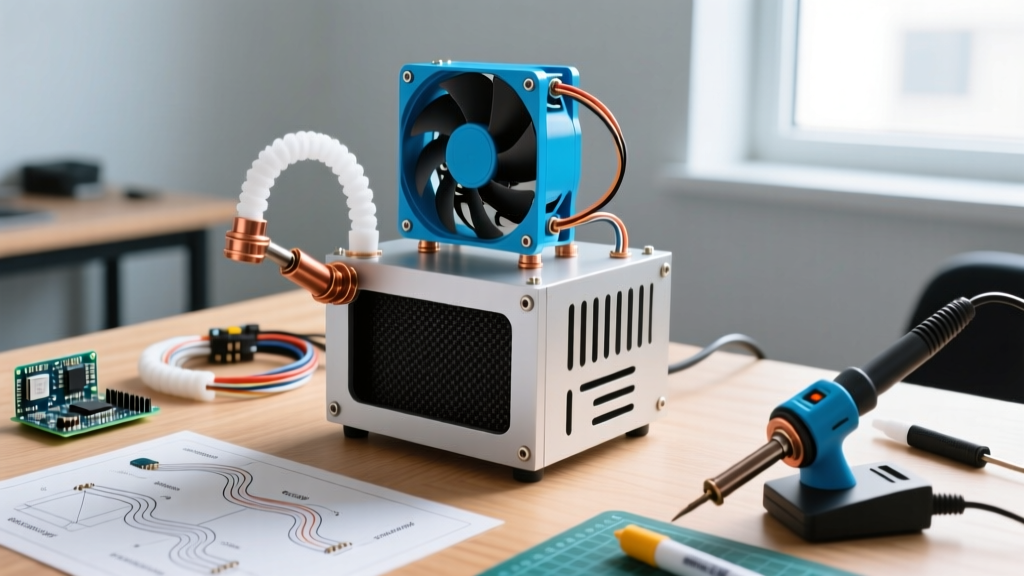
Mount the Noctua NF-F12 on the exhaust side of the housing, pulling air through the carbon filter rather than pushing it. Pulling air creates a negative pressure zone inside the chamber, which further forces any micro-leaks in the housing seams to draw air inward rather than leaking unfiltered smoke outward. Secure the fan using M4 screws with rubber vibration isolators to keep bench noise below 30dB.
Step 4: Wiring the PWM Circuit
Wire the 12V DC panel jack to the fan's power and ground pins. For a basic setup, connect the PWM wire directly to the 12V rail to run the fan at 100% speed. For variable speed control, wire a 10k ohm potentiometer between the 12V rail and the PWM signal wire, allowing you to dial the RPM from 800 to 2000 based on the volume of flux smoke your current soldering task produces.
Performance Matrix: DIY vs. Commercial Extractors
How does this $52 DIY build compare to off-the-shelf units? The table below breaks down the performance metrics against popular commercial models.
| Model / Build | Estimated Cost | Static Pressure | Filtration Type | Filter Replacement Cost |
|---|---|---|---|---|
| This DIY Build (NF-F12) | $52.00 | 4.02 mm H2O | Pelletized Activated Carbon | $14 (Generic Cut-to-Fit) |
| Hakko FA-400 | $65.00 | ~1.5 mm H2O (Est.) | Carbon-Impregnated Foam | $12 (Hakko 100-02) |
| Weller WSA350 | $135.00 | ~2.8 mm H2O (Est.) | HEPA + Carbon Combo | $45 (Weller WSA350F) |
| BOFA AD345 (Pro) | $1,200+ | High (Industrial) | Multi-stage HEPA/Carbon | $250+ (OEM Cartridges) |
While the BOFA units are mandatory for 24/7 commercial manufacturing floors (as they meet strict NIOSH guidelines for occupational asthma prevention), the DIY NF-F12 build vastly outperforms the Hakko FA-400 in static pressure and utilizes superior pelletized carbon compared to cheap impregnated foams.
Advanced Maintenance: Knowing When to Swap the Carbon
Activated carbon does not filter particulates; it adsorbs VOC molecules into its microscopic pores. Once the pores are full, the carbon is 'spent' and will begin off-gassing trapped chemicals back into your workspace. Because carbon filters don't visually look dirty like HEPA filters, makers often run them long past their saturation point.
The Gravimetric Weight Test
The most accurate way to monitor filter health without expensive VOC sensors is the weight test. When you install a brand-new piece of cut-to-fit carbon filter, weigh it on a digital kitchen scale and write the baseline weight in Sharpie on the housing (e.g., 'Base: 142g'). Activated carbon can adsorb VOCs up to roughly 15% to 20% of its own weight. Once the filter's weight increases by 15% (in this example, reaching ~163g), the carbon matrix is saturated. Discard it according to local hazardous waste guidelines and cut a fresh replacement.
Edge Case: High-Humidity Environments
If your workshop is in an unclimate-controlled garage with high ambient humidity, be aware that activated carbon has a high affinity for water vapor. In environments exceeding 70% relative humidity, the carbon will aggressively adsorb water molecules, displacing VOCs and drastically shortening the filter's effective lifespan. If you solder in a humid environment, consider adding a cheap silica gel desiccant pack inside the pre-filter chamber to trap ambient moisture before it reaches the carbon bed.
Frequently Asked Questions
Can I use a HEPA filter instead of carbon?
No. HEPA filters capture physical particulates (dust, smoke ash) but do absolutely nothing to stop volatile organic compounds (VOCs) and rosin vapors, which are gaseous. You must use activated carbon to adsorb the gases. For the ultimate setup, layer a thin HEPA pre-filter over the carbon to catch physical flux spatter and extend the carbon's life.
Is it safe to vent this out a window instead of using carbon?
Yes, exterior venting is actually the gold standard for fume extraction. If you can route a 4-inch flexible aluminum duct from your fan's exhaust out a nearby window, you eliminate the need for carbon filters entirely and guarantee 100% removal of VOCs from your breathing zone. However, this requires proximity to a window, which isn't feasible for all bench setups.
Why is my DIY extractor vibrating loudly?
High static pressure fans like the Noctua industrialPPC series spin at high RPMs (up to 2000). If the fan is screwed directly into rigid plastic or metal, harmonic resonance will amplify the noise. Always use silicone vibration-dampening mounts or rubber washers between the fan frame and the housing to isolate the acoustic transfer.