
The Sky Factory 3 Solderer vs. Real-World Metallurgy
When DIYers, makers, and gamers search for how to use solderer sky factory 3, they are typically navigating the Refined Storage mod to automate the crafting of processors, printed circuits, and silicon. In the game, the Solderer block operates on a simplified input-output logic: insert redstone, gold, or diamonds alongside a generic solder item, and the machine reliably yields advanced electronic components without fail.
However, real-world electronics manufacturing does not allow for arbitrary material combinations. At ElectricalFlux, we use the simplified logic of Sky Factory 3 as a conceptual springboard to explore the rigorous material compatibility guide required for actual physical soldering. Unlike a Minecraft machine that accepts any "solder" item, a real soldering iron requires precise metallurgical matching between the solder alloy, the flux chemistry, and the base metal substrate. This guide bridges the gap between virtual automation and real-world material science, providing the deep technical knowledge you need to build reliable physical circuits.
Solder Alloy Compatibility Matrix
Selecting the right alloy is the first critical step in material compatibility. The IPC (Association Connecting Electronics Industries) strictly categorizes alloys based on their melting profiles, wetting characteristics, and long-term reliability. Here is how real-world alloys compare to the generic "solder" items found in modpacks, and where they actually excel in the workshop.
| Alloy Designation | Composition | Melting Point | Substrate Compatibility & Use Case |
|---|---|---|---|
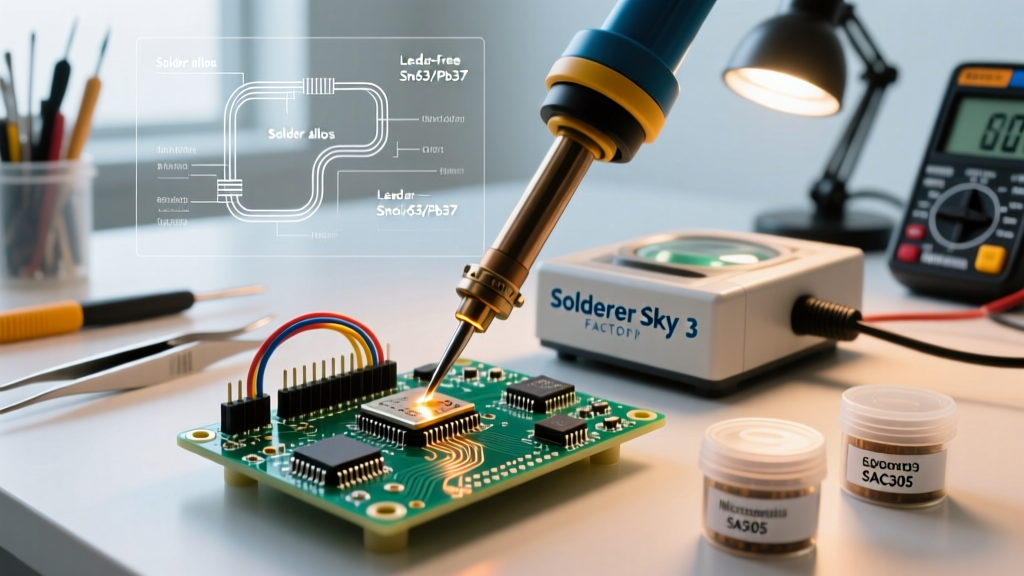
| Sn63/Pb37 | 63% Tin, 37% Lead | 183°C (Eutectic) | Excellent wetting on bare copper and HASL. Ideal for hobbyist DIY, through-hole, and quick rework. Transitions instantly from liquid to solid. |
| SAC305 | 96.5% Sn, 3.0% Ag, 0.5% Cu | 217°C - 220°C | Industry-standard lead-free. Requires higher iron temps (350°C+). Compatible with ENIG and OSP. Prone to tin whiskers over long-term deployment. |
| Sn96.5/Ag3.5 | 96.5% Sn, 3.5% Ag | 221°C (Eutectic) | High-reliability aerospace and automotive. Excellent shear strength but brittle under high-impact drop testing. Poor compatibility with bismuth finishes. |
| Sn42/Bi58 | 42% Tin, 58% Bismuth | 138°C (Low-Temp) | Used for heat-sensitive components and step-soldering. Highly incompatible with lead-bearing finishes (creates a 96°C melting eutectic phase that causes joint failure). |
Base Metal Substrates: Understanding Wetting and IMCs
In Sky Factory 3, you can solder gold, silicon, and redstone interchangeably. In reality, soldering is a complex diffusion process. The molten solder dissolves a microscopic layer of the base metal to form an Intermetallic Compound (IMC). According to guidelines published by the NASA Electronic Parts and Packaging (NEPP) Program, the ideal IMC layer (typically Cu6Sn5 on copper pads) should be strictly controlled between 1 to 3 micrometers thick. Too thin, and the bond is weak; too thick, and the joint becomes dangerously brittle.
Copper and HASL (Hot Air Solder Leveling)
Bare copper offers the best thermal and electrical conductivity but oxidizes within seconds when exposed to soldering temperatures. HASL boards come pre-tinned with a thin layer of Sn/Pb or lead-free solder, making them highly compatible with Sn63/Pb37 wires. The flux in your solder core only needs to clean minor surface contamination rather than aggressively strip heavy copper oxide.
ENIG (Electroless Nickel Immersion Gold)
ENIG is a premium PCB finish where a thin layer of gold protects an underlying nickel layer. A common misconception is that you are soldering to the gold. In reality, the molten solder dissolves the gold into the tin matrix in milliseconds, and the actual IMC bond forms with the nickel (creating Ni3Sn4). Compatibility Warning: If the electroless nickel bath is poorly controlled during manufacturing, it can lead to the "Black Pad" defect, where the solder completely dewets from the pad, resulting in catastrophic field failures.
Aluminum and Stainless Steel
Standard Sn/Pb and SAC alloys are entirely incompatible with aluminum and stainless steel. These metals form an impenetrable, self-healing oxide layer that standard rosin fluxes cannot breach. To solder aluminum, you must use specialized zinc-based alloys, aggressive inorganic acid fluxes, or ultrasonic soldering irons that use cavitation to shatter the oxide layer beneath the molten solder pool.
Flux Chemistry: The Hidden Catalyst
No discussion on material compatibility is complete without flux. While the SF3 Solderer ignores oxidation, real-world copper oxidizes instantly at 300°C. Flux chemically reduces this oxide layer, allowing the solder to wet the metal. The IPC J-STD-004 standard classifies fluxes by composition and activity level:
- ROL0 (Rosin, Low Activity, No Halides): The standard for most commercial and DIY electronics. It is non-corrosive and leaves a benign residue that does not require cleaning. Highly compatible with standard Sn63 and SAC alloys.
- ORH1 (Organic, High Activity, Halides): Water-soluble fluxes designed for heavily oxidized boards or difficult-to-solder alloys. Compatibility Note: The residue is highly corrosive and must be cleaned with deionized water post-soldering, or it will cause dendritic growth and short circuits.
- REL1 (Resin, Low Activity, Halides): Often found in high-reliability no-clean formulations. The halide content provides a slight wetting boost for SAC305 alloys on ENIG pads without leaving conductive residues.
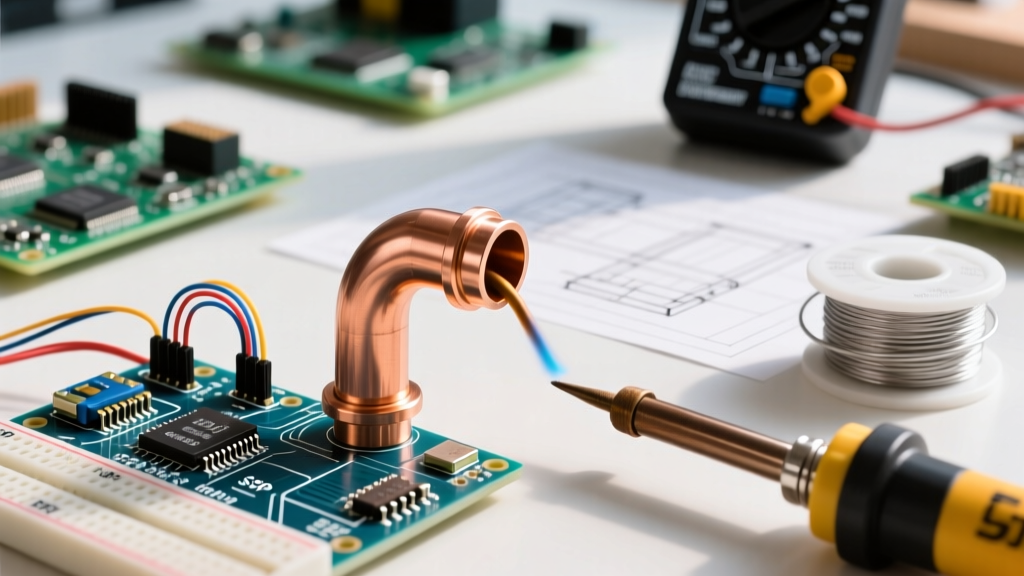
Expert Insight: Never mix flux chemistries blindly. Applying a highly acidic plumbing flux (designed for copper pipes) to a PCB will destroy the copper traces and contaminate your soldering iron tip, rendering it permanently incompatible with future electronics work.
Thermal Profiles and Compatibility Failures
Even with perfectly compatible materials, improper thermal transfer will destroy the joint. Understanding failure modes is crucial for troubleshooting your workbench projects.
Dewetting vs. Non-Wetting
Non-wetting occurs when the solder balls up and refuses to bond to the pad, leaving the base metal exposed. This is usually a compatibility failure between the flux and the substrate (e.g., trying to use a mild ROL0 flux on heavily tarnished brass). Dewetting, on the other hand, happens when the solder initially coats the pad but then pulls back into islands as it heats up, exposing the IMC layer. This is often caused by exceeding the thermal budget, causing the flux to burn off before the joint is completed, or by incompatible metallic impurities in the solder pot.
Cold Joints and Thermal Mass Mismatch
A cold joint appears dull, grainy, and convex. In the context of material compatibility, this often happens when soldering a high-thermal-mass component (like a large ground plane or a thick connector pin) with a low-thermal-mass iron tip. The solder melts from the iron's heat, but the base metal never reaches the eutectic temperature required to form the Cu6Sn5 IMC. The result is a mechanical wrap rather than a metallurgical bond. To fix this, you must increase the tip size to maximize surface area contact, not just increase the iron's temperature dial, which risks delaminating the PCB's FR4 fiberglass substrate.
Safety and Environmental Compatibility
While Sky Factory 3 abstracts away the hazards of material processing, real-world soldering requires strict adherence to safety protocols. The Occupational Safety and Health Administration (OSHA) mandates specific ventilation and handling procedures for leaded solders. When using Sn63/Pb37, the primary risk is not skin contact, but the inhalation of colophony (rosin) fumes generated by the flux, which is a known respiratory sensitizer and asthma trigger. Always pair your material compatibility matrix with an active fume extraction system featuring a HEPA and activated carbon filter to ensure your workshop environment remains safe for long-term use.
Bridging the Gap: From Gaming to the Workbench
Understanding how to use solderer sky factory 3 teaches valuable lessons in resource management, input-output logic, and automation. Applying that same analytical mindset to your physical workbench—respecting IPC standards, alloy melting points, substrate metallurgy, and flux chemistries—will elevate your DIY electronics from fragile, unreliable prototypes to robust, aerospace-grade assemblies. The next time you wire up a microcontroller or repair a PCB, remember that true compatibility goes far deeper than simply placing the right items into the right slots.