
The Cold War Crucible: USSR Electronics Manufacturing
During the 1980s, the Soviet Union's military-industrial complex and consumer electronics sectors operated under a doctrine of strict autarky. Cut off from Western supply chains, the USSR developed its own rigorous metallurgical standards to ensure the reliability of everything from the Elektronika 60 minicomputers to Vega-119 audiophile stereo systems. For modern electronics restorers, vintage audio enthusiasts, and military hardware historians in 2026, original Soviet solders 1980s production runs represent a fascinating intersection of chemistry, state-mandated quality control, and historical preservation.
Unlike the fragmented Western market where proprietary alloy blends were common, Soviet solder production was centralized and governed by uncompromising GOST (Государственный стандарт, or State Standard) specifications. Understanding these alloys is critical for anyone attempting period-accurate restorations of Cold War-era Eastern Bloc electronics.
Decoding the GOST Standards: What Made Soviet Solders 1980s Unique?
The backbone of Soviet soldering metallurgy was defined by GOST 21930-76 and GOST 21931-76, which dictated the exact chemical composition, impurity limits, and physical properties of tin-lead and silver-bearing solders. The naming convention was highly systematic: POS (ПОС) stands for Pripoy Olovyanno-Svintsovyy (Tin-Lead Solder), followed by a number indicating the percentage of tin.
According to materials science archives documented by the University of Cambridge DoITPoMS, the tin-lead phase diagram reveals why the Soviets heavily favored specific ratios. The 60/40 split was chosen not just for its near-eutectic properties, but because it offered the optimal balance of mechanical shear strength and wetting capability for the copper and silver-plated leads used in Soviet military PCBs.
The Undisputed King: POS-61 (ПОС-61)
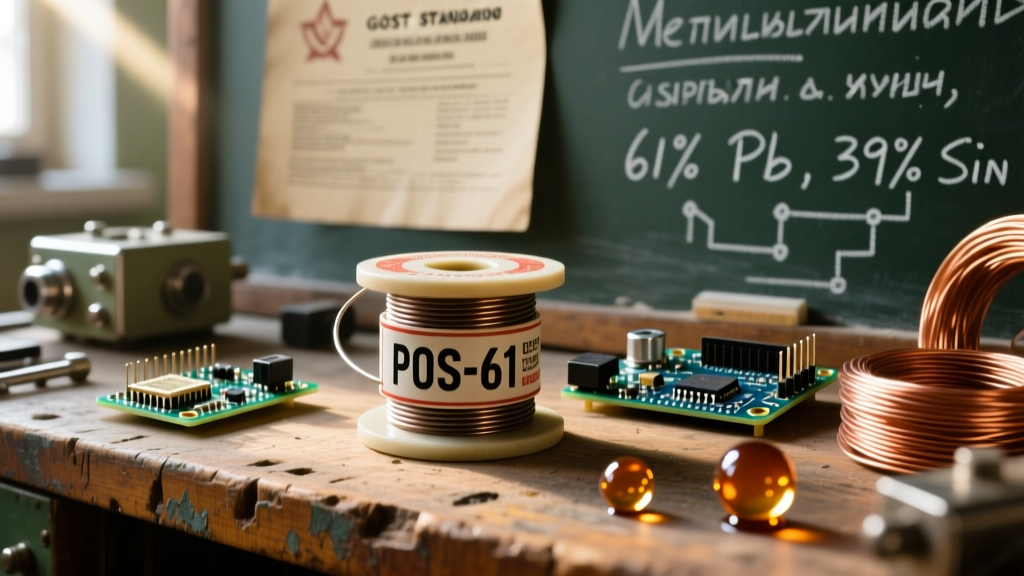
POS-61 is the most iconic and widely encountered Soviet solder from the 1980s. Comprising 59-61% Tin (Sn) and 39-41% Lead (Pb), with strict limits on impurities like antimony, copper, and bismuth, POS-61 was the default choice for printed circuit board assembly and wire tinning.
- Solidus Temperature: 183°C (361°F)
- Liquidus Temperature: 190°C (374°F)
- Tensile Strength: ~4.3 kgf/mm²
- Elongation: ~45%
While Western manufacturers often used true eutectic Sn63Pb37 (which melts and freezes at exactly 183°C to prevent cold joints during the plastic phase), the Soviets opted for POS-61. The 7°C plastic range of POS-61 was deemed acceptable because Soviet manufacturing processes heavily utilized manual soldering with high-thermal-mass irons, and the slight paste range allowed technicians to adjust component placement before the joint fully solidified.
Metallurgical Comparison: Soviet POS vs. Western Equivalents
To understand how Soviet alloys stack up against the Western standards documented by IPC Standards (such as J-STD-006), we must look at the specific elemental breakdowns. Below is a comparison matrix of the most common 1980s Soviet solders versus their modern or Western counterparts.
| Soviet Designation | Sn (%) | Pb (%) | Ag (%) | Solidus / Liquidus (°C) | Western Equivalent | Primary 1980s Use Case |
|---|---|---|---|---|---|---|
| POS-61 (ПОС-61) | 59-61 | 39-41 | 0 | 183 / 190 | Sn60Pb40 (Kester 44) | General PCB, wire tinning, consumer electronics |
| POS-40 (ПОС-40) | 39-40 | 59-60 | 0 | 183 / 238 | Sn40Pb60 | Chassis grounding, heavy gauge wires, potentiometers |
| POS-90 (ПОС-90) | 89-90 | 9-10 | 0 | 183 / 220 | Sn90Pb10 | Medical devices, food-safe equipment, high-purity RF |
| PSr-40 (ПСр-40) | 0 | 0 | 39-41 | 605 / 670 | Braze Alloy 40 | Aerospace, high-temp military, waveguide joints |
The Chemistry of LTI-120 Flux: The Secret to Soviet Wetting
An alloy is only as good as its flux. In the 1980s, the Soviet standard for rosin-based activated flux was LTI-120 (ЛТИ-120). Unlike the mildly activated RMA (Rosin Mildly Activated) fluxes common in the US, LTI-120 was a highly aggressive, chemically complex liquid that was often applied separately or injected into the core of POS-61 wire.
The exact formulation of LTI-120 included:
- Rosin (Colophony): 20–25% (Provides the base shielding and mild cleaning)
- Ethanol: 70–75% (Acts as the volatile solvent)
- Diethylamine Hydrochloride: 3–5% (The powerful activator that strips heavy oxidation)
- Triethanolamine: 1–2% (Corrosion inhibitor and pH buffer)
This specific chemical cocktail allowed Soviet technicians to solder heavily oxidized components and poorly stored military surplus parts without pre-cleaning. However, for modern restorers in 2026, the residue of LTI-120 must be thoroughly cleaned with isopropyl alcohol, as the diethylamine hydrochloride can become conductive and corrosive over decades, leading to the infamous "green fuzz" dendrite growth on vintage Soviet PCBs.
Sourcing and Authenticating 1980s USSR Solder Spools Today
The secondary market for New Old Stock (NOS) Soviet solders 1980s era has exploded, driven by audiophiles who claim POS-61 yields a "warmer" analog sound in vintage tube amplifiers, and by military hardware restorers demanding period-correct materials. On platforms like eBay and specialized electronics forums, a 250g wooden or early plastic spool of authentic 1980s POS-61 typically commands between $35 and $85 USD.
How to Spot Counterfeits
Because of the premium pricing, the market is flooded with modern, low-quality Chinese solder repackaged with fake Cyrillic labels. To authenticate a spool:
- The Spool Material: Authentic 1970s and early 1980s spools were often made of birch wood or dark, brittle Bakelite-style plastics. Late 80s spools used a specific ribbed, translucent polypropylene with molded GOST text.
- The Wire Extrusion: Soviet manufacturing extrusion dies left a distinct, slightly matte finish on the wire with a very consistent diameter (usually 1.0mm or 1.5mm for POS-61). Modern fakes often have a shiny, drawn appearance and inconsistent thickness.
- Specific Gravity Test: If you suspect a fake (e.g., lead-free masquerading as POS-61), weigh a precise length of the wire. The density of Sn60Pb40 is approximately 8.4 g/cm³. Significant deviations indicate modern lead-free or high-antimony counterfeit alloys.
Safety Warning: POS-61 contains roughly 40% lead. The NASA Electronic Parts and Packaging (NEPP) Program extensively documents the health and reliability parameters of tin-lead solders. Always use localized fume extraction (HEPA/Carbon) and wash hands thoroughly. Never use vintage POS-61 on plumbing or any system that contacts potable water.
Frequently Asked Questions (FAQ)
Is POS-61 exactly eutectic?
No. True eutectic tin-lead is Sn63Pb37, which transitions from solid to liquid at a single temperature (183°C). POS-61 (Sn60Pb40) has a "pasty" or plastic range between 183°C and 190°C. While this requires slightly more care to avoid disturbing the joint during cooling, the difference in mechanical reliability is negligible for through-hole and hand-soldered wire joints.
Can I use Soviet acid-core solder on vintage PCBs?
Absolutely not. The Soviets produced POS-61 with various flux cores. While LTI-120 and pure rosin (Kanifol) are safe for electronics (with post-solder cleaning), POS-61 was also manufactured with zinc chloride and orthophosphoric acid cores for soldering galvanized steel and nichrome wires. Acid-core solder will destroy copper traces and cause catastrophic via corrosion. Always test unknown vintage solder on a scrap copper clad board first; if the residue is highly acidic (pH < 4) and smokes with a sharp, choking odor, discard it for electronics use.
Why do audiophiles prefer 1980s Soviet solder over modern Kester?
This is largely rooted in metallurgical nostalgia and the "vintage tone" myth. However, there is a grain of truth: 1980s Soviet lead and tin were smelted from specific regional ores with trace impurities (like trace silver or bismuth) that differ from modern, highly refined, 99.99% pure metals used in Kester 44. While blind audio tests rarely prove a sonic difference, the unique wetting behavior and flux chemistry of NOS POS-61 make it a joy to use for restorers working on 40-year-old oxidized copper pads.