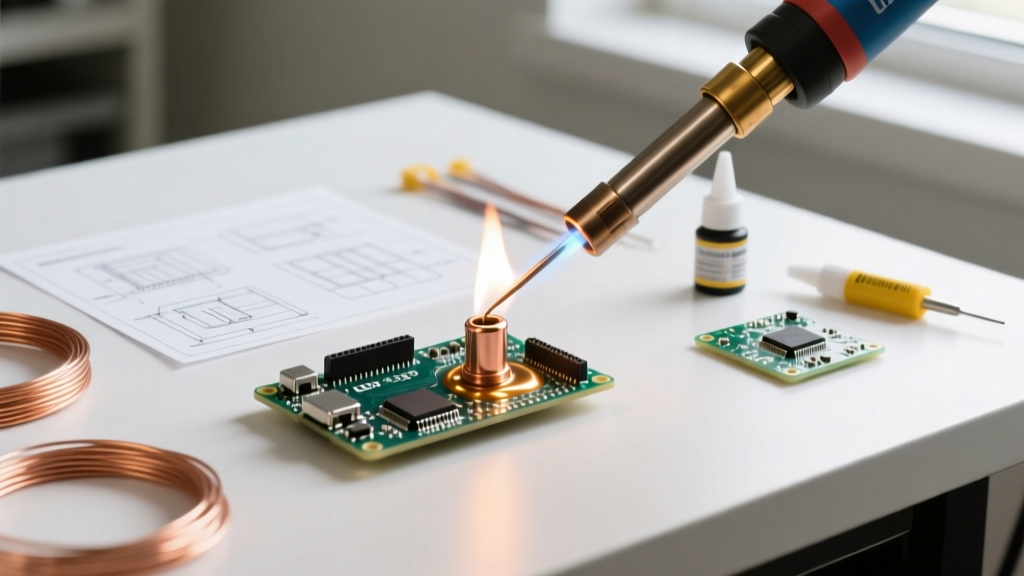

The Physics of Copper Heat Transfer: Why Torch Choice Matters
Selecting the correct torch for copper soldering is rarely a one-size-fits-all decision. Copper is an exceptional thermal conductor—second only to silver among common metals. According to the Copper Development Association, copper's thermal conductivity is approximately 398 W/m·K at room temperature. In practical plumbing and HVAC terms, this means copper acts as a massive heat sink, rapidly pulling thermal energy away from your joint and dissipating it down the pipe length.
If your torch's BTU output and flame envelope do not perfectly align with the copper alloy's thickness and the solder's melting point, you will encounter catastrophic joint failures. This material compatibility guide breaks down the exact metallurgical and thermodynamic pairings required for flawless capillary action in 2026.
Copper Wall Thickness and Thermal Mass Profiles
Before striking an arc or opening a gas valve, you must identify the copper tube type. The wall thickness dictates the thermal mass you must overcome to reach the solder's liquidus temperature.
- Type M (Thin Wall): Typically 0.028 inches thick for 1/2-inch nominal pipe. Heats rapidly but is highly susceptible to warping and flux burn-off if subjected to high-BTU, concentrated flames.
- Type L (Medium Wall): Typically 0.040 inches thick for 1/2-inch nominal pipe. The residential plumbing standard. Requires a balanced flame envelope to heat the fitting cup and the pipe simultaneously.
- Type K (Thick Wall): Typically 0.049 inches thick for 1/2-inch nominal pipe. Used in underground mains and commercial HVAC. Demands high-BTU, aggressive fuel gases to penetrate the thermal mass before the flux degrades.
Fuel Gas Compatibility Matrix
Not all fuel gases are created equal. The flame temperature and heat transfer rate (BTU/hr) must be matched to the copper type and fitting size. Below is the definitive compatibility matrix for modern soldering torches.
| Fuel Gas | Max Air Flame Temp | Compatible Copper Types | Max Recommended Fitting Size | Best Application |
|---|---|---|---|---|
| Propane (C3H8) | ~3,600°F | Type M, Type L | Up to 1/2" | DIY repairs, electronics, small drain lines |
| MAP-Pro (Propylene) | ~3,730°F | Type L, Type K | Up to 1-1/4" | Pro residential plumbing, HVAC service valves |
| Acetylene (C2H2) | ~4,700°F | Type K, Heavy Type L | Up to 2"+ | Commercial mains, thick-walled refrigeration lines |
| Oxy-Acetylene | ~5,600°F | All (Brazing focus) | 4"+ Industrial | High-pressure steam, industrial brazing (not standard soldering) |
Matching the Torch to the Solder Alloy
The torch must heat the copper base metal to the solder's flow point without exceeding the thermal degradation point of the flux. The Harris Products Group emphasizes that improper torch selection is the leading cause of flux inclusion and cold joints.
1. 95/5 Tin-Antimony (Lead-Free Potable Water)
Melting Range: 452°F - 464°F.
Torch Pairing: MAP-Pro or Acetylene with a swirl-tip nozzle. The narrow melting range of 95/5 requires rapid, even heating. A standard propane pencil flame will cause the flux to carbonize before the thick Type L fitting cup reaches 450°F.
2. 50/50 Tin-Lead (Electronics & Non-Potable Drains)
Melting Range: 361°F - 421°F.
Torch Pairing: Propane or Butane micro-torches. Note: Under the EPA Safe Drinking Water Act, lead-based solders are strictly prohibited in potable water systems. Use low-BTU torches for 50/50 to prevent vaporizing the flux and pitting the copper surface.
3. Silver-Bearing Solder (e.g., Harris Stay-Brite)
Melting Range: 430°F - 490°F.
Torch Pairing: MAP-Pro with a broad, bushy flame. Silver solders require a slightly higher thermal threshold and excellent capillary draw. A concentrated, needle-point flame will melt the solder instantly, but it will ball up on the surface rather than wick into the joint because the deeper copper fitting hasn't reached the liquidus temperature.
Expert Insight: The secret to a perfect soldered joint isn't melting the solder with the flame. The secret is heating the copper fitting with the flame until the copper itself is hot enough to melt the solder wire on contact. If the flame touches the solder wire directly, you are masking a cold joint.
Common Failure Modes & Edge Cases
When material compatibility is ignored, specific failure modes emerge. Recognizing these edge cases separates master plumbers from weekend DIYers.
- The Flux Burn-Off Paradox: Using an Acetylene torch on 1/2-inch Type M copper. The extreme BTU output vaporizes the water-soluble flux in under 3 seconds, leaving bare, oxidized copper. The solder will refuse to wet the surface, resulting in a catastrophic leak under pressure.
- Capillary Starvation: Heating the middle of the fitting cup instead of the base. The solder wicks toward the heat source (the middle) rather than being drawn through the entire joint via capillary action. Always apply the flame to the base of the fitting and feed the solder at the opposite edge.
- Thermal Shock Cracking: Quenching a freshly soldered Type K joint with a wet rag. While copper is malleable, rapid localized cooling can induce micro-fractures in the solder crystalline structure, leading to pinhole leaks months later.
2026 Torch Recommendations by Scenario
Based on current market availability and field reliability, here are the top torch configurations for specific copper soldering scenarios.
Best for Residential Type L Plumbing: Bernzomatic TS8000
Price Range: $55 - $65 (Torch only)
Fuel: MAP-Pro
Why it Works: The TS8000 features an instant-on trigger and a swirl combustion chamber that creates a focused yet enveloping flame. It provides the exact BTU output needed to heat 3/4-inch and 1-inch Type L copper fittings evenly without scorching the flux. It is the undisputed industry standard for residential service techs.
Best for HVAC & Thick Type K Mains: TurboTorch Extreme T-7
Price Range: $130 - $150 (Torch head)
Fuel: Acetylene or MAP-Pro
Why it Works: TurboTorch's patented swirl technology creates a vortex flame that wraps entirely around the copper pipe. When paired with Acetylene, the T-7 can bring a 1-1/2-inch Type K copper joint to soldering temperature in under 15 seconds, completely eliminating the risk of flux degradation.
Best for Precision Electronics & Small Gauge Wire: Weller Portasol Professional II
Price Range: $90 - $110
Fuel: Butane
Why it Works: For soldering small copper wires, PCB pads, or delicate 1/8-inch copper tubing, standard plumbing torches are far too aggressive. The Portasol offers adjustable, low-BTU butane heat with interchangeable precision tips, ensuring you don't delaminate circuit boards or melt wire insulation.
Frequently Asked Questions
Can I use a standard propane torch for 3/4-inch copper water lines?
While technically possible, it is not recommended for 3/4-inch or larger lines. Propane lacks the BTU density to heat a 3/4-inch Type L fitting cup quickly enough. By the time the center of the fitting reaches 450°F, the flux on the outer edges will have burned to a glass-like state, preventing solder from wicking. Upgrade to a MAP-Pro torch for any pipe 1/2-inch or larger.
Why does my solder bead up and fall off the copper pipe?
This is a classic wetting failure caused by oxidation. If your torch flame is too hot and burns off the flux, or if you failed to mechanically clean the copper with abrasive pads and apply fresh flux, the molten solder cannot bond to the copper oxide layer. The copper must be chemically clean (via flux) and mechanically clean (via abrasion) for capillary action to occur.
Is it safe to solder copper pipes while they are under pressure?
No. The pipe must be completely drained and open at a downstream valve. Even a small amount of trapped water will act as a heat sink, making it impossible to reach the solder's melting point. Furthermore, as trapped water turns to steam, it expands by a factor of 1,600, which can blow molten solder out of the joint and cause severe steam burns.