
The Core Dilemma: Pay a Jeweler or DIY the Solder?
Wearing an engagement ring and a wedding band on the same finger often leads to a frustrating phenomenon: the rings spin independently, grind against one another, and cause accelerated friction wear. The standard industry solution is soldering wedding rings together, fusing them into a single, stable unit. But as a maker or DIY enthusiast, you are likely asking a critical question: Is it more cost-effective to pay a professional jeweler, or should you invest in jewelry soldering equipment and do it yourself?
As an electrical and electronics DIY hub, we frequently cover soldering. However, joining precious metals requires a completely different metallurgical approach than joining copper traces or brass wires. This comprehensive 2026 cost analysis breaks down the exact pricing of professional services, the capital expenditure of a DIY jewelry soldering setup, and the hidden risks that can turn a money-saving DIY project into a catastrophic financial loss.
Professional Jeweler Pricing in 2026
Before purchasing a torch, it is vital to understand the baseline cost of professional ring soldering. According to industry data from the Jewelers of America, the price of fusing two rings depends heavily on the base metal, the ring profile, and the presence of heat-sensitive gemstones.
Base Metal Cost Breakdown
- Yellow Gold (14k or 18k): $45 – $75. Yellow gold is the most forgiving metal to solder. It conducts heat predictably and does not require post-solder plating.
- White Gold: $85 – $130. White gold requires the same soldering process as yellow gold, but the heat from the torch will burn off the rhodium plating. The jeweler must re-plate the fused ring, adding $40 to $60 to the total cost.
- Platinum: $110 – $160+. Platinum has a significantly higher melting point (3,215°F / 1,768°C) compared to 14k gold (approx. 1,500°F / 815°C). Standard bench jewelers often require specialized oxy-hydrogen torches or laser welders to fuse platinum without melting the shanks, driving up the labor cost.
The DIY Route: Capital Equipment and Consumables
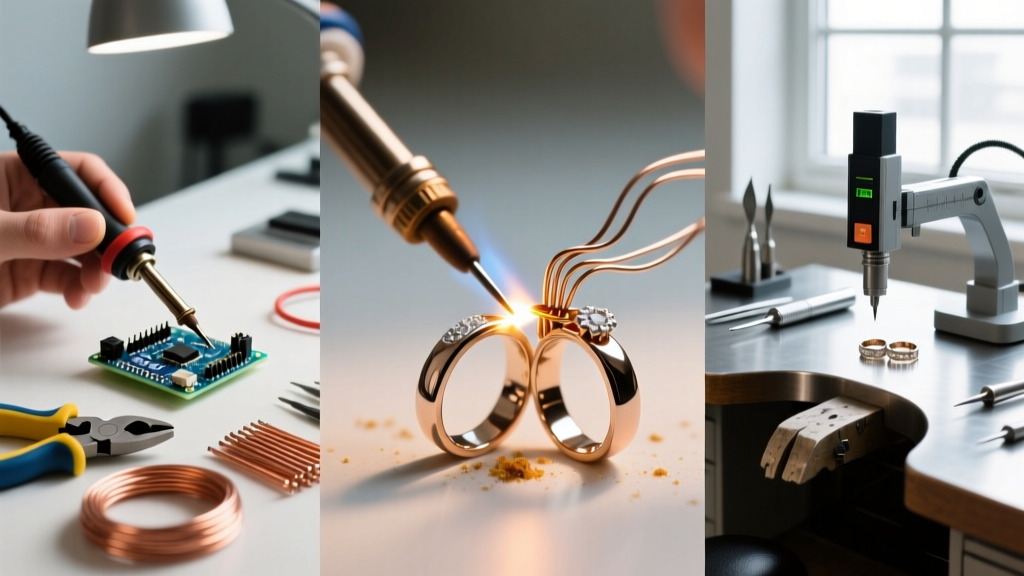
If you decide to bypass the jeweler, you cannot simply use your existing electronics workbench gear. Soldering wedding rings together requires specialized jewelry tools designed to reach high temperatures with pinpoint precision. Here is the exact cost of building a DIY jewelry soldering station in 2026.
1. The Heat Source (Torch Setup)
For electronics, a 60W Hakko FX-888D is standard. For jewelry, you need a localized, high-BTU flame.
- Budget Option: Blazer Big Shot GT8000 Butane Micro-Torch ($55 - $65). This is a high-output butane torch capable of reaching 2,500°F. It is sufficient for soldering 14k and 18k yellow gold rings, provided you use the correct solder grade.
- Professional Option: Smith Little Torch Acetylene/Oxygen Setup ($165 - $190). The industry standard for bench jewelers. It offers interchangeable tips (sizes 00 to 5) allowing you to pinpoint the flame exactly on the seam without overheating the surrounding shank or gemstone prongs.
2. Jewelry Solder and Flux
Precious metal solder is not a separate alloy like tin/lead; it is an alloy of the base metal itself, formulated to melt at slightly lower temperatures than the ring. As detailed in the Rio Grande jewelry supply catalog, gold solders are categorized by flow temperature:
- Hard Solder (Melts ~1,450°F): Used for the primary structural joint. ($15 per 1 dwt sheet)
- Medium Solder (Melts ~1,365°F): Used for secondary joints or repairs. ($15 per 1 dwt sheet)
- Easy Solder (Melts ~1,325°F): Used for final sizing or low-heat repairs. ($15 per 1 dwt sheet)
- Borax Flux Cone and Dish ($12): Essential for preventing oxidation and allowing the solder to flow via capillary action.
3. The Pickle Pot (Cleaning)
After soldering, the rings will be covered in firescale (oxidation). You must quench them in a mild acid solution called 'pickle'. A dedicated slow cooker ($20) filled with Sparex No. 2 sodium bisulfate solution ($15) and copper tongs ($8) is mandatory. Using steel tongs will cause a chemical reaction that copper-plates your gold rings.
The Metallurgical Trap: Why Electronics Solder Fails
CRITICAL WARNING: Never attempt to use electronics solder (Sn60/Pb40, Sn63/Pb37, or lead-free SAC305) on precious metals. Electronics solder melts between 361°F and 430°F. It lacks the metallurgical compatibility to alloy with gold or platinum. Instead of creating a structural bond, it will simply sit on the surface as a brittle, ugly smear that will fail under sheer stress and permanently ruin the ring's finish and resale value. Furthermore, the Gemological Institute of America (GIA) notes that introducing foreign, low-melting-point alloys into karat gold can cause irreversible structural embrittlement.
Comprehensive Cost Comparison Matrix
To visualize the financial commitment, compare the cost of hiring a professional against building a DIY setup for a standard 14k yellow gold ring pair.
| Item / Service | Professional Jeweler (2026) | DIY Budget Setup (Butane) | DIY Pro Setup (Oxy-Acetylene) |
|---|---|---|---|
| Labor / Service Fee | $45.00 - $75.00 | $0.00 | $0.00 |
| Torch / Heat Source | N/A (Included) | $60.00 (Blazer GT8000) | $180.00 (Smith Little Torch) |
| Gold Solder (Hard) | N/A (Included) | $15.00 | $15.00 |
| Flux, Pickle & Tongs | N/A (Included) | $35.00 | $35.00 |
| Total Initial Cost | $45.00 - $75.00 | $110.00 | $230.00 |
| Cost Per Subsequent Job | $45.00 - $75.00 | ~$5.00 (Consumables) | ~$5.00 (Consumables) |
Hidden Costs and Edge Cases
When analyzing the cost of soldering wedding rings together, the raw numbers only tell half the story. The true cost includes risk mitigation and edge-case handling.
Gemstone Heat Damage and Removal
If the wedding band or engagement ring contains heat-sensitive stones (such as emeralds, opals, tanzanite, or even treated diamonds), the heat from the torch will shatter or cloud them. A professional jeweler will charge an additional $25 to $50 per stone to carefully remove them from their prongs before soldering, and reset them afterward. If you DIY this and crack a $2,000 diamond due to improper heat sinking with a wet charcoal block, your 'money-saving' project just cost you thousands.
White Gold Rhodium Re-Plating
As mentioned, white gold is actually yellow gold alloyed with white metals (like nickel or palladium) and plated with rhodium for a bright white finish. The soldering process burns the rhodium off the immediate area. A professional includes the re-plating cost in their white gold quote. If you DIY, you cannot plate it yourself without a specialized electroplating setup (adding $150+ to your DIY capital costs), leaving you with a visible, slightly yellowish seam.
Sizing Difficulties Post-Solder
Once two rings are soldered together, resizing them in the future becomes exponentially more difficult and expensive. The jeweler must cut through two shanks, size them independently to maintain the circular geometry, and re-solder them. If your finger size changes, expect to pay double the standard sizing fee.
Final Verdict: Is DIY Worth the Investment?
From a purely financial perspective, soldering wedding rings together is rarely a viable one-off DIY project. If you are only fusing your own wedding set, paying a professional jeweler $65 for yellow gold or $110 for white gold is vastly more economical than purchasing a $110 to $230 torch and chemical setup, especially when factoring in the catastrophic financial risk of melting a prong or shattering a gemstone.
However, if you are an avid maker, a metalsmithing hobbyist, or someone who frequently repairs vintage jewelry for friends and family, the DIY route offers immense long-term ROI. Once the capital cost of a Smith Little Torch and a pickle pot is absorbed, the consumable cost per solder joint drops to under $5.00. For the dedicated DIYer, mastering jewelry soldering is a highly rewarding skill—provided you respect the metallurgy, leave the electronics solder on the workbench, and invest in the proper precious-metal alloys.