
The True Cost of Micro-SMD Assembly: Standard vs. Locking Tweezers
As surface-mount devices (SMDs) continue to shrink—with 0201 and 01005 packages becoming standard in 2026 RF and IoT designs—the physical limitations of human hands have become a primary bottleneck in electronics assembly. For technicians and engineers researching tweezers, soldering locking mechanisms represent a critical upgrade path from traditional static forceps. But with specialized locking SMD tweezers costing anywhere from $35 to over $120, are they a justifiable capital expenditure, or an over-engineered luxury?
This cost analysis breaks down the direct upfront costs, hidden rework expenses, and ergonomic financial risks associated with micro-soldering, comparing standard ESD tweezers against mechanical locking alternatives.
Categorizing the Tools: What Are You Actually Buying?
To perform an accurate ROI calculation, we must first segment the market into three distinct tiers of component-handling tools.
Tier 1: Standard ESD Tweezers (The Baseline)
Models like the Hakko CHP-7-SA or Vetus ESD-15 ($5–$12) rely entirely on the user's pinch grip. While adequate for 0805 or 0603 components, maintaining a static, tremor-free grip on a 0.6mm x 0.3mm 0201 capacitor while simultaneously applying a soldering iron with the other hand leads to high rates of tombstoning and pad lifting.
Tier 2: Mechanical PCB Holders & Helping Hands
Tools like the QuadHands Workbench or generic silicone-tipped hemostats ($20–$45) secure the board or wire, but they do not actively hold the SMD component in place during the critical moment of solder wetting. They solve board stability, not component manipulation.
Tier 3: Precision Locking Soldering Tweezers
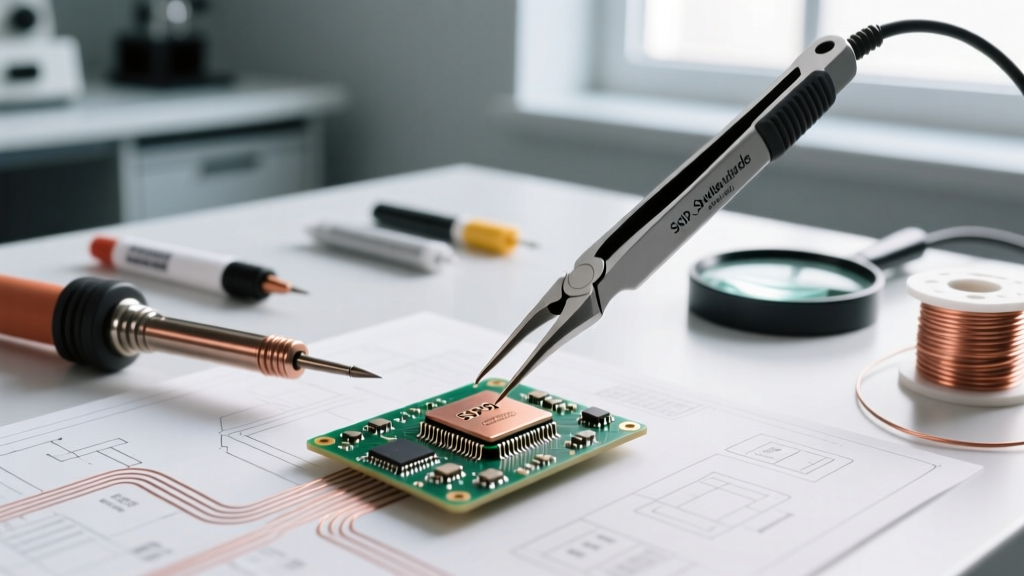
Specialized tools such as the Edsyn LS30 or Grobet USA Locking Forceps ($40–$85) feature a ratchet or screw-lock mechanism. The technician squeezes the tweezer to grip the SMD part, and the mechanism locks. This frees the technician's fingers from maintaining constant tension, allowing the non-dominant hand to assist with solder wire feeding or flux application without dropping the component.
Cost Analysis Matrix: Direct vs. Hidden Costs
The following table illustrates the financial impact of tool selection over a 12-month period in a high-mix, low-volume (HMLV) prototyping environment.
| Tool Category | Upfront Cost (2026) | Avg. Rework Time Impact | Ergonomic Strain Level | Estimated 1-Year Hidden Cost |
|---|---|---|---|---|
| Standard ESD Tweezers | $8.00 | +3.5 mins per micro-SMD defect | High (Pinch fatigue) | $450+ (Scrapped boards/Labor) |
| PCB Helping Hands | $35.00 | Neutral (Doesn't hold SMD) | Medium | $120 (Yield loss on 0402s) |
| Locking SMD Tweezers | $55.00 | -60% placement defects | Low (Ratchet support) | $15 (Tip replacement) |
The ROI of Locking Mechanisms in High-Mix Production
The financial justification for locking tweezers hinges entirely on the cost of rework. According to the IPC-7711/7721 standard for rework and modification, the complexity of reworking micro-SMDs increases exponentially as component size decreases. Reworking a bridged QFN-24 or a tombstoned 0201 resistor is not a simple 30-second fix; it requires localized pre-heating, precision wicking, and flux cleaning.
Expert Insight: In a 2026 prototyping lab where technician labor is billed at $45/hour, a single botched 0201 placement that requires a 4-minute micro-rework cycle costs $3.00 in lost time. If a technician places 50 micro-SMDs a day with a 10% defect rate using standard tweezers, that is $15.00 lost daily. A $55 locking tweezer pays for itself in under four days of active micro-assembly.
Furthermore, attempting to pry a misaligned 0402 component off a freshly tinned pad with standard tweezers often results in pad delamination. Replacing a scrapped 6-layer impedance-controlled PCB can cost upwards of $150 in low-volume runs, instantly wiping out any savings from buying cheaper hand tools.
Metallurgy and Tip Degradation: The Hidden Maintenance Costs
When calculating the total cost of ownership (TCO), buyers must consider the metallurgy of the tweezer tips. Soldering environments are harsh; flux vapors, accidental iron contact, and mechanical abrasion degrade tips rapidly.
- Carbon Steel (Budget Locking Forceps): Prone to rust if not oiled, and highly magnetic. Hidden Cost: Magnetic tips will pick up solder splatter and attract ferrous debris, ruining sensitive RF components. ($15 initial, high failure rate).
- Anti-Magnetic Stainless Steel (Standard ESD): Resists corrosion but work-hardens and loses alignment over time. ($10 initial, moderate lifespan).
- PEEK / Ceramic-Coated Tips (Premium Locking): Brands like Erem or specialized SMD lines offer PEEK (Polyether ether ketone) tips that are non-marring, ESD-safe, and thermally insulating. Hidden Cost: Replacement PEEK tips cost $25–$40 per pair. However, they prevent crushing fragile glass-body diodes and ceramic capacitors, saving component costs.
Ergonomics and ESD Compliance: The Financial Risks of Fatigue
Hand fatigue is a silent budget killer. Maintaining a 200-gram pinch force for hours leads to thenar muscle fatigue, resulting in micro-tremors. These tremors cause solder bridges on 0.5mm pitch TQFP chips. The Occupational Safety and Health Administration (OSHA) notes that repetitive pinch-grip tasks significantly increase the risk of musculoskeletal disorders (MSDs). A single worker's compensation claim or lost week due to carpal tunnel syndrome costs a company thousands of dollars, dwarfing the price of ergonomic locking tools.
Additionally, compliance with the ANSI/ESD S20.20 standard is mandatory when handling components sensitive to electrostatic discharge. Many cheap, generic locking hemostats purchased from hardware suppliers are made of un-dissipative plastics or raw metals that can act as antennas or generate triboelectric charges. Investing in verified ESD-safe locking tweezers (typically featuring carbon-impregnated PPS or specialized coatings) prevents catastrophic latent ESD failures that might not be caught until the end-product is in the field.
Failure Modes: When Locking Tweezers Cost You Money
Locking tweezers are not a universal panacea. Misapplication can lead to costly failures:
- Crush Damage: Ratchet mechanisms lack tactile feedback. If a technician locks the tweezer onto a fragile glass MELF diode or a hollow-core inductor with excessive force, the component will shatter. Solution: Use locking tweezers with adjustable tension screws or opt for PEEK-tipped models that distribute pressure.
- Thermal Transfer: If the soldering iron accidentally touches the metal shaft of a locking tweezer, the thermal mass of the locking mechanism will rapidly wick heat away from the joint, resulting in a cold solder joint. Solution: Maintain strict iron discipline and use ceramic-coated shafts for high-density boards.
- Slow Release Times: In high-speed production, the split-second required to disengage a mechanical lock can slow down throughput compared to the instant release of spring-loaded standard tweezers. Locking tweezers are best reserved for complex, multi-pad SMDs (like QFNs or BGAs) rather than high-volume passive placement.
Final Verdict: Who Should Invest in Locking SMD Tweezers?
The cost analysis clearly shows that locking soldering tweezers are a high-ROI investment for specific use cases. If your daily workflow involves 0402/0201 passives, QFN/BGA placement, or rework on expensive multi-layer PCBs, the $40–$80 upfront cost is easily justified by the reduction in scrapped boards and rework labor. The Edsyn LS30 and similar ratchet-locking models offer the best balance of ESD safety, ergonomic relief, and precision.
However, for hobbyists primarily soldering through-hole components, or production lines using automated pick-and-place machines where manual SMD placement is rare, standard $8 ESD tweezers remain the most financially logical choice. Evaluate your defect rate, calculate your rework labor costs, and let the data drive your tooling budget.