
The Short Answer: Yes, But Zinc Changes the Rules
When makers, plumbers, and electronics technicians ask, "can brass be soldered?", the simple answer is yes. However, the engineering reality is far more complex. Unlike pure copper, brass is an alloy of copper and zinc (typically ranging from 5% to 45% zinc). When exposed to soldering temperatures exceeding 300°C, the zinc rapidly migrates to the surface and oxidizes, forming a refractory zinc oxide layer. This layer actively repels standard rosin fluxes, resulting in the dreaded "ball-up" effect where solder refuses to wet the joint.
To successfully solder brass in 2026, you must abandon generic soldering habits and adopt a strict decision framework based on your specific brass alloy, flux chemistry, and thermal delivery system. This guide provides the exact parameters required for reliable brass soldering, from delicate RF shielding to heavy-duty pneumatic fittings.
The Brass Joining Decision Matrix
Before picking up an iron, determine if soldering is actually the correct metallurgical process for your application. Use this matrix to evaluate your joint requirements against alternative methods.
| Joining Method | Temperature Range | Tensile Strength | Best Application | Brass Suitability |
|---|---|---|---|---|
| Soft Soldering | < 450°C | Low to Moderate | Electronics, low-pressure plumbing, RF shields | Excellent (with correct flux) |
| Silver Brazing | 600°C - 800°C | High | HVAC, high-pressure hydraulics, structural | Superior (avoids zinc burn) |
| TIG Welding | > 1000°C | Very High | Custom fabrication, marine hardware | Poor (Zinc vaporizes, creating toxic fumes and porous welds) |
Expert Insight: If your brass fitting will be subjected to continuous vibration or pressures exceeding 150 PSI, abandon soft soldering. Switch to a silver-bearing brazing alloy (like Harris Safety-Silv 45) to prevent capillary fracture.
Step 1: Identify Your Brass Alloy (The CDA Designations)
The Copper Development Association (CDA) categorizes brass alloys by their elemental makeup. Your alloy dictates your flux requirement.
- C260 (Cartridge Brass): 70% Copper, 30% Zinc. This is the most common brass for electronics enclosures, RF shields, and musical instruments. It has excellent solderability and can be joined using highly active Rosin Mildly Activated (RMA) fluxes.
- C360 (Free-Machining Brass): Contains roughly 3% Lead added to improve machinability. The lead segregates at the grain boundaries and surface, severely inhibiting solder wetting. Mandatory requirement: You must use an aggressive acid-based flux (Zinc Chloride) to cut through the lead/zinc oxide barrier.
- C464 (Naval Brass): Contains ~1% Tin for corrosion resistance. Solderability is moderate; requires mechanical abrasion and an RMA or mild acid flux.
Step 2: Select the Correct Flux Chemistry
Flux selection is the single most critical variable when determining if brass can be soldered successfully. Standard no-clean fluxes will fail on C360 brass.
1. Zinc Chloride / Acid Flux (e.g., Ruby Fluid, Superior No. 30)
Use Case: C360 Free-machining brass, plumbing fittings, mechanical joints.
Chemistry: ZnCl2 dissolves heavy zinc and lead oxides at 350°C.
Warning: Acid flux is highly corrosive. You must neutralize the joint post-solder using a baking soda and distilled water solution, followed by an isopropyl alcohol rinse. Failure to do so will result in severe galvanic corrosion within weeks.
2. Rosin Mildly Activated (RMA) (e.g., Kester 186 or 245)
Use Case: C260 Cartridge brass, electronics, RF cavities.
Chemistry: Abietic acid (rosin) with mild activators. Safe for electronics; no neutralization required.
Limitation: Will not penetrate the oxide layer of leaded brass (C360).
Step 3: Filler Metal Selection
Match your solder alloy to the environmental stress of the joint. As of 2026 market pricing, here are the optimal choices:
- Sn63/Pb37 (Eutectic): Melts at 183°C. Ideal for C260 RF shields and low-stress electronics. Cost: ~$45/lb. Provides a shiny, easily inspectable fillet.
- SAC305 (Sn96.5/Ag3.0/Cu0.5): Melts at 217°C. The RoHS-compliant standard for commercial electronics. The silver content increases shear strength, making it suitable for brass battery contacts. Cost: ~$65/lb.
- Sn95/Sb5 (Tin-Antimony): Melts at 235°C. Excellent for plumbing and high-temperature mechanical joints where lead is prohibited and high creep resistance is needed. Cost: ~$55/lb.
Step 4: Thermal Delivery & Equipment Setup
Brass has a thermal conductivity of approximately 109 W/m·K. While this is lower than pure copper (398 W/m·K), brass components are often thick and act as massive heat sinks. According to engineering guidelines from Hakko USA, maintaining tip temperature during the wetting phase is critical to prevent the flux from burning off before the solder flows.
Recommended 2026 Hardware Configuration
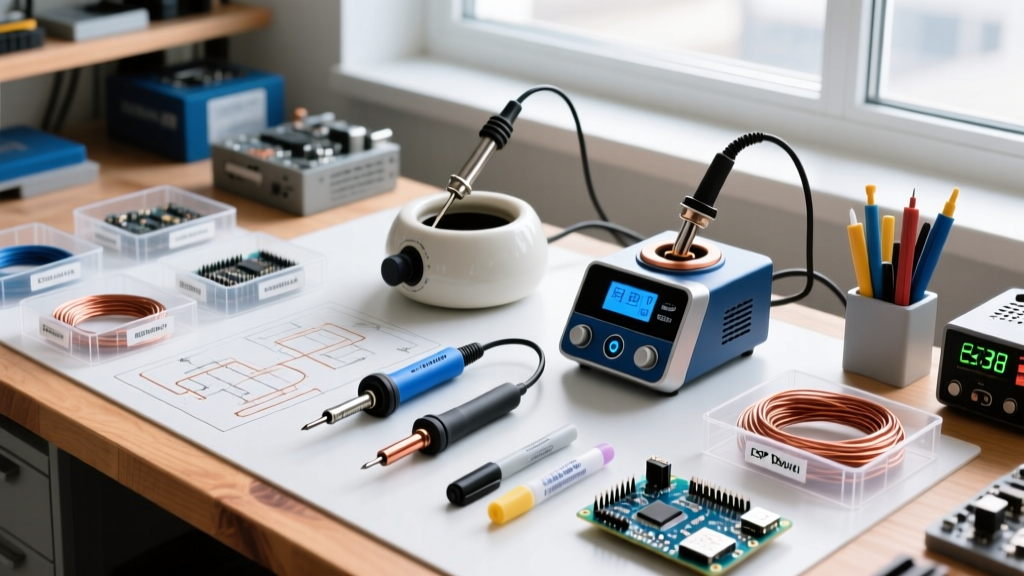
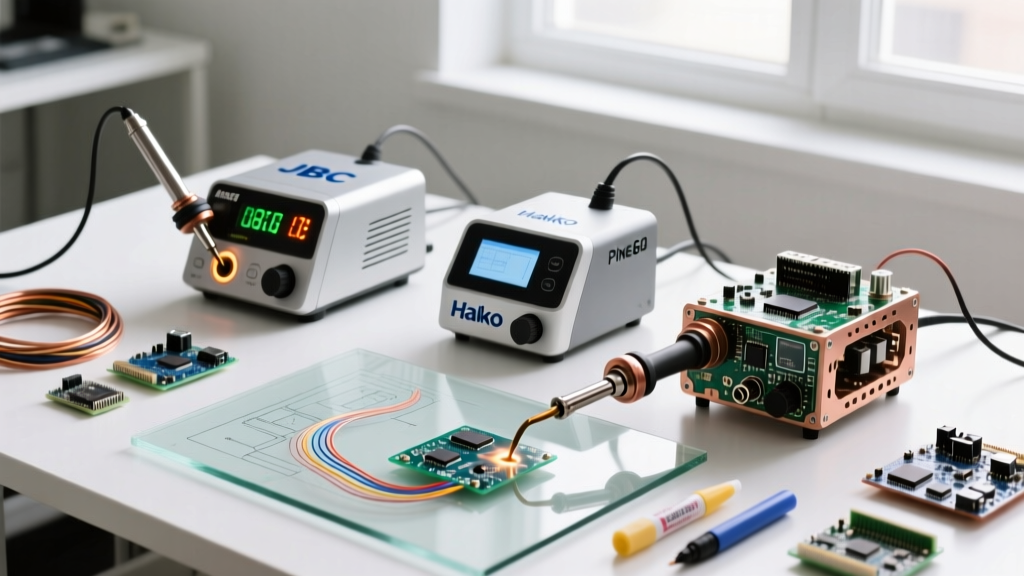
- Station: Hakko FX-951 or Weller WE1010NA. Both feature active thermal recovery sensors.
- Tip Geometry: Use a 2.4mm to 4.0mm Chisel tip (e.g., Hakko T15-D24). Never use conical tips on brass; the microscopic contact area cannot transfer the necessary thermal mass.
- Temperature Setting: 360°C (680°F) for leaded solder; 380°C (716°F) for SAC305. Do not exceed 400°C, or you will accelerate zinc vaporization and pitting.
Step-by-Step Execution Protocol
- Mechanical Prep: Remove factory clear-coats and heavy oxidation using a 3M Scotch-Brite 7447 pad. Do not use steel wool, which embeds iron particles that cause rust.
- Chemical Prep: Wipe the joint with 99% Isopropyl Alcohol to remove skin oils and machining coolants.
- Flux Application: Apply a generous layer of your selected flux (Acid for C360, RMA for C260). Allow it to sit for 30 seconds to begin breaking down surface oxides.
- Pre-Tinning: Apply a small amount of solder to the brass surface before bringing the two mating parts together. If the solder wets and spreads into a mirror finish, your flux is working. If it balls up, stop, clean, and switch to a more aggressive acid flux.
- Final Join: Bring the mated parts together, apply the iron to the thickest part of the joint, and feed solder into the capillary gap. Maximum dwell time: 4 seconds.
- Neutralization: If acid flux was used, scrub with a baking soda paste, rinse with distilled water, and dry with compressed air.
Real-World Failure Modes & Troubleshooting
Failure Mode 1: The "Ball-Up" Effect (Non-Wetting)
Cause: The zinc oxide layer is too thick for the flux to dissolve, or the iron temperature dropped below the flux's activation threshold.
Fix: Increase iron temperature by 15°C. Switch to a larger chisel tip to increase thermal mass transfer. Upgrade from RMA to Zinc Chloride flux.
Failure Mode 2: Black Pitting and Porosity
Cause: Overheating. Zinc vaporizes and oxidizes violently at excessive temperatures, leaving microscopic craters in the solder fillet.
Fix: Lower your station temperature. Reduce dwell time to under 3 seconds. Ensure you are not using a high-wattage gun meant for stained glass.
Failure Mode 3: Cold Joint Cracking (Graininess)
Cause: Moving the brass part while the SAC305 or Sn63 solder is in its plastic (mushy) phase.
Fix: Use a third-hand tool or ceramic putty to immobilize the brass component. Wait for the solder to lose its liquid sheen before releasing the part.
Expert FAQ: Brass Soldering Nuances
Can I use plumbing solder (50/50 Tin/Lead) on brass electrical contacts?
No. 50/50 solder has a wide plastic range (183°C to 214°C). If the brass moves during this cooling phase, the joint will fracture internally. Always use eutectic Sn63/Pb37 for electrical connections to ensure an instant liquid-to-solid transition.
Is it safe to solder brass indoors?
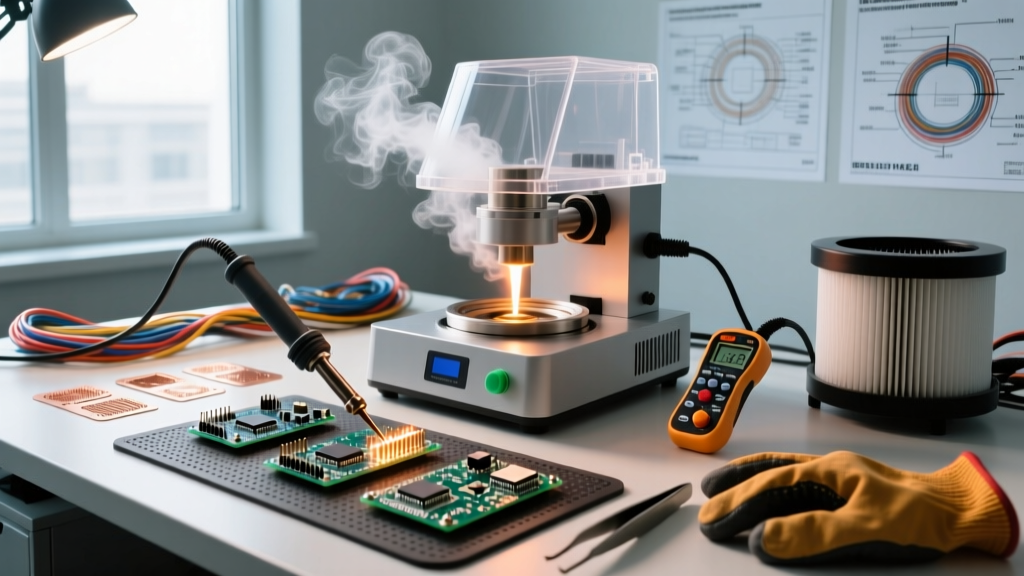
Soldering C260 is safe with standard fume extraction. However, if you overheat C360 or use highly active acid fluxes, you risk releasing zinc oxide fumes and hydrochloric acid vapors. Always use a HEPA/Carbon fume extractor (like the Hakko FA-400) positioned within 6 inches of the joint.
Why does my solder turn grey and crusty on brass after a few days?
This is acid flux residue eating into the zinc. As noted by MacDermid Alpha Electronics (Kester), unneutralized zinc chloride residues will continue to etch the base metal indefinitely. You must chemically neutralize the joint immediately after cooling.
Final Verdict
Can brass be soldered? Absolutely. But success relies entirely on respecting the metallurgy of the specific alloy you are holding. By matching C260 with RMA flux and C360 with Zinc Chloride, utilizing high-thermal-mass chisel tips, and strictly controlling your dwell time, you can achieve aerospace-grade capillary joints on brass components every time.