
The Great Debate: Soldering vs. Brazing in HVAC Systems
When technicians and DIYers search for guides on soldering air conditioning lines, they are often using a colloquialism that masks a critical, code-enforced technical distinction. In the HVAC/R (Heating, Ventilation, Air Conditioning, and Refrigeration) industry, joining pressurized copper refrigerant lines is almost exclusively a brazing process, not a soft soldering process. We convened a panel of three senior HVAC/R commissioning agents and metallurgy experts to break down the exact protocols, material costs, and failure modes associated with joining AC lines in 2026.
According to the EPA Section 608 regulations, refrigerant circuit integrity is paramount to prevent the release of high-GWP (Global Warming Potential) refrigerants like R-454B and R-32, which dominate the 2026 market. Soft soldering (operating below 450°F / 232°C) lacks the tensile strength and vibration resistance required for compressor discharge lines, which routinely see pressures exceeding 400 PSI and temperatures above 180°F. Brazing, which utilizes filler metals that melt above 840°F (450°C), creates a metallurgical bond capable of withstanding these extreme operational stresses.
"The biggest mistake I see junior techs make is treating a refrigerant line like a residential water pipe. If you soft-solder a liquid line, the vibration from the compressor will fatigue the joint, leading to a micro-leak that destroys the system's charge and burns out the compressor." — Marcus Thorne, Senior HVAC/R Commissioning Agent
Filler Metal Showdown: What the Pros Actually Buy in 2026
The precious metals market has seen significant volatility, directly impacting the cost of silver-bearing brazing rods. In 2026, the price of 15% silver-phosphorus-copper rods has surged, prompting some budget-conscious contractors to downgrade to 5% or 2% alternatives. Our panel unanimously advises against this for high-vibration zones (like the compressor service valves).
Expert Filler Metal Matrix
| Alloy Type | Brand / Model Example | Composition | Melting Range | 2026 Est. Cost | Best Application |
|---|---|---|---|---|---|
| Silver-Phos-Copper (15%) | Harris Sil-Fos 15 | 15% Ag, 80% Cu, 5% P | 1190°F - 1475°F | $75 - $85 / oz | Copper-to-Copper (High Vibration) |
| Silver-Phos-Copper (5%) | Harris Dyna-Flo 5 | 5% Ag, 87% Cu, 8% P | 1175°F - 1550°F | $40 - $50 / oz | Copper-to-Copper (Low Vibration) |
| High-Temp Solder | Harris Stay-Brite 8 | 8% Ag, 92% Tin | 535°F | $35 / oz | Condensate Drains, Low-Pressure Traps |
| Silver Braze (45%) | Harris Safety-Silv 45 | 45% Ag, 30% Cu, 25% Zn | 1225°F - 1370°F | $120+ / oz | Copper-to-Steel / Copper-to-Brass |
Expert Insight: "For 90% of residential split-system installations, copper-to-copper joints are the norm. You must use a phosphorus-bearing alloy like Sil-Fos 15. The phosphorus acts as a self-fluxing agent, breaking down copper oxide. However, if you are tying into a steel accumulator or a brass reversing valve, the phosphorus will create a brittle iron-phosphide or zinc-phosphide layer. You must switch to a 45% silver alloy and use a white paste flux for those dissimilar metal joints," explains Sarah Jenkins, HVAC Metallurgical Consultant.
The Silent Killer: Oxidation and Nitrogen Purging
When copper is heated to brazing temperatures (1,200°F+) in the presence of atmospheric oxygen, it rapidly forms black copper oxide scale on the inside of the pipe. The Copper Development Association (CDA) explicitly mandates inert gas purging to prevent this. If this scale is allowed to form, it will eventually flake off during system operation and clog the TXV (Thermostatic Expansion Valve) or EEV (Electronic Expansion Valve), or worse, embed itself in the compressor windings and cause a short to ground.
Step-by-Step Nitrogen Purge Protocol
- Connect the Regulator: Attach a nitrogen regulator to your 'N' or 'K' cylinder. Do not use a standard manifold gauge hose; use a dedicated 1/4" copper purge hose.
- Set the Flow Rate: Dial the regulator to 2 to 3 SCFH (Standard Cubic Feet per Hour). This usually equates to roughly 1 to 2 PSI on the gauge. Warning: Blowing nitrogen at 20 PSI will not only waste gas but can create turbulence that draws oxygen into the joint through the Venturi effect.
- Verify Flow: Place a slightly damp rag or a specialized purge indicator over the open end of the line to confirm a gentle, steady flow of inert gas before striking the torch.
- Maintain Through Cool-Down: Keep the nitrogen flowing until the copper drops below 400°F. Oxidation can still occur during the cooling phase if the gas is cut prematurely.
Torch Selection and Heat Management
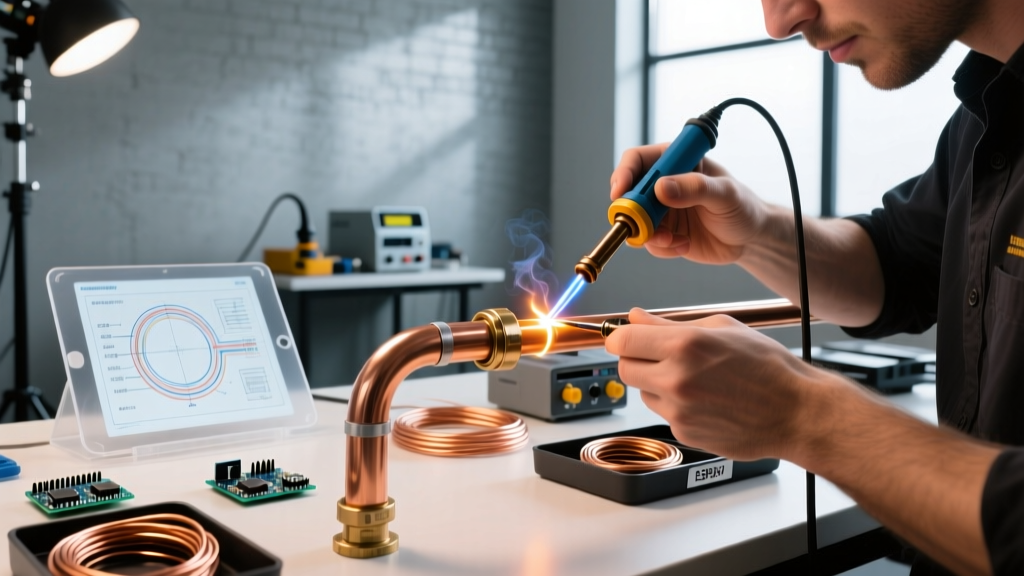
The choice of torch dictates your speed and the quality of the capillary draw. For standard 3/8" to 7/8" OD refrigerant lines, our experts recommend an Oxy-Acetylene setup with a swirl-combustion tip, such as the Victor 100FC with a #2 or #3 tip. Swirl tips concentrate the heat envelope, allowing you to reach brazing temperatures in under 15 seconds, minimizing the time the flux has to burn off.
- Oxy-Acetylene (5,700°F): The undisputed king for 7/8" and 1-1/8" OD lines. The high thermal transfer rate prevents the base metal from acting as a massive heat sink.
- Oxy-Propane / MAPP (4,500°F): Excellent for tight spaces and smaller lines (1/4" to 3/8"). It produces a softer, broader flame that reduces the risk of melting thin-walled copper, but struggles to bring large thermal masses up to the 1,300°F required for Sil-Fos flow.
The Capillary Action Secret
A proper brazed joint relies on capillary action, not gravity or surface piling. The ideal joint clearance for copper-to-copper brazing is between 0.002 and 0.005 inches. If the tube is loose inside the fitting, the filler metal will not draw into the cup. If it is forced in and bottomed out, thermal expansion during heating will push the tube outward, breaking the capillary draw. Always use a proper tubing cutter and a calibrated depth gauge to ensure the tube is inserted exactly to the shoulder of the fitting, leaving a microscopic gap for the molten alloy to wick into.
Common Failure Modes and Edge Cases
Even with the right materials, field conditions introduce variables that cause joint failures. Our panel identified the top three edge cases techs face in 2026:
- Cold Lap (Insufficient Heat): The filler rod melts because the torch flame is melting it, not the base metal. The rod simply sits on the surface of the fitting like a blob of bubblegum. Fix: Heat the fitting, not the rod. Touch the rod to the joint; it should only melt when the copper itself has reached the alloy's liquidus temperature.
- Flux Inclusions: When brazing dissimilar metals (copper to brass) using Safety-Silv 45 and white flux, failing to clean the joint post-braze leaves corrosive fluoride salts on the pipe. In high-humidity environments, this causes rapid galvanic corrosion. Fix: Quench with a wet rag and scrub with a wire brush and warm water immediately after the joint solidifies.
- Micro-Porosity from Moisture: If a system is opened on a 90% humidity day and moisture condenses inside the line, the rapid steam generation during brazing will blow pinholes in the molten filler metal. Fix: Always perform a dry nitrogen sweep before brazing to displace ambient moisture.
Final Verdict from the Panel
Mastering the art of joining refrigerant lines requires abandoning the term "soldering" when dealing with the pressurized circuit. By investing in high-silver phosphorus-copper alloys, strictly adhering to low-CFH nitrogen purging, and utilizing swirl-tip oxy-acetylene torches, technicians can guarantee joints that will outlast the 15-to-20-year lifespan of modern variable-speed inverter compressors. Soft soldering (like Stay-Brite 8) should be strictly reserved for PVC-to-copper condensate drain adapters and low-pressure accessory ports.