
What Defines Soft Soldering in Modern Electronics?
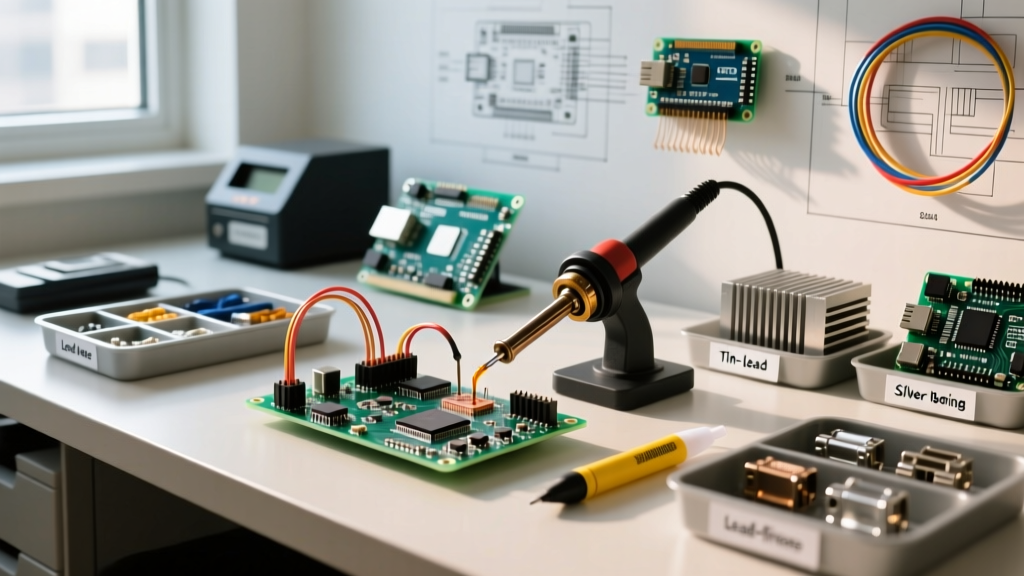
In the realm of electrical assembly and DIY rework, soft soldering is defined by the IPC Standards as a joining process utilizing a filler metal (solder alloy) with a liquidus temperature strictly below 450°C (842°F). Unlike hard soldering or brazing, which relies on capillary action and base metal diffusion at extreme temperatures, soft soldering relies on surface wetting and intermetallic compound (IMC) formation at relatively low thermal thresholds. In 2026, the vast majority of commercial and hobbyist PCB assembly relies on either eutectic Tin-Lead (Sn63Pb37) or lead-free SAC (Tin-Silver-Copper) alloys. Understanding the precise metallurgy and thermal dynamics of these alloys is the first step in troubleshooting defective assemblies.
The Ultimate Soft Soldering Troubleshooting Matrix
Before reaching for your soldering iron, diagnose the visual symptoms of your joint. The following matrix cross-references common visual defects with their root causes and immediate corrective actions, aligned with NASA Workmanship Standards for high-reliability electronics.
| Visual Symptom | Technical Root Cause | Corrective Action |
|---|---|---|
| Cold Joint (Dull, grainy, convex meniscus) | Insufficient thermal transfer; joint moved during the plastic/pasty phase of solidification. | Apply fresh RMA flux. Reflow with a chisel tip at +20°C above liquidus. Hold stationary until fully solidified. |
| Solder Bridging (Shorts between adjacent pins) | Excessive solder volume; insufficient flux activity; incorrect tip geometry for fine-pitch. | Apply no-clean tacky flux. Drag a clean, fluxed bevel tip across pins. Remove excess with 0.050" copper wick. |
| Non-Wetting (Solder balls up, avoids pad) | Severe oxidation on PCB pad or component lead; expired or contaminated solder paste. | Mechanically clean pad with fiberglass scratch pen. Apply aggressive rosin-based flux (e.g., Kester 186) and re-tin. |
| Pad Lifting (Copper trace separates from FR-4 substrate) | Excessive dwell time (>3 seconds); iron temperature exceeding 400°C on standard Tg130 laminate. | Lower iron temp to 350°C. Use a larger thermal mass tip to transfer heat faster, reducing required dwell time. |
| Icicles / Spikes (Sharp protrusions on through-hole joints) | Flux exhaustion before solder solidified; pulling the iron away too slowly or at the wrong angle. | Reflow with additional liquid flux. Withdraw the iron at a sharp 45° angle in a single, swift motion. |
Deep-Dive Failure Analysis: Why Joints Fail
1. The Metallurgy of Cold and Disturbed Joints
A true "cold joint" is rarely caused by the iron being simply "too cold." More often, it is a disturbed joint. Lead-free alloys like SAC305 (Sn96.5/Ag3.0/Cu0.5) have a melting point of 217°C, but they do not freeze instantly. They exhibit a "pasty range" where the alloy is semi-solid. If the component or PCB is subjected to mechanical vibration or thermal shock (like a blast of cold air from a fan) while in this pasty range, the forming intermetallic crystals fracture. This results in the classic grainy, dull, and brittle appearance. To fix this, you must completely re-melt the joint using an active flux to strip the newly formed surface oxides, and allow it to cool naturally in still air.
2. Solder Bridging on Fine-Pitch Components
When soft soldering 0.5mm or 0.4mm pitch QFP (Quad Flat Package) ICs, bridging is the most frequent failure mode. The surface tension of molten solder wants to pull the liquid into a sphere, but flux reduces this surface tension, allowing the solder to wet the copper pads preferentially. If you experience bridging, do not add more solder. Instead, apply a high-tack no-clean flux gel (such as Amtech NC-559-V2-TF). Use a Chemtronics desoldering braid to wick away the excess mass, then perform a final drag-soldering pass with a hoof/bevel tip loaded with a microscopic amount of fresh solder and copious flux.
3. Thermal Damage and Pad Lifting
FR-4 PCB laminates are bound by epoxy resins that degrade under extreme localized heat. Standard FR-4 has a Glass Transition Temperature (Tg) of roughly 130°C to 140°C. When a 380°C soldering iron tip contacts a small SMD pad, the thermal gradient is massive. If the tip dwells for more than 3 to 4 seconds, the epoxy softens, and the mechanical bond between the copper foil and the fiberglass substrate fails. When you remove the iron, the copper pad lifts right off the board. The counter-intuitive solution is to use a larger, wider tip. A wider chisel tip increases the contact area, transferring the necessary joules of heat into the joint in under 1.5 seconds, well before the substrate reaches its failure threshold.
Soft Soldering FAQ: Expert Answers
Q: Why is my solder balling up and refusing to flow onto the pad?
A: This is a non-wetting or de-wetting failure, almost always caused by heavy oxidation. If a PCB has been sitting in a humid environment for months, the copper pads develop a thick oxide layer that standard mild rosin flux cannot penetrate. You must mechanically remove the oxidation using a fiberglass scratch pen or very fine 2000-grit sandpaper until bright copper is visible, then immediately apply a mildly activated rosin flux (RMA) and tin the pad with fresh 63/37 solder.
Q: Can I use plumbing flux for PCB soft soldering?
A: Absolutely not. Plumbing soft soldering utilizes highly corrosive acid-core fluxes (like zinc chloride or Oatey paste) designed to eat through heavy oxidation on copper pipes. If used on a PCB, the acid residue will remain active, rapidly corroding the thin copper traces and causing catastrophic short circuits due to ionic contamination. Always use electronics-grade Rosin (R, RMA, RA) or No-Clean (NC) fluxes.
Q: What is the ideal iron temperature for SAC305 lead-free soft soldering?
A: While SAC305 melts at 217°C, your iron must be set significantly higher to account for thermal loss upon contact with the PCB's ground planes. For standard multilayer boards, set your station (e.g., Hakko FX-951 or Weller WE1010) to 350°C - 370°C. If you are soldering to heavy copper pours or large ground vias, you may need to temporarily increase to 385°C, but never exceed 400°C, as this will rapidly oxidize your iron tip and degrade the flux chemistry before it can clean the joint.
2026 Buyer Recommendations for Soft Soldering Consumables
Having the right diagnostic knowledge is only half the battle; executing the repair requires premium consumables. Here are the current industry-standard recommendations for serious rework:
- Wire Solder (Leaded): Kester 24-6337-00273 (0.031" diameter, Sn63Pb37, 331 Flux Core). Remains the gold standard for hobbyists and repair techs where lead restrictions do not apply. Expect to pay around $35-$45 per 1lb spool in 2026.
- Wire Solder (Lead-Free): Alpha Assembly EcoCore SAC305 (0.020" diameter). Features a halogen-free, no-clean core that minimizes splatter and leaves a safe, non-conductive residue. Priced at approximately $55-$65 per spool.
- Tacky Flux Gel: Amtech NC-559-V2-TF (10cc syringe). Essential for BGA rework, drag soldering, and reflowing cold joints. Its high viscosity keeps it exactly where you dispense it until heated. (~$25 per syringe).
- Desoldering Wick: Chemtronics 80-6-5 Soder-Wick (0.060" width, No-Clean flux coated). The precise oxide-free copper braiding wicks molten solder via capillary action faster than any competitor, minimizing thermal dwell time on delicate pads. (~$8 per 5ft roll).
Final Thoughts on Process Control
Soft soldering is less about raw heat and more about thermal management and chemical surface preparation. By respecting the metallurgical limits of your chosen alloy, utilizing the correct flux chemistry for the specific oxidation level, and adhering to strict dwell-time limits, you will eliminate 95% of common rework defects. Keep your tips tinned, store your solder paste in a cool environment, and always inspect your final joints under a 10x loupe or digital microscope to verify proper wetting and fillet formation.