
The "Soldering Liquid" Misconception: Flux vs. Paste
When hobbyists and junior technicians search for "soldering liquid," they are almost always looking for liquid flux. In the electronics manufacturing industry, true solder is a solid alloy (wire, bar, or preform). The term "liquid solder" is a colloquial misnomer that typically refers to either liquid flux used for drag soldering and BGA rework, or conductive silver epoxy. For PCB assembly and rework in 2026, liquid flux is the critical chemical agent that removes oxidation, reduces surface tension, and ensures proper wetting.
To cut through the marketing noise, we convened a panel of three IPC-certified master instructors and rework station engineers to evaluate the top liquid fluxes on the market. Their insights are grounded in the rigorous IPC J-STD-001 requirements for soldered electrical and electronic assemblies.
2026 Expert Panel Criteria for Liquid Flux Selection
As component densities shrink to 01005 passives and 0.35mm pitch BGAs, the chemical properties of your flux dictate your yield rate. Our experts evaluated candidates based on four non-negotiable metrics:
- Surface Insulation Resistance (SIR): Must maintain >10^11 ohms post-reflow to prevent parasitic leakage in high-impedance analog circuits.
- Activation Thermal Window: The flux must activate smoothly between 120°C and 150°C without violent spattering (outgassing) when the iron tip hits 350°C.
- Residue Tack & Cleanability: No-clean residues must be non-tacky to prevent dust accumulation, while water-soluble variants must rinse cleanly in DI water without leaving ionic salts.
- Halogen-Free Compliance: Adherence to IEC 61249-2-21 standards, ensuring zero bromine or chlorine that could cause long-term corrosion under conformal coatings.
Comparison Matrix: Top Liquid Fluxes by Application
| Product Model | Chemistry Type | Activation Temp | Residue Profile | Best Application | Est. Price (2026) |
|---|---|---|---|---|---|
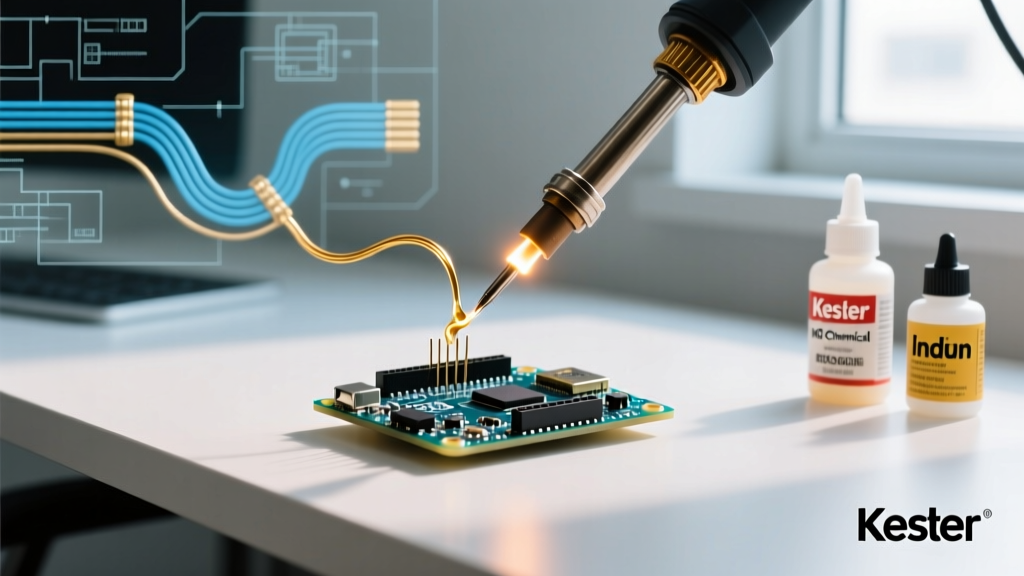
| Kester 951 | RMA (Rosin Mildly Activated) | 120°C - 140°C | Hard, non-conductive, cleanable | Through-hole, heavy drag soldering | $22 / 2oz |
| MG Chemicals 8341 | No-Clean, Halogen-Free | 130°C - 160°C | Minimal, non-tacky, clear | SMD rework, QFN/BGA stenciling | $28 / 100ml |
| Indium #1013 | Water-Soluble (Organic Acid) | 100°C - 130°C | Highly active, mandatory wash | Aerospace, medical, severe oxidation | $45 / 100g |
Deep Dive: Expert Picks & Real-World Performance
Kester 951: The RMA Workhorse for Through-Hole & Drag Soldering
According to our panel, Kester 951 remains the undisputed king of mildly activated rosin (RMA) liquid fluxes. It contains a precise blend of natural gum rosin and mild activators that strip copper oxidation rapidly without pitting the pad.
"When I am teaching students how to drag-solder a 100-pin TQFP microcontroller, Kester 951 is the only liquid I allow on the bench. Its high rosin content provides a physical barrier that prevents solder bridges, and the flux boils at a rate that perfectly matches a standard 320°C chisel tip."
— Sarah Jenkins, IPC-7711/7721 Certified Trainer
Failure Mode Warning: Because Kester 951 leaves a hard, amber rosin residue, it can trap heat if applied too thickly over thermal vias. Furthermore, if you are applying a silicone conformal coating later, the rosin residue must be cleaned with a saponifier like MicroCare MCC-PRMA, otherwise the coating will delaminate.
MG Chemicals 8341: The No-Clean Champion for SMD Rework
For modern surface-mount rework where cleaning is impractical, MG Chemicals 8341 is our top 2026 recommendation. This is a true no-clean, halogen-free liquid flux. Unlike cheaper alcohol-based fluxes that evaporate before the solder melts, 8341 utilizes a proprietary solvent carrier that sustains activation through the entire reflow profile of SAC305 (Silver/Copper) lead-free alloys.
Expert Tip: Use a 25-gauge Luer-lock needle on a pneumatic dispenser set to 0.8 bar. This deposits exactly 0.05ml per drop, perfectly wetting a 0603 pad without flooding the adjacent component.
Indium #1013: High-Reliability Water-Soluble for Aerospace
When working on heavily oxidized legacy boards or high-reliability medical devices, no-clean and RMA fluxes lack the chemical aggression required. Indium #1013 is an organic acid (OA) water-soluble liquid flux that strips severe tarnish in milliseconds. The Indium Corporation technical datasheets highlight its exceptional wetting speed, which is critical when hand-soldering large ground planes that act as massive heat sinks.
Critical Cleaning Protocol: Water-soluble fluxes are highly corrosive if left on the board. You must clean the assembly with heated (60°C) deionized (DI) water within 2 hours of soldering. Failure to do so will result in dendritic growth (electrochemical migration) and catastrophic short circuits under humidity.
Application & Dispensing: Expert Techniques
The best liquid flux will fail if applied incorrectly. Our experts outlined the following dispensing protocols based on the component topology:
- The Flux Pen (Kester 951 Pen): Ideal for broad, quick application on through-hole headers. Drawback: The felt tip degrades over time, leaving microscopic fibers on the PCB that can burn during soldering and cause carbon tracking.
- Syringe & Blunt Needle (21 to 27 Gauge): The professional standard. Use a 21-gauge needle for thick, viscous fluxes over large BGA pads. Step up to a 27-gauge needle for precision micro-SMD work. Always cap the needle immediately to prevent solvent evaporation and clogging.
- Aerosol Spray: Reserved exclusively for selective wave soldering pallets or full-board pre-treatment. Never use aerosol liquid flux for precision SMD rework; the overspray will contaminate connectors and optical sensors.
Critical Failure Modes: What Happens When You Choose Wrong?
Choosing the wrong liquid flux chemistry for your specific thermal profile and end-use environment leads to distinct, measurable failures:
- Parasitic Capacitance in RF Circuits: If you use a high-residue RMA flux on a 2.4GHz or 5GHz RF antenna trace and fail to clean it, the dielectric constant of the rosin residue will detune the antenna, dropping signal gain by 2-4 dB.
- Outgassing and Solder Spatter: Applying a water-based or low-boiling-point liquid flux to a board preheated above 150°C causes instantaneous vaporization. This results in microscopic solder balls (spatter) lodging under BGA packages, causing hidden shorts.
- Probe Contact Failure: Tacky no-clean residues will coat ICT (In-Circuit Test) pogo pins, leading to false-negative test results and expensive debugging delays on the production line.
FAQ: Expert Answers on Liquid Soldering Compounds
Can I use plumbing liquid flux for electronics?
Absolutely not. Plumbing liquid fluxes (often zinc chloride or highly aggressive hydrochloric acid blends) are designed for copper pipes, not PCBs. They will instantly destroy the copper traces, eat through the solder mask, and cause irreversible galvanic corrosion. Always use fluxes specifically formulated to IPC J-STD-004 standards.
Does liquid flux expire?
Yes. Unopened liquid flux typically has a shelf life of 12 to 24 months when stored between 10°C and 25°C. Once opened, the volatile alcohol or glycol ether solvents begin to evaporate, increasing the viscosity and altering the activation temperature. If your liquid flux becomes syrupy or crystallizes, discard it; attempting to thin it with IPA (Isopropyl Alcohol) will ruin the precise activator-to-rosin ratio.
What is the difference between liquid flux and tacky flux?
Liquid flux has a low viscosity (similar to water or light oil) and relies on capillary action to flow under components. Tacky flux (flux paste) contains thixotropic agents and rosin solids that give it a gel-like consistency, allowing it to hold SMD components in place prior to reflow. For drag soldering, liquid is superior; for BGA reballing, tacky flux is mandatory.