
The Professional Standard: Bernzomatic Soldering Torch Applications in the Trades
When industrial contractors, HVAC technicians, and heavy-duty electricians need reliable, high-BTU heat in the field, the bernzomatic soldering torch is frequently the tool of choice. While hardware store shelves are lined with generic pencil torches and basic butane irons, professional trades require equipment capable of overcoming the massive thermal sinks found in large-diameter copper pipes and heavy-gauge electrical lugs. Bernzomatic, a brand now under the Worthington Industries umbrella, has dominated this space by engineering torches with swirl-combustion technology that wraps the flame around the workpiece, drastically reducing heat-up times and preventing localized overheating.
In this comprehensive industry guide, we break down the exact Bernzomatic models used in commercial plumbing, HVAC refrigeration, and heavy electrical grounding. We will explore the metallurgical realities of sweating copper, the specific filler alloys required for code-compliant joints, and the field troubleshooting techniques that keep your torch firing in sub-zero weather.
Core Hardware: TS8000 vs. TS4000 for Industrial Use
To understand how to apply these tools, you must first understand the thermodynamics of the fuel and the burner head design. The two flagship models for professional use are the TS8000 and the TS4000. Both feature a cast-aluminum burner head and a piezoelectric instant igniter, but their internal swirl chambers and fuel compatibilities dictate their specific industry applications.
A critical E-E-A-T note for professionals: True MAPP gas (methylacetylene-propadiene) was discontinued in 2008. When technicians refer to 'MAPP' today, they are actually using MAP-Pro, which is propylene (C3H6). Propylene burns significantly hotter than standard propane and is essential for overcoming the thermal mass of pipes larger than 1/2-inch OD.
| Model | Primary Fuel | Max Flame Temp (Air) | Burner Tech | Best Industry Application | 2026 Avg. Price (Head) |
|---|---|---|---|---|---|
| Bernzomatic TS8000 | MAP-Pro (Propylene) | 3,730°F (2,054°C) | High-Intensity Swirl | HVAC linesets, 4/0 AWG+ lugs, brazing | $52 - $58 |
| Bernzomatic TS4000 | Propane | 3,600°F (1,982°C) | Standard Swirl | Residential plumbing, small wire lugs | $38 - $42 |
| Bernzomatic ST2200T | Butane | 3,150°F (1,732°C) | Pencil Flame | Micro-electronics, jewelry (Not for heavy industry) | $25 - $30 |
HVAC and Refrigeration: Sweating Copper Linesets
In the HVAC industry, the integrity of a refrigerant lineset is paramount. According to the EPA Section 608 regulations, technicians must ensure systems are completely leak-free to prevent the release of ozone-depleting substances and high-GWP HFC/HFO refrigerants. While brazing (using brass or high-silver alloys above 840°F) is preferred for high-pressure R-410A and R-32 systems, soft soldering is still widely used for low-pressure suction lines, drain lines, and specific service valves.
Overcoming Thermal Mass in Large-Diameter Pipes
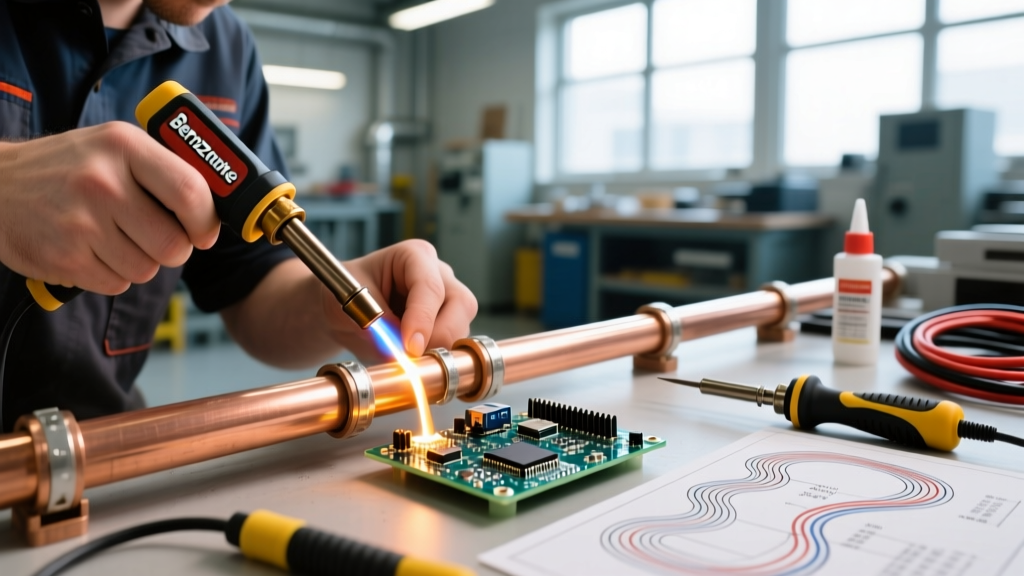
When sweating a 7/8-inch OD suction line, the thermal mass of the copper acts as a massive heat sink. A standard pencil torch will result in a 'cold joint' because the heat dissipates into the surrounding pipe faster than the filler metal can melt. The Bernzomatic TS8000 solves this via its swirl combustion chamber. The gas is injected at an angle, creating a vortex that projects a concentrated, wrapping flame. This heats the entire circumference of the fitting simultaneously, ensuring the flux activates and the solder draws into the joint via capillary action evenly.
Alloy Selection: Sil-Fos vs. Lead-Free
For copper-to-copper HVAC joints, technicians rely on silver-bearing phosphorus-copper alloys like Sil-Fos 5 (5% silver, 6% phosphorus, 89% copper). The phosphorus acts as a self-fluxing agent on bare copper, eliminating the need for corrosive chemical fluxes that could be drawn into the compressor. The TS8000 running on MAP-Pro provides the precise 1,300°F to 1,500°F working range required to flow Sil-Fos without burning the silver out of the matrix.
Heavy-Duty Electrical: Lug Terminations and Grounding
In commercial and industrial electrical work, terminating 4/0 AWG to 500 MCM copper ground wires to building steel or grounding buses requires soldered lugs for high-fault-current reliability. Mechanical crimps are standard, but utility specs often mandate solder-sealed lugs to prevent moisture ingress and galvanic corrosion over decades of service.
Industry Warning: Never use plumbing flux (which contains zinc chloride or ammonium chloride) on electrical connections. These acidic fluxes are highly corrosive and will eat through the copper strands over time, leading to high-resistance faults. Always use a rosin-based, no-clean electrical flux, or a specialized electrical solder paste like Harris Stay-Brite 8 kit, which includes a mild, non-corrosive flux.
A 500 MCM copper lug holds an immense amount of thermal energy. To solder this properly, the electrician must pre-tin the lug, apply the rosin flux, and use the TS8000 to heat the barrel of the lug—not the wire directly. Once the lug reaches roughly 450°F, the Stay-Brite 8 (which flows at 535°F) is touched to the seam. The solder will instantly wick into the barrel. A wet rag or specialized heat-sink paste must be applied to the wire insulation an inch away from the lug to prevent the XHHW or THHN insulation from melting back.
Step-by-Step: Sweating a 3/4-Inch Type L Copper Joint
To illustrate the proper field technique using a Bernzomatic TS4000 (adequate for 3/4-inch plumbing lines), follow this industry-standard procedure:
- Surface Preparation: Cut the pipe square using a rotary tube cutter. Ream the inside edge to prevent turbulent water flow. Use 120-grit emery cloth to polish the outside of the pipe and the inside of the fitting until both shine like a new penny. Oxidation is the enemy of capillary action.
- Flux Application: Apply a thin, even layer of water-soluble lead-free plumbing flux (e.g., Oatey No. 95) to the pipe. Insert the pipe into the fitting and give it a quarter-turn to spread the flux evenly and prevent air pockets.
- Heat Application: Ignite the TS4000. Apply the inner blue cone of the flame to the fitting, not the pipe. Move the flame in a circular motion to heat the joint evenly. Touch the solder to the opposite side of the joint from the flame.
- Capillary Draw: When the fitting reaches the correct temperature (roughly 450°F for lead-free 95/5 tin-antimony solder), the solder will instantly melt and be sucked into the joint. Feed exactly 3/4-inch of solder for a 3/4-inch joint. Wipe the joint with a damp rag to smooth the fillet and remove residual flux.
Field Troubleshooting and Maintenance
Industrial environments are harsh. Torches get dropped in mud, left in freezing vans, and clogged with vaporized flux. Here is how to troubleshoot common Bernzomatic failures on the job site:
- Symptom: Flame sputters or dies in cold weather.
Cause: Propane struggles to vaporize below 32°F (0°C).
Solution: Switch to the TS8000 and MAP-Pro. Propylene has a lower boiling point (-53°F) and maintains high vapor pressure in sub-zero environments. Never heat a fuel cylinder with a torch or hot water; keep it inside your coat until ready to use. - Symptom: Yellow, sooty flame instead of a sharp blue cone.
Cause: Carbon buildup in the swirl chamber or a blocked gas orifice from vaporized flux.
Solution: Disconnect from the cylinder. Use a brass wire brush to gently clean the burner tube. Blow compressed air backward through the gas orifice to dislodge carbon deposits. - Symptom: Hissing sound at the cylinder connection.
Cause: Degraded O-ring or cross-threaded CGA 600 connection.
Solution: Inspect the black rubber O-ring inside the torch collar. If flattened or cracked, replace it. Ensure you are threading the collar straight on to avoid stripping the brass threads.
Safety and Code Compliance on the Job Site
Using a high-BTU Bernzomatic soldering torch constitutes 'hot work' under most commercial building codes. According to the NFPA 51B standard for fire prevention during hot work, contractors must utilize a fire watch and appropriate shielding when working near combustible framing, insulation, or drywall. Always use a flame-retardant cloth or a specialized copper heat-shield pad behind the joint when sweating pipes in enclosed stud bays. Furthermore, the Copper Development Association strongly advises against quenching hot copper joints with water immediately after soldering, as thermal shock can cause micro-fractures in the solder matrix, leading to pinhole leaks months after the system is pressurized.
By matching the correct Bernzomatic model to your specific thermal requirements, selecting the right metallurgical filler, and adhering to strict safety protocols, you ensure that every joint you make will withstand the pressure, temperature, and time demands of professional industry applications.