
The 2026 Landscape of DIY Water Quality Monitoring
As of 2026, the integration of water quality monitoring into DIY hydroponics, aquaponics, and automated aquariums has moved from a niche hobbyist pursuit to a standard requirement. At the heart of particulate monitoring is the turbidity sensor Arduino ecosystem. Turbidity—the cloudiness or haziness of a fluid caused by large numbers of individual particles—is a critical proxy for water health, filtration efficiency, and bacterial load.
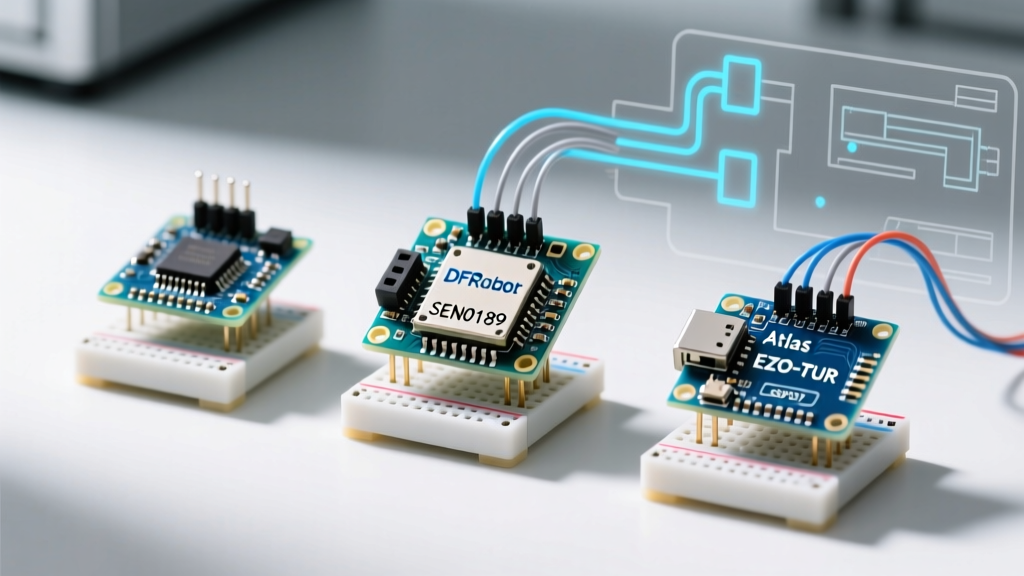
However, not all optical sensors are created equal. The market is currently flooded with everything from $4 generic clone modules to $150+ industrial-grade I2C probes. Choosing the wrong sensor can lead to catastrophic false readings, especially when dealing with colored water or micro-bubbles. In this component comparison, we dissect three distinct tiers of turbidity sensors for Arduino projects: the hobbyist-standard DFRobot SEN0189, the ultra-budget generic TSW-20M clones, and the industrial-grade Atlas Scientific EZO-TURB.
What is NTU?
Turbidity is measured in Nephelometric Turbidity Units (NTU). According to the U.S. Environmental Protection Agency (EPA), turbidity is a key indicator of water quality, where higher NTU values indicate more suspended solids. For context, the United States Geological Survey (USGS) notes that pristine mountain streams might register below 1 NTU, while muddy runoff can exceed 1,000 NTU. True scientific measurement requires adherence to the ISO 7027 standard, which dictates specific light wavelengths and scattering angles.
Component Comparison Matrix
| Feature | Generic TSW-20M Clone | DFRobot SEN0189 | Atlas Scientific EZO-TURB |
|---|---|---|---|
| Approx. Price (2026) | $4 - $7 | $16 - $19 | $149 - $165 |
| Light Source | Visible Red LED (~650nm) | NIR LED (~880nm) | NIR LED (860nm, ISO 7027) |
| Interface | Analog / Digital (LM393) | Analog (0-5V) | I2C / UART (EZO Chip) |
| Accuracy / Range | Low / 0-1000 NTU (Relative) | Medium / 0-3000 NTU | High / 0-4000 NTU (ISO Compliant) |
| Best Use Case | Basic threshold triggering | Hobbyist hydroponics & pools | Commercial agriculture & research |
Deep Dive: Generic TSW-20M Modules (The Budget Gamble)
The generic modules found on Amazon and AliExpress are easily identifiable by their exposed PCBs, a visible red LED, and an LM393 comparator chip. They output both an analog voltage and a digital threshold pin (adjusted via a blue trimpot).
The Fatal Flaw: Wavelength and Absorbance
The primary failure mode of these $5 sensors is their use of a visible red LED (typically ~650nm). According to the ISO 7027 standard, turbidity must be measured using Near-Infrared (NIR) light at 860nm to prevent the color of the water from affecting the reading. Because the generic module uses visible red light, it measures absorbance as much as it measures scatter. If you add a dark, nutrient-rich liquid fertilizer to your hydroponic reservoir, the water will absorb the red light, causing the sensor to report a massive spike in turbidity—even if the water is perfectly clear of particulates.
- Pros: Extremely cheap; digital pin allows for simple 'if water is dirty, turn on filter' logic without an ADC.
- Cons: Fails ISO 7027; highly susceptible to water color; exposed optics lead to rapid biofouling.
Deep Dive: DFRobot SEN0189 (The Hobbyist Standard)
The DFRobot SEN0189 has been the go-to turbidity sensor Arduino choice for advanced hobbyists for several years. It features an enclosed optical chamber that blocks ambient light, a significant upgrade over the bare PCBs of generic clones.
Technical Specifications and Calibration
DFRobot utilizes an NIR LED, which vastly improves accuracy in colored liquids. The sensor outputs an analog voltage inversely proportional to turbidity (higher turbidity = lower voltage due to light scatter away from the photodetector).
Out of the box, DFRobot provides a polynomial mapping function for Arduino:
NTU = -1120.4 * V^2 + 5742.3 * V - 4352.9
While this formula works for general estimates, experienced integrators know that manufacturing variances in the phototransistors require a custom 3-point calibration using Formazin standard solutions or carefully measured DIY dilutions (like full-fat milk in distilled water, though milk fat globules scatter light differently than silica standards).
Wiring and Signal Conditioning
- VCC: 5V (Crucial: Do not power with 3.3V, or the internal LED will not reach the correct luminosity, ruining the calibration curve).
- GND: Common ground with the Arduino.
- AOUT: Connect to an analog pin (e.g., A0). Use a 0.1µF ceramic capacitor between AOUT and GND to filter high-frequency noise from water pumps.
Deep Dive: Atlas Scientific EZO-TURB (The Industrial Benchmark)
If you are building a commercial aquaponics facility or a university-grade water testing rig in 2026, the Atlas Scientific EZO-TURB is the undisputed heavyweight. Priced around $155, it is an entirely different class of device.
ISO 7027 Compliance and I2C Integration
The EZO-TURB strictly adheres to ISO 7027. It uses an 860nm NIR LED and a detector positioned exactly at a 90-degree angle to measure scattered light. This geometry ensures that only particulate scatter is measured, completely ignoring water coloration.
Instead of raw analog voltages, the EZO-TURB features an onboard microcontroller that handles the complex math, temperature compensation, and signal averaging. It communicates via I2C (default address 0x64) or UART. Sending the ASCII command R via I2C returns a perfectly formatted, calibrated NTU string.
- Pros: Lab-grade accuracy; immune to water color; onboard temperature compensation; waterproof IP68 rating.
- Cons: High cost; requires I2C pull-up resistors (4.7kΩ) on the Arduino bus; overkill for simple school projects.
Real-World Failure Modes & Edge Cases
Regardless of which turbidity sensor Arduino module you choose, optical sensors share common physical vulnerabilities in wet environments. Understanding these edge cases separates amateur builds from reliable systems.
1. Micro-Bubble Interference
Aeration stones and water pumps introduce micro-bubbles into the water column. To an optical sensor, a bubble is indistinguishable from a solid particle; both scatter light. Solution: Implement a software degassing delay. Turn off the aeration pump for 60 seconds before taking a sensor reading, or write a moving-median filter in your Arduino code to discard sudden, transient NTU spikes that characterize bubble passes.
2. Biofouling and Optic Coating
In nutrient-rich water, algae and bacterial slime will coat the sensor's optical window within 48 hours, causing a slow, artificial drift toward higher NTU readings. Solution: For the DFRobot and Generic modules, wrap the outer housing in copper foil tape (creating an oligodynamic antimicrobial barrier). For the Atlas EZO-TURB, utilize their optional mechanical wiper accessory, or schedule automated CIP (Clean-In-Place) flushes using dilute hydrogen peroxide.
3. LED Degradation Over Time
LEDs lose luminosity over thousands of hours of continuous operation. If your Arduino code assumes a static light output, your NTU readings will slowly drift. Solution: Do not leave the sensor powered 24/7. Use an Arduino digital pin connected to a MOSFET to power the sensor's VCC line only for the 500 milliseconds required to take a reading. This extends the LED lifespan from months to decades.
Final Verdict: Which Sensor Should You Buy?
Your choice of turbidity sensor Arduino hardware must align with your project's tolerance for error and your budget constraints.
If you are building a simple, low-cost school project or an automated cat water fountain that only needs to know when the water is generally dirty, the Generic TSW-20M is sufficient, provided you understand its limitations regarding water color.
For 90% of DIY hydroponic growers, aquarists, and homebrewers, the DFRobot SEN0189 is the sweet spot. At under $20, its NIR LED and enclosed chamber provide reliable, repeatable data that can be easily integrated into an ESP32 or Arduino dashboard.
However, if you are developing a commercial product, managing a large-scale municipal water testing IoT network, or require strict regulatory compliance, bypass the hobbyist gear entirely. The Atlas Scientific EZO-TURB is a mandatory investment for true ISO 7027 accuracy and long-term industrial reliability.