
The Core Contenders in Arduino Sensor Proximity
When designing an arduino sensor proximity system, hobbyists and engineers alike often default to the cheapest option available, only to encounter catastrophic failures in real-world environments. Proximity detection is not a one-size-fits-all discipline. The physics of sound waves, infrared light scattering, and laser time-of-flight (ToF) each present unique advantages and fatal flaws depending on your target material, ambient lighting, and required precision.
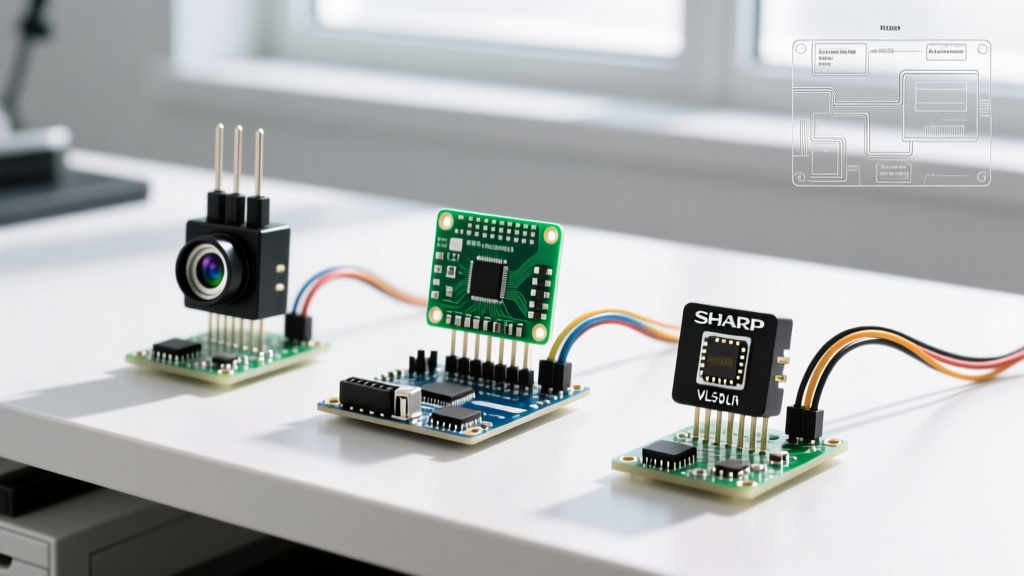
In this comprehensive component comparison, we dissect the three dominant proximity sensing technologies used with microcontrollers: Ultrasonic, Infrared (IR), and Time-of-Flight (ToF). We will evaluate specific, widely available models, analyze their 2026 market pricing, and expose the edge cases that datasheets often bury in the footnotes.
Ultrasonic Proximity: The Acoustic Workhorse
Ultrasonic sensors measure distance by emitting a high-frequency sound pulse (typically 40 kHz) and timing the echo's return. The most ubiquitous model in the maker space is the HC-SR04, but professional deployments often require industrial alternatives like the MaxBotix MB1010.
HC-SR04 vs. MaxBotix MB1010
- HC-SR04 ($2 - $4): Features a 4-pin interface (VCC, Trig, Echo, GND). It operates at 5V logic and offers a theoretical range of 2cm to 400cm. However, its blind spot is roughly 2-3cm, and the 15-degree beam angle causes severe acoustic shadowing when detecting small objects.
- MaxBotix MB1010 ($28 - $35): Provides analog voltage, pulse-width, and serial outputs. It features continuous real-time auto-calibration and a highly focused beam pattern. According to the MaxBotix Ultrasonic Sensor Guide, their LV-MaxSonar series compensates for temperature and humidity variations, which is critical since the speed of sound shifts by approximately 0.6 m/s for every 1°C change in air temperature.
The Fatal Flaw: Acoustic Absorption
Ultrasonic sensors fail completely when targeting sound-absorbing materials. If your Arduino project involves detecting clothing, acoustic foam, or thick carpets, the 40 kHz pulse will be absorbed rather than reflected, resulting in phantom "out of range" timeouts. Furthermore, operating multiple HC-SR04 modules in close proximity without sequential triggering logic will result in severe acoustic crosstalk, where Sensor A reads the echo from Sensor B's ping.
Infrared (IR) Proximity: When Light Beats Sound
Infrared proximity sensors rely on the triangulation of reflected IR light (usually around 850nm to 950nm). The Sharp GP2Y0A21YK0F remains the gold standard for analog IR distance measurement in robotics and interactive installations.
Sharp GP2Y0A21YK0F Deep Dive
Priced between $8 and $12, this module outputs an analog voltage inversely proportional to the distance of the object (ranging from 10cm to 80cm). Because the output is highly non-linear, Arduino developers must implement a mathematical mapping function or a lookup table in their code to translate the ADC (Analog-to-Digital Converter) readings into centimeters.
Expert Wiring Tip: The Sharp IR sensor draws significant current spikes (up to 300mA) during its LED emission cycle. Failing to place a 10µF to 47µF electrolytic capacitor across the VCC and GND pins directly at the sensor will introduce voltage ripple, causing erratic ADC readings on your Arduino.
The Fatal Flaw: Ambient Saturation and Target Color
IR sensors are notoriously susceptible to ambient sunlight, which contains massive amounts of infrared radiation. Operating a Sharp IR sensor outdoors at noon will saturate the photodetector, effectively blinding it. Additionally, the reflectivity of the target matters immensely; a matte black surface will absorb the IR beam, making the sensor read a much greater distance than reality, while a white surface will reflect it perfectly.
Time-of-Flight (ToF): The Premium Precision Choice
Time-of-Flight sensors represent the modern pinnacle of proximity detection. Instead of sound or broad IR scattering, ToF modules like the VL53L1X emit a Class 1 invisible 940nm VCSEL (Vertical-Cavity Surface-Emitting Laser) and measure the exact picoseconds it takes for photons to bounce back.
VL53L1X Specifications and Integration
Retailing for $8 to $14, the VL53L1X communicates via I2C and can accurately measure distances up to 400cm with millimeter precision, regardless of the target's color or acoustic properties. As detailed in the STMicroelectronics VL53L1X datasheet, the chip features a programmable Region of Interest (ROI), allowing you to narrow the laser's field of view to ignore background clutter.
Arduino I2C Implementation Challenges
While the hardware is superior, the software integration requires care. The default I2C address for the VL53L1X is 0x29. If you need multiple ToF sensors on the same Arduino I2C bus, you must use the sensor's XSHUT (shutdown) pin to sequentially boot them and assign unique software addresses via the Adafruit ToF Breakout Guide methodologies. Furthermore, because it operates at 3.3V logic, connecting it directly to a 5V Arduino Uno's I2C pins without a logic level shifter (like the BSS138) risks frying the sensor's internal microcontroller over time.
Head-to-Head Comparison Matrix
| Feature | Ultrasonic (HC-SR04) | Infrared (Sharp GP2Y0A21) | ToF (VL53L1X) |
|---|---|---|---|
| Est. Price (2026) | $2.50 | $9.00 | $11.00 |
| Effective Range | 2cm - 400cm | 10cm - 80cm | 4cm - 400cm |
| Interface | Digital Pulse (5V) | Analog Voltage | I2C (3.3V Logic) |
| Target Color Dependency | None | High | Low |
| Sunlight Immunity | Excellent | Poor | Good (with IR filters) |
| Beam Angle | ~15° (Wide) | ~5° (Narrow) | Programmable (15° - 27°) |
Real-World Failure Modes & Troubleshooting
To achieve true E-E-A-T (Experience, Expertise, Authoritativeness, and Trustworthiness) in your embedded designs, you must anticipate how these sensors fail outside the laboratory.
1. The Transparent Object Problem
If your Arduino robot needs to detect glass doors or clear acrylic bins, ToF and IR sensors will fail. The laser and IR light will pass directly through the transparent material, registering the wall behind it instead. Ultrasonic sensors are the only viable choice here, as the acoustic impedance mismatch between air and glass guarantees a strong echo reflection.
2. Multipath Interference in ToF
When mounting a VL53L1X inside a 3D-printed enclosure, ensure the housing does not intrude into the sensor's field of view. Even a 1mm lip of black PLA plastic inside the FoV will cause "cover glass crosstalk," where the laser reflects off the housing and blinds the SPAD (Single-Photon Avalanche Diode) array, resulting in permanently stuck minimum-distance readings.
3. Power Supply Sag in Multi-Sensor Arrays
Running five HC-SR04 sensors simultaneously can draw upwards of 100mA during the ping cycle. If powered directly from the Arduino's 5V linear regulator, this transient load will cause a voltage sag, triggering brownout resets on the ATmega328P. Always use a dedicated 5V buck converter (like the LM2596 module) to power sensor arrays, tying the grounds together at a single star-point to prevent ground loops.
Final Verdict: Which Arduino Sensor Proximity Module Wins?
There is no universal winner; the correct choice is dictated entirely by your physical environment:
- Choose Ultrasonic (HC-SR04 / MaxBotix) if you are building outdoor robotics, detecting transparent objects, or operating on a strict sub-$3 budget where millimeter precision is unnecessary.
- Choose Infrared (Sharp GP2Y0A21) for short-range, indoor interactive art installations or line-following arrays where analog voltage simplicity is preferred over digital bus complexity.
- Choose Time-of-Flight (VL53L1X) for precision drone altitude holding, indoor SLAM (Simultaneous Localization and Mapping) robots, and industrial bin-level monitoring where target color, temperature, and acoustic noise must be entirely ignored.
By matching the physics of the sensor to the specific edge cases of your environment, your Arduino proximity projects will transition from fragile prototypes to robust, production-ready systems.