
The Evolution of Arduino and Motor Shield Integrations
When building kinetic art, autonomous rovers, or automated blinds, the phrase Arduino and motor shield typically brings to mind a simple plug-and-play stacking solution. However, the 2026 robotics landscape demands far more than the legacy plug-and-play shields of the past decade. Modern makers and engineers must balance thermal efficiency, PWM switching losses, and continuous current limits. Choosing the wrong H-bridge topology can result in catastrophic thermal shutdowns or drained battery packs in mobile robots.
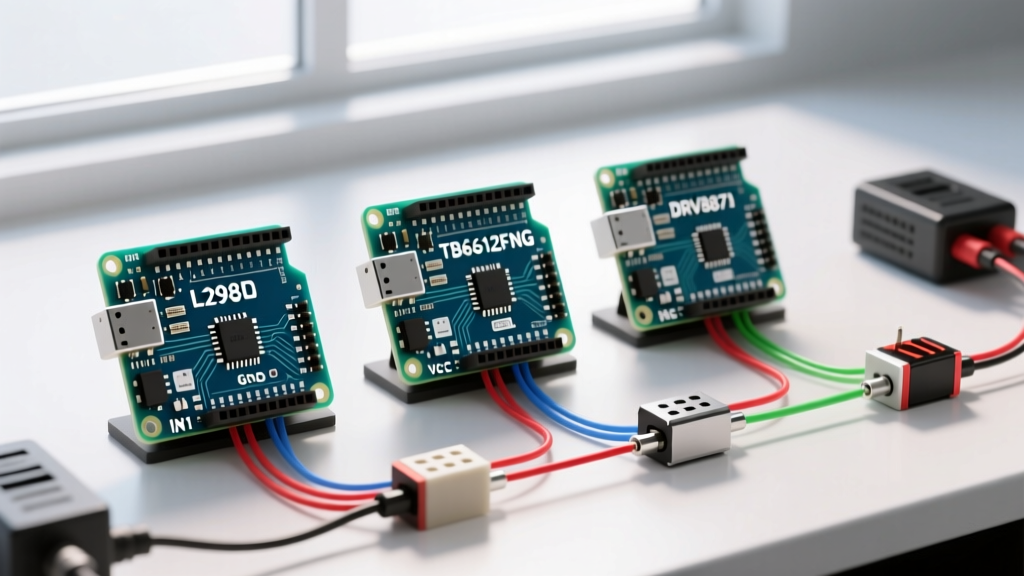
In this comprehensive component comparison, we dissect the most prominent motor drivers compatible with the Arduino ecosystem. We will evaluate the classic bipolar L298N, the highly efficient MOSFET-based TB6612FNG, the high-current single-channel DRV8871, and the official Arduino Motor Shield Rev3 to help you match the exact silicon to your project's electromechanical requirements.
Component Comparison Matrix
Before diving into the silicon-level nuances, here is a high-level specification matrix comparing the top contenders for your next Arduino and motor shield integration.
| Driver IC / Module | Topology | Max Continuous Current | Voltage Drop (Vf) | Avg Price (2026) | Best Application |
|---|---|---|---|---|---|
| L298N (Generic Module) | BJT Darlington | 2.0A per channel | ~1.8V to 2.3V | $3.50 - $5.00 | High-voltage, low-duty-cycle prototypes |
| TB6612FNG (Breakout) | MOSFET H-Bridge | 1.2A per channel | ~0.5V (Rds_on) | $6.50 - $8.50 | Battery-powered mobile robotics |
| DRV8871 (Breakout) | Integrated MOSFET | 3.6A (Single Ch) | ~0.4V | $4.00 - $6.00 | High-torque single DC motors |
| Arduino Shield Rev3 | BJT (L298P) | 2.0A per channel | ~2.0V | $38.00 - $45.00 | Classrooms, rapid plug-and-play |
Deep Dive: The Legacy Workhorse (L298N)
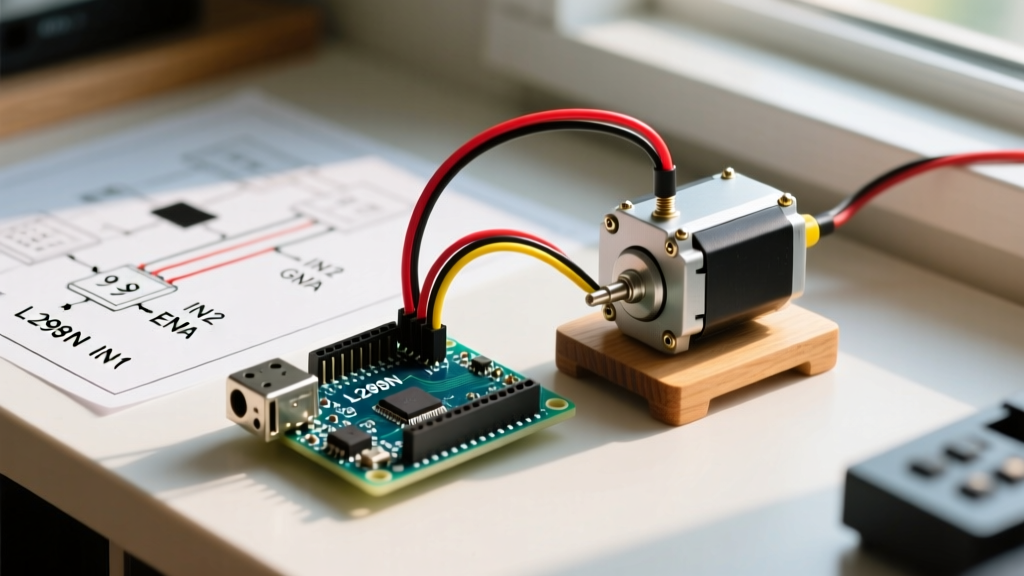
The L298N is arguably the most recognized motor driver in the maker space. Manufactured originally by STMicroelectronics, this dual full-bridge driver relies on Bipolar Junction Transistor (BJT) Darlington pairs. While it can handle a wide voltage range (up to 46V), its BJT topology is its Achilles heel in modern battery-operated designs.
The Thermal Reality of BJT Drivers
Because the L298N uses Darlington pairs, the current must pass through multiple base-emitter junctions. This results in a fixed voltage drop of roughly 1.8V to 2.3V at just 1A of continuous current. If you are driving a 6V motor at 1.5A, nearly 3.5 watts of power is dissipated purely as heat within the silicon. Without a massive heatsink, the IC will rapidly hit its internal thermal shutdown threshold of 150°C.
Expert Insight: Never use the L298N for 3V or 5V logic-level motors on a battery supply. The voltage drop will starve your motor of torque, and the wasted energy will drain your LiPo pack in minutes. Reserve the L298N for 12V+ lead-acid or benchtop applications where efficiency is secondary to cost.
Deep Dive: The Efficiency King (TB6612FNG)
For modern mobile robotics, the TB6612FNG is the undisputed champion of dual-channel control. Unlike the L298N, the TB6612FNG utilizes MOSFET H-bridges. According to the Pololu TB6612FNG documentation, the low on-resistance (Rds_on) of these MOSFETs yields a voltage drop of merely 0.5V at 1A.
PWM Frequency and Switching Losses
While the TB6612FNG is highly efficient at DC, makers often run into acoustic noise issues when using default Arduino PWM frequencies (approx. 490Hz). To push the motor whine out of human hearing range, developers often increase the PWM frequency to 20kHz or 30kHz via timer manipulation. However, pushing the TB6612FNG past 100kHz introduces severe switching losses, causing the IC to overheat despite its MOSFET topology. Stick to the 20kHz–32kHz sweet spot for silent, efficient operation.
Deep Dive: High-Current Single Channel (DRV8871)
Sometimes, a project doesn't need steering; it just needs raw linear force or a high-torque conveyor belt. The Texas Instruments DRV8871 is a single brushed-DC motor driver capable of pushing 3.6A continuously. It eliminates the complexity of logic-level phase inputs, relying instead on two simple IN pins (IN1 and IN2) for coast, brake, forward, and reverse states. It features integrated overcurrent protection (OCP) that safely shuts down the device during stall conditions without requiring external sense resistors.
The Official Arduino Motor Shield Rev3: Convenience vs. Cost
The official Arduino Motor Shield Rev3 utilizes the L298P (a surface-mount variant of the L298N). Priced between $38 and $45 in 2026, it is significantly more expensive than clone modules. However, it offers two distinct engineering advantages:
- Integrated Current Sensing: It features dual 0.15-ohm shunt resistors tied to analog pins A0 and A1, allowing you to read real-time current draw and detect motor stalls via software.
- Stacking Geometry: It perfectly aligns with the Arduino Uno R3 and Mega2560 headers, integrating a 2-pin screw terminal for external power and a dedicated 5V regulator for logic isolation.
While excellent for educational environments where wiring mistakes are common, professional engineers and advanced hobbyists generally avoid it due to the inherent thermal inefficiencies of the L298P silicon.
Wiring Edge Cases and Failure Modes
When integrating any Arduino and motor shield setup, overlooking peripheral protection will lead to silicon death. Pay close attention to these specific failure modes:
- Flyback Diode Speed: The L298N contains internal flyback diodes, but they are notoriously slow. If you are using high-frequency PWM, the reverse voltage spikes can cause latch-up. Always parallel external fast-recovery Schottky diodes (like the 1N5819) across the motor terminals when using L298N modules at >5kHz PWM.
- Logic Ground Loops: A common beginner mistake is powering the motor driver's VCC from a high-current battery while powering the Arduino via USB, but forgetting to tie the grounds together. The logic signals require a common ground reference. Without it, the 5V PWM signal floats, causing erratic motor behavior and potentially frying the Arduino's ATmega328P GPIO pins via back-feeding.
- Optoisolation for Industrial Loads: If you are using an Arduino to control a motor shield that switches 24V industrial actuators, use digital isolators (like the ISO7721) between the Arduino pins and the driver logic inputs to protect your microcontroller from inductive ground bounce.
Decision Framework: Which Driver Should You Choose?
Use this rapid diagnostic flow to finalize your component selection:
- Is your project battery-powered (LiPo/Li-ion) and mobile? Choose the TB6612FNG. The MOSFET efficiency will maximize your run-time and eliminate the need for bulky heatsinks.
- Are you driving a single high-torque 12V/24V motor (e.g., a linear actuator or winch)? Choose the DRV8871. Its 3.6A continuous limit and integrated OCP are perfect for heavy inductive loads.
- Are you teaching a classroom or need instant plug-and-play stacking with current monitoring? Invest in the Official Arduino Motor Shield Rev3.
- Are you prototyping on a benchtop with a 12V lead-acid battery and a strict $5 budget? The L298N remains a viable, albeit thermally challenged, option.
By moving beyond the default plug-and-play assumptions and analyzing the underlying H-bridge topologies, you can drastically improve the battery life, acoustic profile, and reliability of your next Arduino and motor shield project.