
The Evolution of the Arduino Humidity Sensor Market
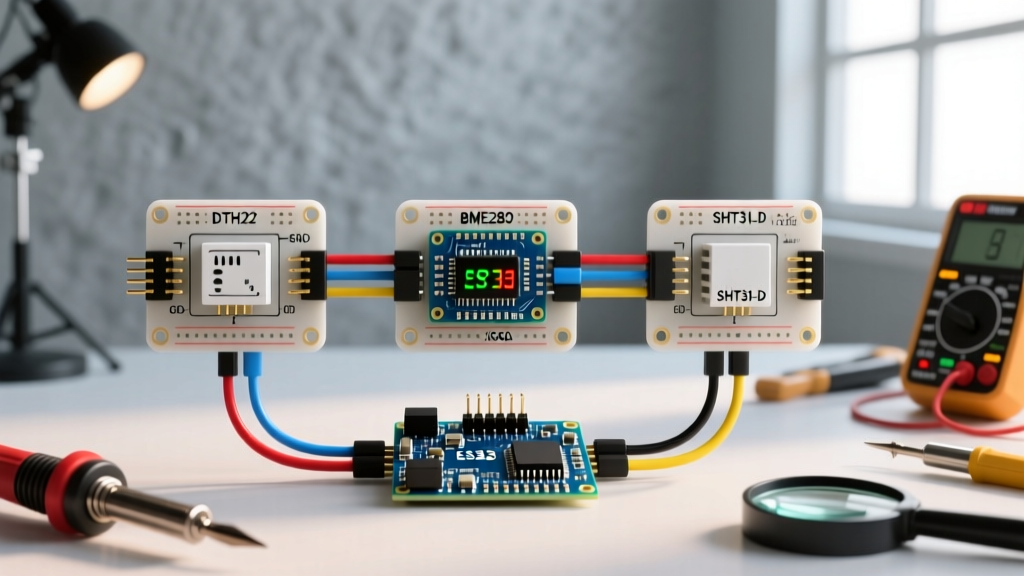
If you have been building environmental monitoring projects for more than a few years, you likely started with a DHT11. By 2026, the DHT11 is universally recognized as a toy—plagued by poor resolution and massive drift. When makers and engineers upgrade to a serious arduino humidity sensor, they typically face a three-way crossroads: the legacy DHT22 (AM2302), the multi-function Bosch BME280, and the precision Sensirion SHT31-D. Choosing the right component is no longer just about reading a datasheet; it requires understanding I2C bus overhead, self-heating thermal errors, and condensation failure modes. In this component comparison, we strip away the marketing claims and evaluate these three sensors based on real-world integration, timing constraints, and long-term stability.
The Contenders: Architecture and Baseline Specs
1. The Legacy Workhorse: DHT22 (AM2302)
The DHT22 utilizes a capacitive humidity sensing element and a thermistor. It communicates via a proprietary single-bus (1-wire) protocol that is not compatible with standard Dallas 1-Wire devices. While it offers a respectable ±2% RH accuracy on paper, its 2-second sampling period and strict timing requirements make it a bottleneck for modern, interrupt-driven firmware. In 2026, genuine DHT22 units cost between $4.50 and $6.00, though the market is flooded with $1.50 clones that exhibit severe calibration drift above 80% RH.
2. The Multi-Tool: Bosch BME280
The BME280 is an integrated environmental sensor combining humidity, barometric pressure, and temperature in a single 2.5 x 2.5 mm LGA package. It communicates via standard I2C or SPI. Bosch Sensortec designed this chip primarily for mobile and IoT applications, meaning it is highly optimized for low power consumption. According to the official Bosch Sensortec BME280 documentation, it provides ±3% RH accuracy and a incredibly fast 1-second startup time. Genuine modules hover around $8.00 to $12.00, while clone boards can be found for under $2.00, though clones often lack the precision laser-trimming of the original Bosch silicon.
3. The Precision Instrument: Sensirion SHT31-D
Sensirion is the industry gold standard for metrology-grade humidity sensing. The SHT31-D uses a CMOSens® technology that integrates a capacitive sensor and a signal processing ASIC on a single chip. It features a standard I2C interface, a wide operating voltage range (2.4V to 5.5V), and an integrated internal heater. The Sensirion SHT31-DIS product data highlights its typical accuracy of ±2% RH and exceptional long-term stability, resisting drift even in harsh, high-humidity environments. Breakout boards for the SHT31-D typically retail between $10.00 and $14.00.
Head-to-Head Specification Matrix
| Feature | DHT22 (AM2302) | Bosch BME280 | Sensirion SHT31-D |
|---|---|---|---|
| Protocol | Proprietary 1-Wire | I2C / SPI | I2C |
| RH Accuracy | ±2% (Typical) | ±3% (Typical) | ±2% (Highly Stable) |
| RH Resolution | 0.1% | 0.008% | 0.01% |
| Sample Rate | 0.5 Hz (2s delay) | Up to 1 Hz (configurable) | Up to 10 Hz |
| Operating Voltage | 3.3V - 5.5V | 1.71V - 3.6V | 2.4V - 5.5V |
| Avg Price (2026) | $4.50 - $6.00 | $8.00 - $12.00 (Genuine) | $10.00 - $14.00 |
| Best Use Case | Basic hobbyist weather stations | Altitude/Pressure-compensated IoT | Greenhouses, incubators, lab gear |
Protocol Overhead and Timing Realities
When integrating an arduino humidity sensor into a complex firmware loop—especially on WiFi-enabled boards like the ESP32 or Arduino Nano 33 IoT—protocol overhead dictates system stability.
The DHT22 Blocking Trap: The DHT22 requires the microcontroller to pull the data line low for at least 1ms to initiate a reading, then meticulously time the incoming 40-bit data stream. Most standard Arduino libraries achieve this using delayMicroseconds() or by disabling interrupts. This blocks the CPU for up to 5ms per read, and forces a mandatory 2-second wait between polls. If you are running a FreeRTOS web server or maintaining a BLE connection, the DHT22 will cause stack watchdog resets and dropped packets.
The I2C Advantage (BME280 & SHT31-D): Both the BME280 and SHT31-D utilize standard I2C. You can send a measurement command, return to your main loop() or RTOS task, and read the result milliseconds later. The SHT31-D supports clock stretching and standard 100kHz/400kHz I2C speeds. The BME280 supports up to 3.4MHz High-Speed I2C mode, though 400kHz is standard for most Arduino Wire implementations. For non-blocking architectures, I2C sensors are the only viable choice.
Real-World Edge Cases and Failure Modes
Datasheets assume ideal laboratory conditions. In the field, environmental sensors face severe edge cases that can ruin your data.
The BME280 Self-Heating Trap
A common mistake documented in the Adafruit BME280 learning guide and various engineering forums is powering the BME280 with 5V while running it in continuous measurement mode. The BME280's internal ASIC generates heat. If mounted on a breakout board with a 5V LDO, or if polled continuously without sleep cycles, the chip's internal temperature can rise 1.5°C to 2.0°C above ambient. Because relative humidity is intrinsically tied to temperature, this self-heating artificially lowers the RH reading by up to 5%. Solution: Always power the BME280 with 3.3V, use 'Forced Mode' (taking a single reading and returning to sleep), and apply a software offset if continuous monitoring is strictly required.
Condensation and the SHT31-D Heater
In greenhouse automation or outdoor enclosures, humidity frequently hits 100%, causing condensation to bridge the sensor's capacitive plates. When this happens, the DHT22 and BME280 will output erratic data or lock up until physically dried. The SHT31-D solves this with an integrated resistive heater. By writing to the heater control register (Command 0x306D), you can pulse the heater for a few seconds to evaporate condensation. While this draws an additional 20mA to 110mA (depending on the heater level), it is a critical survival mechanism for high-moisture deployments.
Long-Term Drift and Hysteresis
Capacitive polymer sensors suffer from hysteresis—meaning the reading at 60% RH will differ depending on whether the environment transitioned from 40% or 80%. The Sensirion SHT31-D exhibits minimal hysteresis (typically <1% RH) and includes factory calibration data stored in on-chip memory. The DHT22, conversely, is notorious for drifting up to 5% over a 12-month period if exposed to volatile organic compounds (VOCs) or extreme temperature cycling.
2026 Purchasing Decision Framework
Do not default to the cheapest option. Select your arduino humidity sensor based on the specific constraints of your deployment environment:
- Choose the DHT22 if: You are building a simple, battery-free educational project for a classroom, your code is strictly single-threaded, and you need a 5V-tolerant sensor without level shifters. Avoid it for any commercial or IoT product.
- Choose the BME280 if: You need to calculate altitude or sea-level compensated pressure alongside humidity. It is the undisputed king of multi-variable environmental sensing for drone telemetry and indoor air quality (IAQ) HVAC monitoring, provided you manage the 3.3V logic and self-heating constraints.
- Choose the SHT31-D if: Accuracy, long-term stability, and high-humidity survival are paramount. If you are building a reptile terrarium controller, a medical incubator, or a hydroponics climate system, the SHT31-D's internal heater and metrology-grade calibration justify the $14 premium.
Engineering Rule of Thumb: Relative humidity is only as accurate as your temperature reading. Always ensure your humidity sensor is thermally isolated from heat-generating components like voltage regulators, motor drivers, and WiFi antennas on your custom PCB.