
The Illusion of Standard Random in Arduino
When makers and engineers search for random in arduino, they almost immediately encounter the built-in random() function. While convenient for blinking LEDs or basic game mechanics, this function is fundamentally flawed for applications requiring true unpredictability. The standard Arduino random() reference explicitly notes that it generates pseudo-random numbers using a deterministic algorithm—typically a Linear Congruential Generator (LCG). If the seed is known, the entire sequence can be predicted.
Maker Maxim: Pseudo-randomness is sufficient for a dice-rolling game, but it is a critical vulnerability in cryptographic key generation, secure token creation, and high-stakes randomized art installations.
In this 2026 community resource roundup, we dissect the most effective software libraries, hardware peripherals, and DIY analog circuits to achieve true entropy in your microcontroller projects.
Debunking the Floating Pin Seed Myth
The most common advice found in legacy forums is to seed the PRNG using an unconnected analog pin:
randomSeed(analogRead(A0));Why this fails: An unconnected ADC pin does not read pure white noise. Instead, it acts as an antenna, picking up 50Hz/60Hz mains hum, digital switching noise from the microcontroller itself, and quantization artifacts. Studies on ATmega328P ADC noise floors show that a floating pin typically yields only 10 to 14 bits of actual entropy, often clustering around predictable median values. For a 32-bit seed, this leaves vast portions of the seed space entirely unpopulated, making the PRNG sequence trivial to brute-force.
Community Software Libraries: Squeezing Entropy from Silicon
If you are constrained to legacy 8-bit AVR boards like the Arduino Uno R3 or Nano, you must rely on software-level entropy harvesting. The community has developed several robust workarounds.
1. The Entropy Library (Watchdog Timer Jitter)
Walter Anderson’s Entropy library remains the gold standard for AVR-based boards. It exploits the microscopic timing jitter between the microcontroller's main clock and the independent Watchdog Timer (WDT) oscillator. By measuring the exact CPU cycle count when a WDT interrupt fires, the library harvests genuine hardware-level entropy.
- Generation Speed: ~8 to 10 bits per second.
- Best Use Case: Generating a one-time 32-bit or 64-bit seed for a faster PRNG (like Xorshift) at boot.
- Limitation: Far too slow for bulk random number generation or real-time audio noise synthesis.
2. Xorshift and Mersenne Twister Implementations
Once you have a high-quality seed, you need a fast PRNG. The community-maintained Xorshift libraries offer 32-bit and 64-bit variants that execute in a fraction of the time of the standard random() function, while passing the rigorous Diehard statistical tests for randomness. For scientific simulations requiring massive periods (2^19937 - 1), the Mersenne Twister implementations available via the Arduino Library Manager are the preferred choice, though they consume roughly 2.5KB of SRAM.
Hardware-Accelerated True Random Number Generation (TRNG)
As of 2026, the maker ecosystem has largely shifted toward 32-bit ARM and RISC-V architectures that include dedicated hardware TRNG peripherals. This eliminates the need for software hacks.
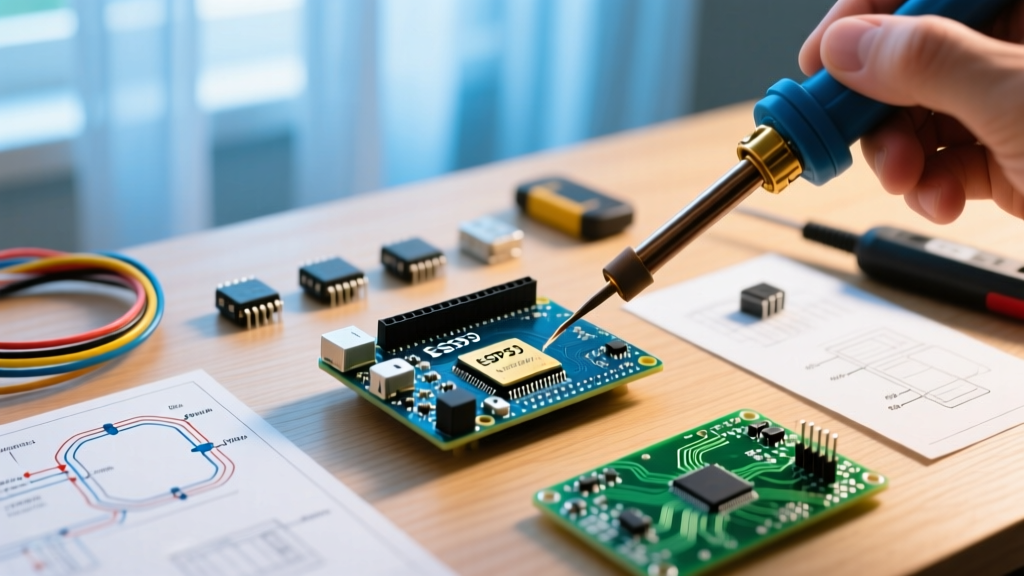
ESP32 and ESP32-S3: SAR ADC Noise Harvesting
The Espressif ESP32 family features a hardware RNG peripheral that samples thermal noise from the Successive Approximation Register (SAR) ADC. According to the Espressif Random API Documentation, when the RF subsystem is enabled, the entropy source is continuously mixed with hardware noise, producing NIST-compliant random bitstreams.
- Cost: Standard ESP32-WROOM-32 dev boards retail for $5.00 - $8.00; the newer ESP32-C6 RISC-V boards can be found for ~$4.50.
- Implementation: Simply use
esp_random()in the ESP-IDF or the standardrandom()function in the Arduino core, which automatically routes to the hardware TRNG under the hood.
Arduino Uno R4 (Renesas RA4M1)
The Arduino Uno R4 Minima and WiFi boards utilize the Renesas RA4M1 ARM Cortex-M4 microcontroller. This chip includes a dedicated TRNG peripheral based on ring oscillator jitter. Unlike the older AVR chips, the Uno R4 can generate cryptographically secure random numbers natively at high speeds without tying up the main CPU threads, making it an excellent choice for secure IoT gateways.
Comparison Matrix: Randomness Generation Methods
| Method / Hardware | Entropy Source | Generation Speed | Entropy Quality | Approx. Cost (2026) |
|---|---|---|---|---|
Standard random() (AVR) |
Algorithmic (LCG) | Very Fast | Low (Predictable) | $0 (Built-in) |
| Floating Pin Seed | ADC Quantization / Mains Hum | Instant (One-time) | Poor (Clustered) | $0 (Built-in) |
| Entropy Library (AVR WDT) | Clock Jitter | ~10 bits/sec | High (True Entropy) | $0 (Library) |
| ESP32 Hardware RNG | SAR ADC Thermal Noise | ~5 Mbps | Cryptographic Grade | $4.50 - $8.00 |
| Arduino Uno R4 TRNG | Ring Oscillator Jitter | High (Hardware offload) | Cryptographic Grade | $22.00 - $27.50 |
| Microchip ATECC608A | Dedicated Silicon TRNG | Moderate (I2C bottleneck) | FIPS 140-2 Compliant | ~$1.25 per IC |
DIY Analog Noise: The Zener Diode Avalanche Method
For makers building custom PCBs or working with microcontrollers lacking hardware TRNGs (like the STM32F103 'Blue Pill' or classic ATtiny85), generating true analog noise is a highly rewarding hardware project. The most reliable method is exploiting the avalanche breakdown noise of a Zener diode.
Circuit Specifics and BOM
When a Zener diode is reverse-biased near its breakdown voltage, the resulting avalanche effect generates a wideband, high-amplitude white noise spectrum. This is fundamentally rooted in quantum mechanical shot noise, providing an excellent entropy source recognized by organizations like NIST's Random Bit Generation project for hardware entropy sources.
Recommended Bill of Materials (BOM):
- 1N4734A Zener Diode (5.6V): Chosen specifically because 5.6V is the threshold where Zener breakdown and avalanche breakdown overlap, yielding the flattest noise spectrum.
- LM358 Dual Op-Amp: Used to amplify the millivolt-level noise signal to the 0-5V range required by the microcontroller's ADC.
- 12V DC Power Supply: Required to properly reverse-bias the diode through a current-limiting resistor.
- Resistors: 10kΩ (bias), 1MΩ (feedback), 100kΩ (gain setting).
- Capacitors: 100nF ceramic (decoupling), 10µF electrolytic (power filtering).
Implementation Note: Do not feed the raw amplified noise directly into your logic. Instead, sample the ADC at a rate lower than the Nyquist limit of your op-amp's bandwidth to prevent aliasing, and apply the Von Neumann extractor algorithm in software to remove any DC bias introduced by the op-amp's input offset voltage.
Frequently Asked Questions (FAQ)
Can I use the micros() function to seed my random generator?
Using micros() at boot is marginally better than a static seed, but it is still highly predictable. The time from power-on to the execution of your setup() function is largely deterministic, varying only by microseconds based on capacitor charge curves and oscillator startup times. It is not a reliable entropy source.
Is the ESP8266 hardware RNG reliable?
The original ESP8266 RANDOM_REG32 register is notoriously flawed. It relies on RF subsystem noise, but if the Wi-Fi radio is disabled or in deep sleep, the register often returns repeating patterns or static values. For reliable true random in the Espressif ecosystem, always use the modern ESP32 or ESP32-S3 architectures.
Do I need true randomness for a randomized LED matrix display?
No. For visual effects, human perception cannot distinguish between a high-quality PRNG (like Xorshift128+) and true hardware entropy. Save your hardware TRNG resources and complex analog circuits for cryptography, secure boot tokens, and scientific data sampling.