
The Truth Behind the 'Qualcomm Arduino Acquisition Review' Searches
If you have been scouring maker forums, Reddit threads, or tech news aggregators for a definitive Qualcomm Arduino acquisition review, you have likely encountered a tangled web of rumors, misunderstandings, and conflated industry news. Let us address the elephant in the room immediately: Qualcomm has not acquired Arduino.
As of 2026, Arduino remains an independent entity governed by Arduino SA, a Swiss-based holding company that fiercely protects its open-source hardware and software ethos. Qualcomm, a fabless semiconductor giant, operates on a fundamentally different business model focused on IP licensing and silicon design. However, the persistent search volume for a buyout review stems from a very real, deeply integrated strategic partnership between the two companies, compounded by a massive acquisition Qualcomm did make in the embedded AI space.
This comprehensive guide serves as your quick reference and FAQ to untangle the corporate reality from the hardware integration, providing deep technical insights into what happens when Qualcomm silicon meets the Arduino ecosystem.
Quick Reference: Acquisition Rumor vs. Partnership Reality
To save time for engineers and procurement specialists, here is the matrix breaking down the market noise versus the verifiable industry facts.
| Market Rumor / Misconception | Verifiable Fact (2026 Status) | Technical / Corporate Impact |
|---|---|---|
| Qualcomm bought Arduino SA. | False. Arduino SA remains independent and headquartered in Lugano, Switzerland. | Arduino IDE and core libraries remain open-source and vendor-agnostic. |
| Qualcomm acquired a major Arduino partner. | True. Qualcomm acquired Edge Impulse (a primary Arduino TinyML partner) in 2024. | Accelerated native Snapdragon NPU support within Arduino's machine learning workflows. |
| Arduino is abandoning Atmel/ARM for Qualcomm. | False. Arduino maintains a diverse silicon portfolio (STMicroelectronics, NXP, Renesas, Espressif). | Qualcomm is reserved strictly for high-end Edge AI/IoT gateway tiers (e.g., Portenta X8). |
The Great Conflation: Why Makers Think Qualcomm Owns Arduino
The primary driver behind the 'Qualcomm Arduino acquisition review' search trend is a classic case of industry conflation. In early 2024, Qualcomm made a massive move into the embedded machine learning space by acquiring Edge Impulse, the leading platform for TinyML development.
Because Edge Impulse has been deeply intertwined with Arduino's ecosystem for years—powering the Arduino Nano 33 BLE Sense and the Portenta family's AI vision pipelines—the maker community mistakenly conflated Qualcomm acquiring Arduino's software partner with Qualcomm acquiring Arduino itself.
Industry Insight: Qualcomm's M&A strategy targets silicon architecture (like Nuvia) and edge-AI software stacks (like Edge Impulse). Acquiring a hardware board manufacturer and IDE maintainer like Arduino would introduce open-source licensing complexities and hardware supply chain liabilities that run counter to Qualcomm's fabless IP model.
The Hardware Intersection: Arduino Portenta X8 Deep Dive
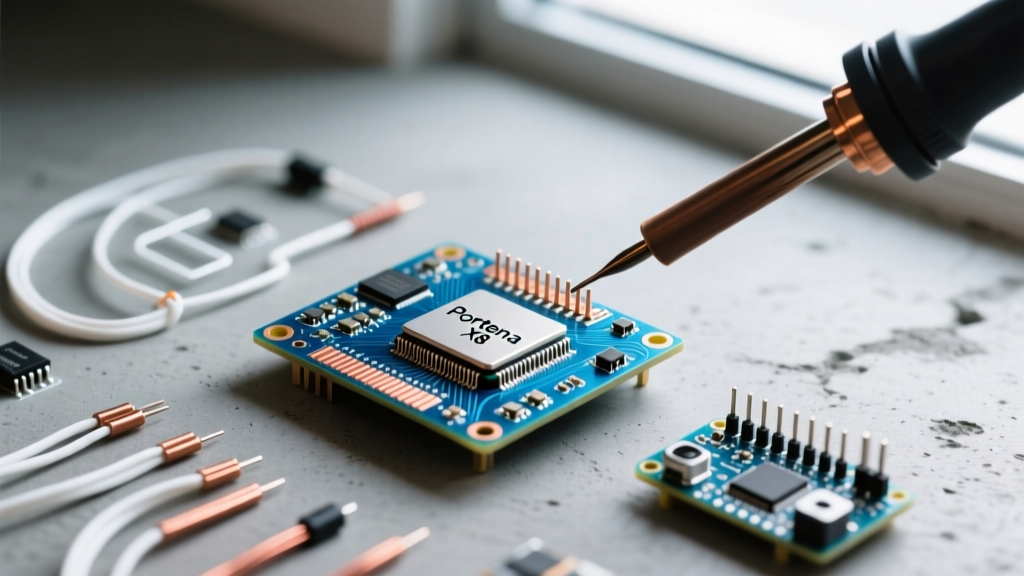
While an acquisition never happened, the hardware collaboration between the two companies resulted in one of the most powerful system-in-package (SiP) boards in the maker and industrial IoT space: the Arduino Portenta X8.
When engineers search for how Qualcomm and Arduino intersect, they are usually looking for the technical review of this specific board. Priced around $239, the Portenta X8 is not a traditional microcontroller; it is a heterogeneous computing powerhouse.
Snapdragon 9205 SiP Architecture
The core of the Portenta X8 is the Qualcomm Snapdragon 9205, an application processor designed specifically for premium IoT and edge gateways. Here is the exact silicon breakdown:
- Application Core: Quad-core ARM Cortex-A53 running up to 1.8 GHz, capable of running a full Linux distribution (via the Arduino Mbed OS Linux overlay).
- Real-Time Core: ARM Cortex-M4 running at 400 MHz, handling deterministic, low-latency tasks typical of traditional Arduino sketches.
- Dedicated NPU: A Neural Processing Unit capable of ~1.5 TOPS (Tera Operations Per Second), allowing for local, offline inference of complex vision and audio models without cloud latency.
- Connectivity: Integrated Cat-M1 / NB-IoT cellular modem, Wi-Fi, and Bluetooth 5.0.
Real-World Performance and Edge Cases
In industrial deployments, the Portenta X8 bridges the gap between a Raspberry Pi and a standard STM32 microcontroller. A common failure mode in edge deployments is thermal throttling when running continuous NPU inference. The Snapdragon 9205's 11nm process node mitigates this, allowing the board to passively dissipate heat in enclosed IP67 industrial housings without requiring active cooling—a critical advantage over standard SBCs (Single Board Computers).
Comparison Matrix: Portenta X8 vs. Pure Qualcomm Dev Boards
If you are evaluating hardware for an enterprise IoT deployment, how does the Arduino-Qualcomm hybrid compare to Qualcomm's native development kits?
| Feature | Arduino Portenta X8 (Snapdragon 9205) | Qualcomm DragonBoard RB5 (QRB5165) |
|---|---|---|
| Primary Target | Industrial Edge AI, TinyML, Rugged IoT | Robotics, High-End Vision, Drones |
| Compute Power | Cortex-A53 + Cortex-M4 + 1.5 TOPS NPU | Cortex-A77 + 15 TOPS AI Engine |
| OS / Environment | Arduino IDE / Mbed OS / Embedded Linux | Yocto Linux / Android / ROS 2 |
| Form Factor | Portenta (Castellated pins, SO-DIMM carrier) | 96Boards Enterprise Edition |
| Approx. Price (2026) | ~$239 USD | ~$500+ USD (via third-party carriers) |
FAQ: Quick Answers for Embedded Engineers
Will the Arduino IDE become proprietary under Qualcomm influence?
No. The Arduino IDE is governed by open-source licenses (GPL/LGPL for various components). Furthermore, Arduino SA's corporate structure in Switzerland is designed to prevent hostile takeovers that would compromise the open-source hardware definitions. The collaboration with Qualcomm is strictly limited to silicon integration and BSP (Board Support Package) development.
How does the Edge Impulse acquisition affect Arduino TinyML workflows?
Qualcomm's ownership of Edge Impulse has actually improved the Arduino experience. By 2026, the export pipelines from Edge Impulse to Arduino C++ libraries are highly optimized for Qualcomm's Hexagon DSP and NPU architectures. Makers using the Portenta X8 can train a model in the Edge Impulse studio and deploy it to the Snapdragon NPU with near-zero manual quantization effort.
Can I use standard Arduino libraries on the Qualcomm Snapdragon core?
Yes, but with architectural caveats. The Cortex-A53 runs a lightweight Linux environment. Standard Arduino libraries designed for bare-metal AVR or Cortex-M microcontrollers (like direct port manipulation via PORTB) will not work on the Linux side. You must use the Arduino Mbed OS abstraction layers or route real-time hardware calls to the onboard Cortex-M4 co-processor via RPC (Remote Procedure Calls).
Is the Portenta X8 suitable for hobbyists?
Generally, no. At $239, and requiring a solid understanding of embedded Linux, heterogeneous computing, and RPC communication, the Portenta X8 is designed for enterprise prototyping and industrial deployment. Hobbyists looking for Qualcomm-level edge AI are better served by ESP32-S3 boards for basic vision tasks, or Raspberry Pi 5 modules for general Linux-based AI.
Final Verdict: Partnership, Not Ownership
Any Qualcomm Arduino acquisition review that claims a buyout has occurred is fundamentally misreading the embedded systems market. What we are witnessing is a highly sophisticated symbiosis: Arduino provides the ubiquitous, developer-friendly abstraction layer and hardware form factors, while Qualcomm provides the raw, heterogeneous silicon required for next-generation Edge AI. For engineers and makers, this means access to enterprise-grade Snapdragon architecture without having to abandon the familiar Arduino IDE and library ecosystem.