
The Core Concept: What Makes the LilyPad Arduino 328 Unique?
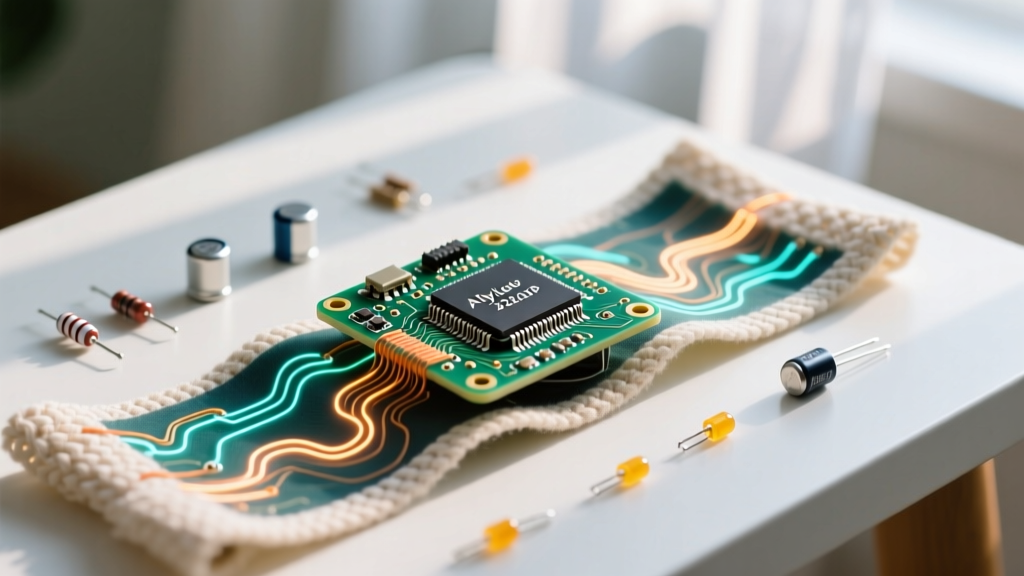
The LilyPad Arduino 328 (officially the SparkFun DEV-13342) represents a fundamental departure from traditional breadboard-friendly microcontrollers. Designed specifically for e-textiles and wearable technology, it abandons the standard rectangular PCB and rigid male header pins in favor of a circular, 50mm diameter board with 20 large, plated through-hole sew tabs. This physical architecture allows makers to integrate the microcontroller directly into garments using conductive thread rather than copper wire and solder.
While the broader maker community has seen an influx of modern ARM-based wearable boards, the classic LilyPad Arduino 328 remains a staple in 2026 for educational environments, cosplay integration, and low-power textile projects. Its enduring relevance lies in its simplicity, the vast ecosystem of compatible LilyPad sensors (like the TMP102 temperature sensor or the LIS3DH accelerometer), and the robust nature of the ATmega328P silicon.
The Silicon Heart: ATmega328P-V at 8MHz
At the center of the LilyPad sits the ATmega328P-V microcontroller. The -V suffix is critical: it denotes the low-voltage variant of the chip, capable of operating reliably at voltages as low as 1.8V. Unlike the standard Arduino Uno, which clocks its ATmega328P at 16MHz (requiring a minimum of 4.5V), the LilyPad utilizes an 8MHz ceramic resonator. This lower clock speed reduces the minimum operating voltage to 2.7V, allowing the board to be powered directly by a 3.7V LiPo battery without the efficiency losses associated with a step-up voltage regulator.
Hardware Architecture and Pinout Breakdown
Understanding the physical layout is crucial for routing conductive thread without causing short circuits. The sew tabs are spaced to minimize accidental thread crossings. Below is the architectural breakdown of the 20 available connection points.
| Tab Label | Function | Notes for E-Textile Routing |
|---|---|---|
| D0 - D13 | Digital I/O (14 pins) | D13 features an onboard status LED. D10-D13 double as SPI. |
| A0 - A5 | Analog Input / Digital I/O | A4 (SDA) and A5 (SCL) are dedicated to I2C communication. |
| + | Power (VCC) | Accepts 2.7V to 5.5V. Directly tied to the battery positive terminal. |
| - | Ground (GND) | Must be routed to every peripheral. Use a dedicated ground bus. |
| RST | Reset | Active LOW. Can be sewn to a tactile switch for manual resetting. |
| RX / TX | Serial Communication | Used strictly for FTDI programming or serial debugging. |
The Physics of Conductive Thread: Resistance and Voltage Drop
The most common point of failure in LilyPad Arduino 328 projects is ignoring the electrical resistance of conductive thread. Unlike 22 AWG copper wire (which has negligible resistance over short distances), conductive thread introduces significant voltage drops that can starve peripherals of power.
Thread Material Comparison
- Stainless Steel Thread (e.g., LessEMF): Approximately 18 to 20 Ω/meter. Highly durable, washable, but terrible for high-current power lines.
- Silver-Plated Nylon: Approximately 2.5 to 3.0 Ω/meter. Better conductivity, but prone to tarnishing and higher friction.
- Silver-Plated Copper (e.g., Karl Grimm High Flex): Approximately 0.3 Ω/meter. Excellent conductivity, highly flexible, but fragile and prone to snapping under high tension.
Real-World Voltage Drop Calculation
Imagine you are sewing a line of 5 addressable RGB LEDs (like the WS2812B) into a jacket sleeve, 50cm away from the LilyPad and battery. Each LED can draw up to 60mA at full white, totaling 300mA (0.3A).
Using Stainless Steel Thread (18 Ω/m):
Resistance for 0.5m = 9 Ω.
Voltage Drop (V = I × R) = 0.3A × 9 Ω = 2.7V drop.
If your LiPo battery is at 3.7V, the LEDs will only receive 1.0V. They will fail to illuminate.Using Silver-Plated Copper Thread (0.3 Ω/m):
Resistance for 0.5m = 0.15 Ω.
Voltage Drop = 0.3A × 0.15 Ω = 0.045V drop.
The LEDs receive 3.65V and function perfectly.
Actionable Advice: Always use low-resistance copper-based threads for Power (+) and Ground (-) lines. Reserve high-resistance stainless steel threads exclusively for low-current digital signal lines (like I2C data or button inputs), where the microamp-level current draw makes voltage drop irrelevant. For deeper insights on material handling, refer to the SparkFun Guide to Sewing with Conductive Thread.
Power Management in Wearables
The LilyPad Arduino 328 does not feature an onboard voltage regulator or a USB power management IC. This is an intentional design choice to minimize quiescent current draw and board thickness. Power is typically supplied via a 3.7V Lithium Polymer (LiPo) battery, such as the 110mAh or 400mAh cells commonly used in wearables.
Because the ATmega328P-V can operate natively at 3.7V, the battery is connected directly to the (+) and (-) tabs. To charge the battery, makers must sew in a dedicated LilyPad LiPower Board or use a separate JST-connected charging module. Never attempt to charge a LiPo battery while it is directly sewn to the microcontroller without a dedicated TP4056 or MCP73831 charging circuit, as overcharging poses a severe fire hazard.
Programming Workflows: FTDI and ISP
Because the LilyPad lacks a built-in USB-to-Serial converter, you cannot simply plug it into a PC via a standard cable. Programming requires one of two methods:
- FTDI Basic Breakout (3.3V): You sew or clip a 3.3V FTDI adapter to the RX, TX, +, -, and GND tabs. The 3.3V logic level is critical; using a 5V FTDI adapter can back-feed 5V into the ATmega's RX pin, potentially damaging the silicon over time.
- ICSP (In-Circuit Serial Programming): The LilyPad features a 2x3 male header footprint for ISP. Using an AVR Pocket Programmer, you can bypass the bootloader entirely and flash compiled HEX files directly to the flash memory. This is the preferred method for mass-producing wearable units, as it eliminates the 1.5-second bootloader delay upon startup.
For official board definitions and IDE setup, always consult the Official Arduino LilyPad Documentation to ensure your IDE is configured for the 8MHz clock speed.
Common Failure Modes and Edge Cases
Working with soft circuits introduces mechanical and environmental variables that rigid PCBs do not face. Here are the most frequent failure modes and their solutions:
- Fray-Induced Short Circuits: Conductive thread frays at the cut ends, causing microscopic metallic fibers to bridge adjacent sew tabs. Solution: Apply a drop of clear nail polish or specialized Fray Check liquid to every knot and cut end to insulate the fibers.
- Washing Machine Destruction: While the ATmega328P chip can survive a wash cycle, the LiPo battery will short-circuit, and the sew tabs will oxidize. Solution: Design garments with removable snaps for the battery and MCU. If the electronics must remain embedded, coat the nodes in MG Chemicals 422C Silicone Conformal Coating, which remains flexible after curing and provides IP67-level moisture resistance.
- Thread Tension Snapping: Silver-plated copper thread has low tensile strength. If the garment stretches, the power lines will snap. Solution: Sew a parallel, non-conductive nylon thread alongside the conductive thread to bear the mechanical load.
Frequently Asked Questions
Can I use a standard 5V USB power bank to power the LilyPad 328?
Yes, the ATmega328P can tolerate 5V. However, the board's absolute maximum input rating is 5.5V. Ensure your USB power bank outputs a clean 5.0V. Do not use unregulated 9V batteries, as they will instantly destroy the microcontroller.
How long will a 110mAh LiPo battery last on a LilyPad?
The ATmega328P draws roughly 8mA to 12mA while executing code at 8MHz. Without peripherals or sleep modes, a 110mAh battery will last approximately 9 to 13 hours. By utilizing the LowPower.h library to put the MCU into power-down sleep mode between sensor readings, you can reduce current draw to microamps, extending battery life to several weeks.
Is the LilyPad Arduino 328 still relevant compared to modern nRF52 boards?
While BLE-enabled boards like the Adafruit Flora Bluefruit offer wireless connectivity, the LilyPad 328 (retailing around $24.95 USD) remains highly relevant for offline, low-cost, and educational projects where the complexity of RF pairing and advanced power management is unnecessary. Its physical form factor is also heavily supported by legacy e-textile tutorials and academic curricula.