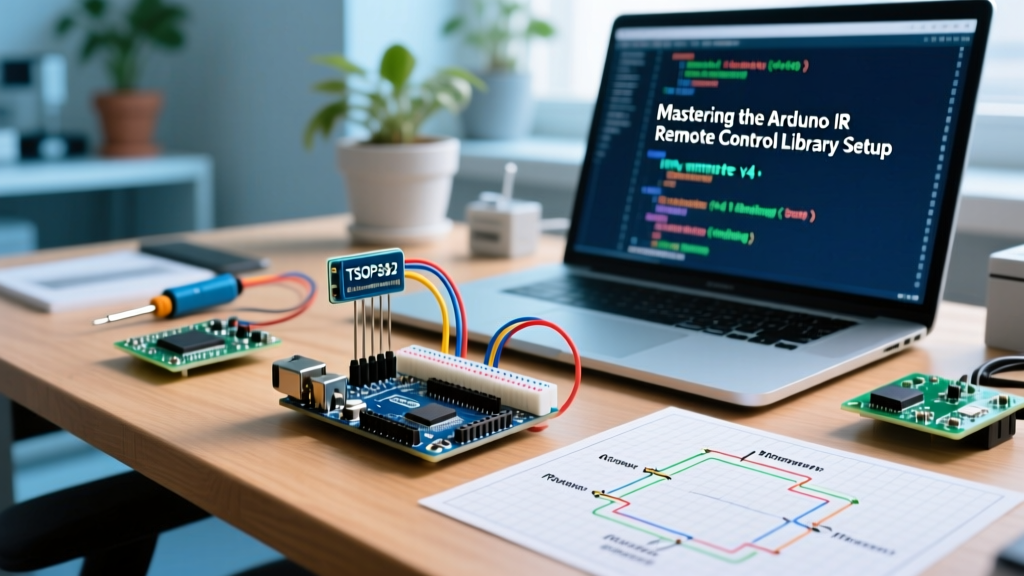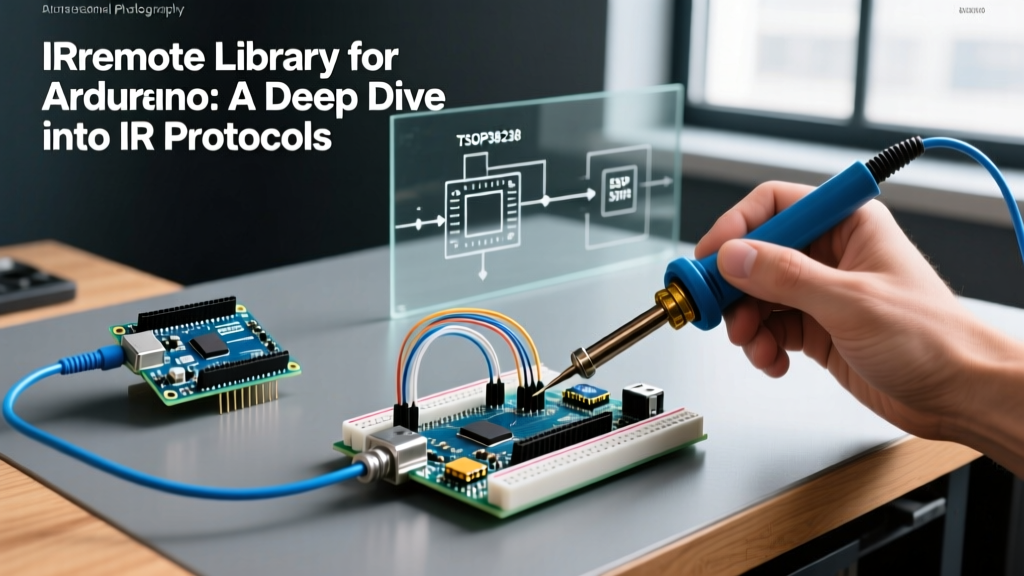

The Evolution of IRremote: From Legacy V2 to Modern V4
For over a decade, the IRremote library for Arduino has been the undisputed standard for infrared communication in embedded DIY projects. Whether you are reverse-engineering a legacy AV receiver, building a custom universal remote, or bridging IR appliances to an IoT network via ESP32, this library is the foundational layer. However, many tutorials circulating in 2026 still rely on outdated V2 syntax, leading to compilation errors and suboptimal performance.
The modern V4+ architecture, spearheaded by Armin Joachimsmeyer, transitioned the library from a monolithic, timer-blocking script to an object-oriented, non-blocking powerhouse. Understanding this shift is critical for writing robust, interrupt-safe firmware. According to the Arduino-IRremote GitHub Repository, the V4 rewrite introduced dedicated IrReceiver and IrSender objects, eliminated the deprecated enableIRIn() function, and drastically improved memory management for constrained microcontrollers like the ATtiny85.
Hardware Topologies: Choosing the Right IR Receiver
Software optimization cannot fix poor hardware selection. The 38kHz carrier frequency is standard for consumer electronics, but the internal Automatic Gain Control (AGC) and noise immunity of the receiver IC dictate your maximum range and reliability.
| Receiver IC | Typical Price (2026) | AGC & Noise Immunity | Best Use Case |
|---|---|---|---|
| VS1838B | $0.10 - $0.15 | Poor (Highly susceptible to CFL/LED flicker) | Basic hobby projects, short-range (<3m) testing |
| Vishay TSOP38238 | $1.10 - $1.40 | Excellent (Integrated EMI shielding, robust AGC) | Production environments, long-range (>10m), high-noise areas |
| OSRAM SFH5111-38 | $0.80 - $1.00 | Very Good (Optimized for low-voltage 3.3V logic) | ESP32 / STM32 direct-interfacing without level shifters |
Hardware Warning: When wiring a TSOP38238 to an ESP32 or other 3.3V microcontroller, ensure you are using a 3.3V-tolerant receiver. Standard 5V receivers will output 5V logic on the data pin, which can permanently damage the GPIO matrix of 3.3V silicon.
Decoding IR Signals: Protocol Deep Dive
Infrared communication is not a single standard; it is a fragmented landscape of proprietary protocols. As detailed in the SB Projects IR Knowledge Base, most protocols rely on pulse-distance coding or Manchester encoding modulated over a 36-40kHz carrier wave.
Protocol Timing Matrix
| Protocol | Encoding Type | Carrier Freq | Header Pulse / Space | Bit Length |
|---|---|---|---|---|
| NEC | Pulse Distance | 38kHz | 9ms / 4.5ms | 32 bits (Addr + Cmd + Inverses) |
| Sony SIRC | Pulse Distance | 40kHz | 2.4ms / 0.6ms | 12, 15, or 20 bits |
| Philips RC5 | Manchester (Biphase) | 36kHz | N/A (Start bits) | 14 bits (Toggle + Address + Command) |
| Samsung | Pulse Distance | 38kHz | 4.5ms / 4.5ms | 32 bits |
The NEC protocol is by far the most ubiquitous, utilized in everything from cheap LED strip controllers to high-end Denon AV receivers. Its 32-bit structure includes an 8-bit address, an 8-bit inverted address, an 8-bit command, and an 8-bit inverted command, providing built-in error checking.
Code Implementation: Modern V4 Syntax
Below is the definitive, non-blocking template for receiving IR signals using the modern V4 API. This replaces the outdated irrecv.decode(&results) paradigm.
#include <IRremote.hpp>

const int RECV_PIN = 2;

void setup() {
  Serial.begin(115200);
  // Initialize receiver with LED feedback on pin 13 (optional)
  IrReceiver.begin(RECV_PIN, ENABLE_LED_FEEDBACK);
  Serial.println(F("IR Receiver initialized on Pin 2"));
}

void loop() {
  if (IrReceiver.decode()) {
    // Print raw and decoded data to Serial Monitor
    IrReceiver.printIRResultShort(&Serial);

    // Example: Check for NEC protocol and specific command
    if (IrReceiver.decodedIRData.protocol == NEC) {
      if (IrReceiver.decodedIRData.command == 0x18) {
        Serial.println(F("Volume Up pressed"));
      }
    }

    // CRITICAL: Resume receiving after processing
    IrReceiver.resume();
  }

  // Non-blocking code can run here safely
}
Handling the decodedIRData Struct
In V4, the decode_results struct was replaced by the decodedIRData object. Key properties include:
protocol: An enum of typedecode_type_t(e.g.,NEC,SONY,UNKNOWN).command: The decoded command byte/integer.address: The device address byte/integer.flags: Bitmask indicating repeat frames (IRDATA_FLAGS_IS_REPEAT) or parity errors.
Advanced Troubleshooting & Edge Cases
Even with perfect wiring, IR implementations frequently fail in real-world environments. Here is how to diagnose the most common edge cases.
1. PWM Timer Conflicts on ATmega328P
The Arduino Uno/Nano relies on hardware timers to generate the precise 38kHz square wave required for IR transmission. By default, the IRremote library hijacks Timer2. This immediately disables hardware PWM on Pins 3 and 11. If your project uses analogWrite() on these pins to drive motors or dim LEDs, they will fail silently.
The Fix: You can reassign the send pin and timer by defining the macro before including the library:
#define IR_SEND_PIN 9
#include <IRremote.hpp>
This forces the library to use Timer1, freeing up Timer2 for standard analogWrite operations.
2. Ambient Light Saturation
Direct sunlight contains massive amounts of broadband infrared radiation. If your TSOP38238 receiver is placed near a window, the internal photodiode will saturate, blinding the AGC circuit. The Adafruit IR Sensor Guide recommends physical optical filtering—specifically, placing a piece of dark, IR-transmissive acrylic (like the front panel of an old VCR) over the sensor to block visible light while passing 940nm wavelengths.
3. Repeat Frame Mishandling
When a user holds down a button on an NEC remote, the remote does not re-send the 32-bit data frame. Instead, it sends a specialized "Repeat Frame" (a 9ms pulse followed by a 2.25ms space and a single 560µs burst). If your code does not check the IRDATA_FLAGS_IS_REPEAT flag, your microcontroller will interpret a held button as a single press, breaking features like volume ramping.
Optimizing Memory and CPU Overhead
When deploying the IRremote library on constrained chips like the ATtiny85 (8KB Flash) or when writing complex ESP32 firmware where RAM is at a premium, the default library inclusion is too bloated. By default, the library compiles decoders for over 20 protocols, consuming roughly 3.5KB of Flash and 400 bytes of RAM.
To strip out unused protocols, use preprocessor directives before the include statement:
#define DECODE_NEC 1
#define DECODE_SONY 1
// Explicitly disable heavy, unused protocols
#define DECODE_DENON 0
#define DECODE_PRONTO 0
#define DECODE_MAGI 0

#include <IRremote.hpp>
This targeted compilation strategy routinely saves 1.5KB to 2KB of Flash memory and reduces the interrupt service routine (ISR) execution time, ensuring your main loop remains highly responsive.
Frequently Asked Questions
Q: Can I use the IRremote library simultaneously with the FastLED library?
A: Yes, but with caveats. Both libraries rely heavily on hardware timers and interrupts. FastLED disables interrupts while pushing data to WS2812B strips, which can cause the IR receiver ISR to miss the tight 560µs pulse timings of the NEC protocol. To fix this, use FastLED.delay() instead of standard delays, or switch to an ESP32 where the IRremote library can utilize the dedicated RMT (Remote Control Transceiver) peripheral, bypassing CPU interrupts entirely.
Q: Why is my raw IR dump showing random noise when no remote is pressed?
A: This is a classic symptom of a floating data pin or a failing VS1838B sensor. Ensure you have a 4.7kΩ pull-up resistor on the data line if your microcontroller's internal pull-ups are weak, and verify that the 5V rail is not experiencing voltage droop from high-current components like relays or motors.