
The 2026 Market Landscape for Microcontrollers in India
If you have searched for the arduino uno cost in india recently, you have likely encountered a massive price disparity. A quick browse through local electronics markets like Lamington Road in Mumbai or online portals reveals prices ranging from as low as ₹350 to over ₹4,500. For a beginner or even a seasoned embedded systems engineer, this 10x price gap raises a critical question: what exactly are you paying for, and when does the premium justify the cost?
In 2026, the microcontroller landscape has shifted. The classic ATmega328P-based Arduino Uno R3 is now considered legacy hardware, officially superseded by the ARM-based Uno R4 series. However, the Indian market remains flooded with R3 clones due to their rock-bottom pricing. This guide dissects the budget versus premium tiers, analyzing component-level differences, hidden import costs, and real-world failure modes to help you make an informed purchasing decision.
Budget Tier: Anatomy of the ₹400 Clone
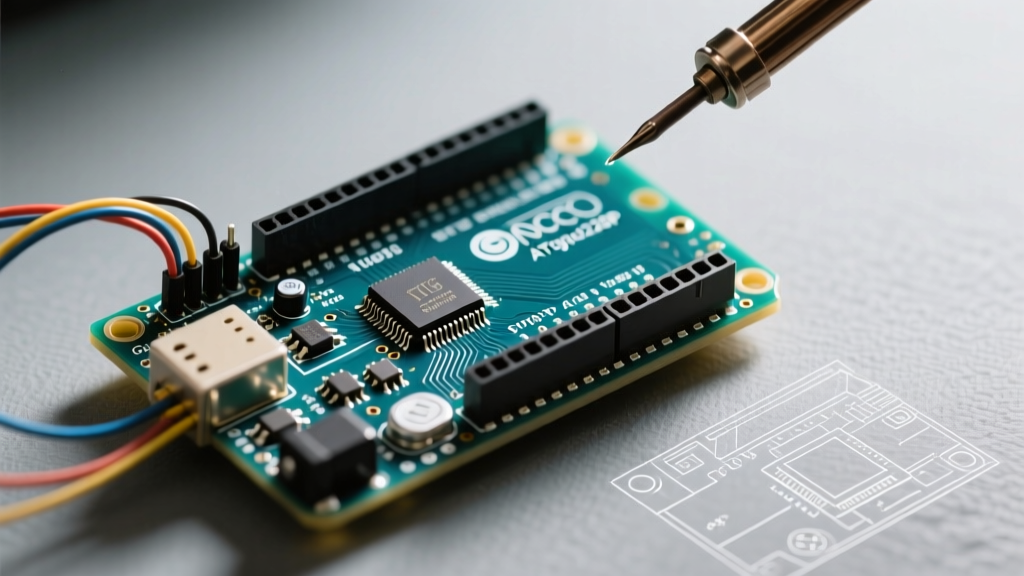
The budget tier in India is dominated by generic 'Uno R3 Compatible' boards. These are not manufactured by Arduino SRL but are exact schematic clones produced in bulk in Shenzhen and imported via Delhi and Bengaluru customs. Depending on the USB-serial converter used, these boards typically cost between ₹400 and ₹850.
The CH340G vs. ATmega16U2 Divide
The primary cost-cutter on budget boards is the USB-to-Serial chip. Genuine boards use the ATmega16U2, a dedicated microcontroller that handles USB communication and allows for native HID (Human Interface Device) emulation. Clones almost universally use the WCH CH340G or CP2102 chips.
- Driver Latency: The CH340G requires manual driver installation on Windows 11, as Microsoft's automatic driver mapping occasionally fails with newer security patches, leading to 'Code 10' Device Manager errors.
- Firmware Flashing: Unlike the ATmega16U2, the CH340G cannot be reflashed to turn your Arduino into a native USB keyboard or MIDI controller without external hardware programmers.
Voltage Regulator Substitutions
A genuine Uno R3 uses the NCP1117ST50T3G low-dropout (LDO) regulator, which can safely handle transient input voltages up to 20V and continuous currents up to 1A. To save roughly ₹15 per unit, clone manufacturers substitute this with the AMS1117-5.0. While the AMS1117-5.0 is rated for 15V, real-world thermal testing shows it enters thermal shutdown when drawing just 400mA at a 12V input, severely limiting its ability to power relay modules or sensor arrays directly from the 5V pin.
Premium Tier: Genuine Arduino Uno R4 Minima and WiFi
The premium tier represents genuine hardware manufactured by Arduino and authorized partners. In 2026, buying 'premium' means stepping into the Arduino Uno R4 ecosystem. According to the official Arduino Store, the R4 series represents a massive architectural leap from the 8-bit AVR chips of the past.
Uno R4 Minima (₹2,400 - ₹2,800)
The R4 Minima is the direct spiritual successor to the R3. It replaces the ATmega328P with a Renesas RA4M1 32-bit ARM Cortex-M4F processor clocked at 48 MHz. This provides a 3x increase in clock speed, 8x more SRAM (32KB), and 8x more Flash memory (256KB). Crucially, it introduces a 12-bit DAC (Digital-to-Analog Converter) on pin A0, allowing for true analog audio output without relying on PWM filtering.
Uno R4 WiFi (₹3,800 - ₹4,500)
The WiFi variant adds an ESP32-S3 co-processor for Wi-Fi and Bluetooth LE connectivity, alongside a striking 12x8 red LED matrix for visual debugging. For IoT projects in the Indian agritech or smart-home sectors, the R4 WiFi eliminates the need to wire a separate ESP8266 module, saving PCB real estate and reducing I2C/SPI bus contention.
Component and Pricing Matrix (2026 INR)
The following table breaks down the average retail pricing across authorized Indian distributors and local hobby shops. Prices include the standard 18% GST on electronic components.
| Board Variant | MCU Architecture | USB-Serial IC | Avg. Price (INR) | Best Use Case |
|---|---|---|---|---|
| Generic Uno R3 (Clone) | ATmega328P (8-bit AVR) | CH340G | ₹400 - ₹550 | Student learning, basic LED/sensor projects |
| Generic Uno R3 (Premium Clone) | ATmega328P (8-bit AVR) | ATmega16U2 | ₹750 - ₹950 | USB HID projects, reliable serial comms |
| Genuine Uno R4 Minima | Renesas RA4M1 (ARM Cortex-M4F) | Renesas RA4M1 (Native USB) | ₹2,400 - ₹2,800 | DSP, audio DAC, high-speed math, commercial prototyping |
| Genuine Uno R4 WiFi | RA4M1 + ESP32-S3 | Native USB + ESP32 | ₹3,800 - ₹4,500 | IoT, BLE beacons, remote telemetry |
Hidden Costs: GST, Customs, and Shipping Logistics
When calculating the true arduino uno cost in india, you must factor in India's taxation and import infrastructure. Electronics and printed circuit assemblies (PCAs) attract an 18% GST.
Pro-Tip for Indian Buyers: Avoid ordering directly from the European Arduino Store. While the base price might seem reasonable, Indian customs will levy a Basic Customs Duty (BCD) of 10-20% plus a Social Welfare Surcharge, and courier handling fees (often ₹500+ via FedEx/DHL) will inflate the final cost by over 40%. Always purchase from authorized local distributors like Mouser India or established domestic robotics platforms like Robu.in where GST is already reconciled and domestic shipping is subsidized.
Real-World Failure Modes: Where Budget Boards Burn
Why do professional engineering firms in Pune and Bengaluru refuse to use ₹450 clones for field deployments? The answer lies in edge-case failure modes that only manifest under environmental stress.
1. The USB-B Connector Shear
Genuine Arduino boards use through-hole USB-B connectors with thick ground-plane solder joints. Many budget clones use surface-mount (SMD) USB-B connectors or poorly waved through-hole joints to save manufacturing time. In field deployments where the USB cable is subject to vibration (e.g., autonomous rovers or agricultural drones), the connector routinely shears off, lifting the copper pads from the FR4 substrate and permanently destroying the board's power input.
2. Crystal Oscillator Baud Rate Mismatch
The CH340G requires an external crystal oscillator to time its serial data packets. While the schematic calls for a 12MHz crystal, some ultra-cheap clone batches mistakenly solder 11.0592MHz or 16MHz crystals due to automated pick-and-place reel mixing. This results in a board that uploads code successfully at 9600 baud, but outputs complete garbage text at 115200 baud because the internal timing divisors are mismatched.
3. Polyfuse Omission
The genuine Uno features a 500mA resettable PTC polyfuse on the USB VBUS line to protect your laptop's USB port from short circuits. Over 70% of sub-₹500 clones omit this fuse entirely, replacing it with a 0-ohm resistor. If you accidentally short the 5V pin to GND while connected to your PC, you risk burning out the USB controller on your motherboard.
Final Verdict: Matching the Board to Your Project
The decision between budget and premium ultimately hinges on your deployment environment and computational requirements.
- Choose the Budget Clone (₹450) if: You are a student, a hobbyist building a desktop weather station, or an educator outfitting a classroom of 30 students where a 10% attrition rate is financially acceptable.
- Choose the Genuine R4 Minima (₹2,600) if: You are developing commercial prototypes, require the 12-bit DAC for audio synthesis, or need the 32-bit ARM Cortex-M4F to run Fast Fourier Transforms (FFT) and PID control loops without integer overflow bottlenecks.
- Choose the Genuine R4 WiFi (₹4,200) if: Your project requires secure MQTT over Wi-Fi, BLE mesh networking, or visual debugging via the onboard LED matrix without wiring external peripherals.
Understanding the true arduino uno cost in india means looking past the sticker price and evaluating the silicon, the power delivery network, and the supply chain logistics. By matching the hardware tier to your project's tolerance for failure, you ensure both fiscal responsibility and engineering reliability.