
The Enduring Legacy of the Arduino Nano V3.0
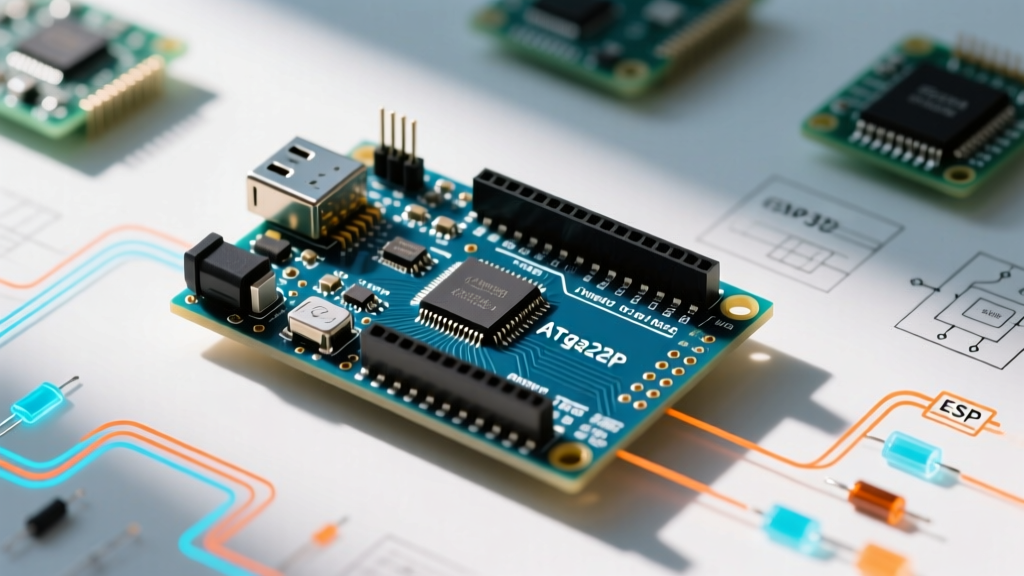
Despite the proliferation of 32-bit ARM Cortex and RISC-V microcontrollers in 2026, the Arduino Nano V3.0 remains a cornerstone of the maker and prototyping ecosystem. Originally defined by its compact 18 x 45 mm footprint and breadboard-friendly 30-mil DIP spacing, the V3.0 revision cemented the transition from the ATmega168 to the ATmega328P-AU microcontroller. This shift doubled the flash memory to 32KB and SRAM to 2KB, establishing a hardware baseline that thousands of legacy libraries and tutorials still rely on today.
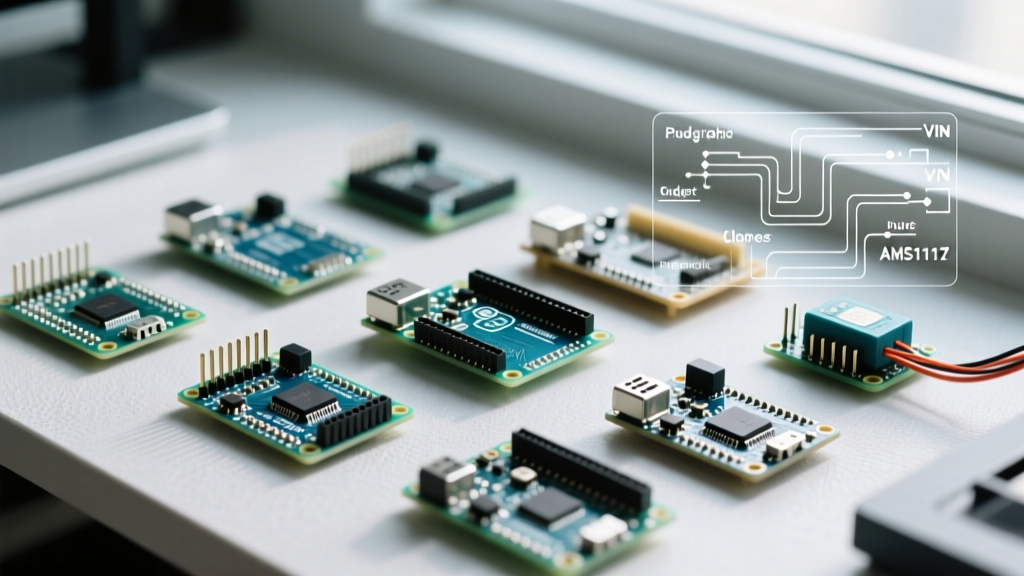
However, navigating the Nano V3.0 ecosystem requires more than just plugging in a USB cable. The market is heavily fragmented between official Italian-manufactured boards and a vast ocean of Asian-market clones. Understanding the silicon differences, power architecture limitations, and compatible expansion shields is critical for moving from a fragile breadboard prototype to a robust, deployed embedded system.
Silicon Heart: ATmega328P-AU and the Clone Market
At the core of the Nano V3.0 is the Microchip ATmega328P-AU (the TQFP-32 surface-mount variant). While the official Arduino Nano utilizes an ATmega16U2-MU as the USB-to-Serial bridge, the clone market has standardized on WCH's CH340 series to drive down costs. In 2026, the CH340C has largely replaced the older CH340G on clone boards due to its integrated internal oscillator, which eliminates the need for an external 12MHz crystal and saves crucial PCB real estate.
Official vs. Clone: A Hardware Breakdown
| Feature | Official Arduino Nano | Nano V3.0 Clone (CH340C) | Nano V3.0 Clone (CH340G) |
|---|---|---|---|
| Microcontroller | ATmega328P-AU | ATmega328P-AU (or AU-MU) | ATmega328P-AU |
| USB-to-Serial IC | ATmega16U2-MU | CH340C (Internal Oscillator) | CH340G (External 12MHz Crystal) |
| Typical Price (2026) | $21.50 - $24.00 | $3.50 - $5.00 | $4.00 - $6.00 |
| Driver Requirement | Native OS Support | Requires WCH CH340 Driver | Requires WCH CH340 Driver |
| Bootloader | Optiboot (32KB Flash) | Optiboot (Often 32KB, sometimes legacy 1.5KB) | Optiboot or Legacy |
Expert Insight: When purchasing clones in bulk, always verify the USB chip. The CH340C is highly reliable, but some ultra-cheap boards use counterfeit ATmega328P chips that fail to operate at 5V/16MHz, leading to erratic I2C timing and serial corruption.
Navigating the Nano V3.0 Shield Ecosystem
The Nano's 15-pin dual-row header layout is not physically compatible with standard Arduino Uno shields without a breadboard or adapter. Fortunately, a dedicated ecosystem of Nano-specific expansion boards has matured over the years.
- I/O Expansion Sensor Shield V5.0: This is the most essential add-on for rapid prototyping. It breaks out every I/O pin into standardized 3-pin headers (Signal, VCC, GND) and includes dedicated I2C and SPI ports. Crucially, it features a secondary power input terminal block, allowing you to power high-current servos directly without routing that current through the Nano's fragile PCB traces.
- Nano Screw Terminal Adapter: For permanent installations where soldering directly to the Nano's castellated edges is undesirable, this shield routes all 30 pins to heavy-duty 3.5mm pitch screw terminals. It often includes an onboard AMS1117-3.3 voltage regulator, which the standard Nano V3.0 lacks natively.
- Motor Driver Shields (L298N / TB6612FNG Nano variants): Specifically designed to stack under the Nano, these shields utilize the TB6612FNG MOSFET driver (superior to the older L298N BJT driver) to handle up to 1.2A per channel continuous current, complete with optocoupled logic isolation to protect the ATmega328P from inductive kickback.
Power Architecture and Critical Failure Modes
The most common way engineers destroy an Arduino Nano V3.0 is by misunderstanding its power routing. The board features three primary power entry points: the USB Mini-B port, the VIN pin, and the 5V pin.
CRITICAL WARNING: The 5V pin on the Nano V3.0 is an output when powered via USB, but it acts as a direct, unregulated input to the microcontroller's VCC rail when powered externally. Injecting 9V or 12V into the 5V pin will instantly fry the ATmega328P and the USB bridge IC. Always regulate external 5V sources before connecting them to this pin.
The VIN Pin and Thermal Throttling
When using the VIN pin (or the barrel jack on shields), the onboard linear regulator steps down the voltage to 5V. On official boards, this is a high-quality regulator; on clones, it is typically an AMS1117-5.0 in a SOT-223 package.
The Failure Mode: The AMS1117-5.0 is rated for 1A, but this is a theoretical maximum assuming infinite heatsinking. On the tiny Nano PCB, the copper pour acts as a minimal heatsink. If you supply 12V to VIN and draw just 200mA from the 5V rail (e.g., powering an LCD and a few LEDs), the regulator must dissipate (12V - 5V) * 0.2A = 1.4 Watts. With a typical SOT-223 thermal resistance of ~50°C/W to ambient, the junction temperature will spike by 70°C above ambient. In a warm enclosure, this triggers the chip's internal thermal shutdown at ~125°C, causing the Nano to randomly reboot or drop USB connection.
Actionable Fix: If your project requires more than 100mA of 5V current, keep your VIN input voltage between 7V and 9V to minimize the voltage dropout and heat dissipation. For higher current needs, bypass the onboard regulator entirely and use an external buck converter (like the MP1584EN) to supply a clean 5V directly to the 5V pin.
Flashing and Bootloader Troubleshooting
Every Nano V3.0 user eventually encounters the dreaded error in the Arduino IDE:
avrdude: stk500_recv(): programmer is not responding
This error indicates a breakdown in the serial handshake between the PC and the bootloader. In the Optiboot bootloader ecosystem, this usually stems from three specific issues:
- Missing CH340 Drivers: Windows 11 and macOS often fail to automatically fetch the correct WCH drivers for CH340C chips. Manually download the signed 2024+ WCH drivers and verify the COM port appears in Device Manager.
- Wrong Processor Selection: Many older clones ship with the legacy ATmega328P bootloader (which reserves 2KB for the boot section) instead of Optiboot (which reserves only 512 bytes). In the Arduino IDE, you must explicitly select Tools > Processor > ATmega328P (Old Bootloader) to match the flash offset.
- Corrupted Bootloader: If the chip was purchased blank or the bootloader section was accidentally overwritten via ISP, the serial handshake will fail. You must use a secondary programmer (like a USBasp or another Arduino Uno) connected to the Nano's SPI headers (D11, D12, D13, RST) to burn a fresh bootloader via the Tools > Burn Bootloader menu.
Arduino Nano V3.0 vs. Modern Alternatives (2026 Context)
With boards like the ESP32-C3 and Raspberry Pi Pico dominating the sub-$5 market, why specify the 8-bit Nano V3.0 in 2026? The answer lies in legacy integration and deterministic 5V logic.
| Platform | Logic Level | Core Architecture | Best Use Case |
|---|---|---|---|
| Arduino Nano V3.0 | 5V Native | 8-bit AVR (16MHz) | Interfacing with legacy 5V industrial sensors, simple relays, and educational environments. |
| Arduino Nano 33 IoT | 3.3V | 32-bit ARM Cortex-M0+ | Battery-powered BLE/WiFi nodes requiring low sleep current. |
| ESP32-C3 SuperMini | 3.3V | 32-bit RISC-V (160MHz) | High-speed IoT applications, web servers, and MQTT telemetry. |
| Raspberry Pi Pico | 3.3V | 32-bit Dual ARM Cortex-M0+ | PIO state machines, high-speed data acquisition, and MicroPython development. |
While the ESP32-C3 offers vastly superior processing power and wireless connectivity, it operates at 3.3V. Interfacing an ESP32 with legacy 5V TTL equipment requires bidirectional logic level shifters, adding BOM cost and wiring complexity. The Nano V3.0 remains the undisputed king of quick, 5V-tolerant hardware hacking. Furthermore, the AVR architecture's lack of a complex RTOS or background WiFi stack means interrupt latency is highly deterministic, making it ideal for precise edge-counting and simple PWM motor control tasks where microsecond timing is non-negotiable.
Final Verdict
The Arduino Nano V3.0 ecosystem is a masterclass in hardware longevity. By understanding the nuances of the CH340 USB bridges, respecting the thermal limits of the AMS1117 linear regulator, and leveraging dedicated Nano shields, engineers can deploy this 8-bit workhorse in demanding environments. Whether you are maintaining legacy industrial test jigs or teaching the fundamentals of embedded C++, the Nano V3.0 continues to earn its place on the workbench.