
The Bare-Metal to RTOS Migration Shock
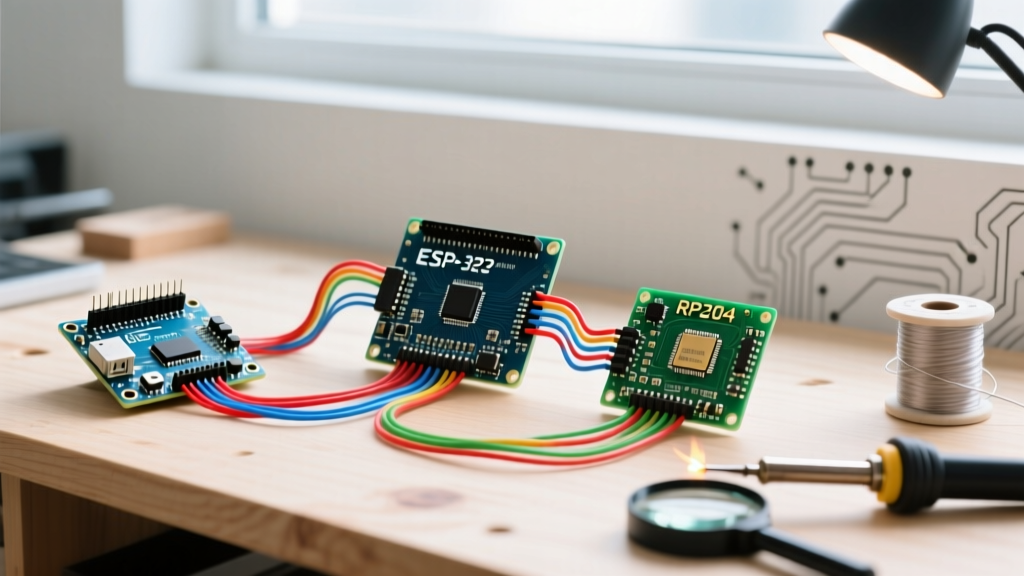
Transitioning from 8-bit AVR microcontrollers to the 32-bit ESP32 ecosystem is a rite of passage for modern embedded engineers. In 2026, the classic ATmega328P (Arduino Uno) still holds a nostalgic place in prototyping, but production demands Wi-Fi, Bluetooth, and dual-core processing power. Consequently, developers are migrating to boards featuring the ESP32-WROOM-32E (averaging $3.50 per module) or the newer ESP32-S3 ($4.20). However, this migration is rarely seamless. The most jarring hurdle occurs when developers attempt to port legacy interrupt-handling code into the Arduino IDE, only to be met with catastrophic system panics.
Unlike the single-core, bare-metal environment of the ATmega328P where a simple noInterrupts() globally pauses execution, the ESP32 runs FreeRTOS on a dual-core Xtensa LX6 (or LX7) architecture. When developers search for an arduino esp32 spinlock_acquire fix, they are usually staring at a serial monitor outputting a fatal exception. Understanding why this happens—and how to properly implement critical sections—is mandatory for stable platform migration.
What Triggers the spinlock_acquire Panic?
In the ESP-IDF (Espressif IoT Development Framework) underlying the Arduino-ESP32 core, hardware spinlocks are used to manage concurrent access to shared resources between the two CPU cores and various interrupt service routines (ISRs). The raw function spinlock_acquire() utilizes the Xtensa architecture's atomic s32c1i instruction to lock a specific hardware mutex.
When migrating AVR code, developers often copy-paste raw ESP-IDF snippets from outdated forums, attempting to use spinlock_acquire() directly inside an Arduino loop() or an ISR. This almost universally results in the dreaded Guru Meditation Error:
Guru Meditation Error: Core 1 panic'ed (Interrupt wdt timeout on CPU1)
Core 1 register dump:
PC : 0x4008a1b2 PS : 0x00060034 A0 : 0x80089f2c
This crash occurs because raw spinlocks do not automatically manage interrupt states across cores, nor do they protect against context-switching delays if misused in task-level code. If a spinlock is held while a higher-priority interrupt fires on the same core, or if the lock variable is not placed in IRAM (Internal RAM), the system deadlocks and the Interrupt Watchdog (IWDT) resets the chip after 300 milliseconds.
AVR vs. ESP32: Critical Section Comparison
To migrate successfully, you must map your AVR mental model to FreeRTOS paradigms. The table below outlines the architectural differences that dictate how critical sections must be handled.
| Feature | AVR (ATmega328P) | ESP32 (Dual-Core FreeRTOS) |
|---|---|---|
| Architecture | 8-bit Single Core (16 MHz) | 32-bit Dual Core (240 MHz) |
| Global Interrupt Disable | cli() / noInterrupts() |
Impossible globally; core-specific only |
| Critical Section Macro | ATOMIC_BLOCK |
portENTER_CRITICAL |
| Underlying Mechanism | Clears Global Interrupt Flag (I-bit) | Hardware Spinlock + Core Interrupt Mask |
| Max Safe Hold Time | Milliseconds (context dependent) | Microseconds (Strictly < 20ms) |
Why Raw spinlock_acquire Fails in Arduino IDE
The primary reason the spinlock_acquire function causes migration failures in the Arduino IDE is a misunderstanding of abstraction layers. The Arduino-ESP32 core provides FreeRTOS macros specifically designed to wrap hardware spinlocks safely. According to the Espressif ESP-IDF FreeRTOS API Guide, developers should rarely interact with raw spinlocks unless writing custom low-level drivers.
When you call spinlock_acquire() manually, you bypass the FreeRTOS scheduler's awareness of the lock. If a context switch occurs, or if you attempt to acquire a spinlock from a task while an ISR on the same core already holds it, the CPU enters an infinite polling loop. The Task Watchdog (TWDT, default 5000ms) or Interrupt Watchdog (IWDT, default 300ms) will eventually trigger a panic to prevent a permanent silicon freeze.
The Correct Migration Path: Safe Critical Sections
To properly migrate your noInterrupts() blocks from AVR to ESP32, you must use the portMUX_TYPE variable combined with the portENTER_CRITICAL_SAFE macro. This approach, documented in the FreeRTOS Critical Section Documentation, ensures that interrupts are disabled on the current core and the hardware spinlock is acquired atomically.
Step 1: Declare the MUX Variable
First, declare a spinlock variable. If this variable will be accessed from an ISR, it must be placed in IRAM and DRAM to prevent cache-miss delays during flash reads.
// Place in global scope
portMUX_TYPE my_critical_mux = portMUX_INITIALIZER_UNLOCKED;

// If used inside an ISR, enforce IRAM placement:
DRAM_ATTR static portMUX_TYPE isr_mux = portMUX_INITIALIZER_UNLOCKED;
Step 2: Enter and Exit Safely
Replace your legacy AVR noInterrupts() and interrupts() calls with the FreeRTOS safe macros. The _SAFE variant is highly recommended for Arduino users because it automatically detects whether it is being called from an ISR or a standard task, adjusting the interrupt mask depth accordingly.
void update_shared_sensor_data() {
  // Acquire lock and disable interrupts on current core
  portENTER_CRITICAL_SAFE(&my_critical_mux);

  // --- CRITICAL SECTION START ---
  // Keep this extremely short! (Microseconds only)
  shared_counter++;
  analog_val = adc_read_fast();
  // --- CRITICAL SECTION END ---

  // Release lock and restore interrupt state
  portEXIT_CRITICAL_SAFE(&my_critical_mux);
}
Troubleshooting Matrix: Edge Cases & Failure Modes
Even with the correct macros, architectural edge cases can trigger panics. Use this matrix to diagnose persistent migration issues.
| Symptom / Error | Root Cause | Actionable Fix |
|---|---|---|
| Cache Disabled but Cached Memory Mapped | Critical section executed while SPI flash is writing (e.g., logging to SD card). | Ensure no Flash/SPI operations occur inside the MUX block. Move I2C/SPI reads outside the lock. |
| Interrupt WDT Timeout (CPU0/CPU1) | Holding the spinlock for >300ms, or blocking on a delay() inside the lock. | Spinlocks are for atomic variable updates, not hardware polling. Use FreeRTOS Queues or Semaphores for long waits. |
| Illegal Instruction / LoadStore Error | MUX variable stored in Flash memory instead of SRAM. | Verify the variable is declared globally or with DRAM_ATTR. Never declare portMUX_TYPE inside a function without static. |
| Deadlock / System Freeze | Attempting to acquire the same MUX twice on the same core (Nested locking). | Refactor code to avoid nested critical sections. FreeRTOS spinlocks on ESP32 are non-recursive. |
2026 Hardware Variants: S3, C3, and C6 Considerations
As of 2026, the original dual-core ESP32 is often replaced by newer variants in commercial designs. If your migration targets the ESP32-C3 or ESP32-C6 (both featuring a single-core RISC-V architecture priced around $2.80 to $3.80), the rules of engagement shift slightly. Because these chips are single-core, the hardware spinlock mechanism is simplified. However, the portENTER_CRITICAL_SAFE macro remains the correct, portable abstraction. It automatically compiles down to simple RISC-V interrupt mask instructions without the overhead of cross-core hardware spinlock polling.
Conversely, if you are migrating to the ESP32-S3 (dual-core Xtensa LX7, heavily used in AI and camera applications), the strict IRAM requirements for ISRs remain identical to the original ESP32. Failing to tag your ISR functions with IRAM_ATTR while manipulating a spinlock will still result in an immediate cache fault panic.
Summary: Ditch the Raw Spinlocks
The journey from AVR to ESP32 requires leaving bare-metal habits behind. The arduino esp32 spinlock_acquire error is a symptom of applying single-core logic to a multi-threaded RTOS environment. By utilizing portMUX_TYPE and the portENTER_CRITICAL_SAFE macros, you respect the FreeRTOS scheduler, prevent watchdog timeouts, and ensure your migrated code runs reliably across all modern Espressif silicon. For further reference on core abstractions, always consult the Official Arduino-ESP32 GitHub Repository to ensure your board definitions match the latest ESP-IDF backend updates.